UPI merchant payments above Rs 2,000 will face new MDR charges.
GTRI warns higher costs could encourage small merchants to accept cash.
The think tank questions whether UPI fees address a genuine revenue need.
UPI MDR Above Rs 2,000 May Push Small Merchants Towards Cash, Says Think Tank
New MDR charges on higher-value UPI merchant payments may raise costs for businesses and consumers, according to economic think tank GTRI

Summary
Advertisement
Starting October 15, 2026, Unified Payments Interface (UPI) merchant payments above Rs 2,000 will attract a Merchant Discount Rate (MDR) of 0.40 per cent, subject to an overall cap of Rs 300. A concessional flat MDR of Rs 5 will apply to certain categories, including railways, telecom services, insurance, and fuel.
Economic think tank Global Trade Research Initiative (GTRI) has raised concerns that the charges could push small merchants and price-sensitive consumers towards cash payments.
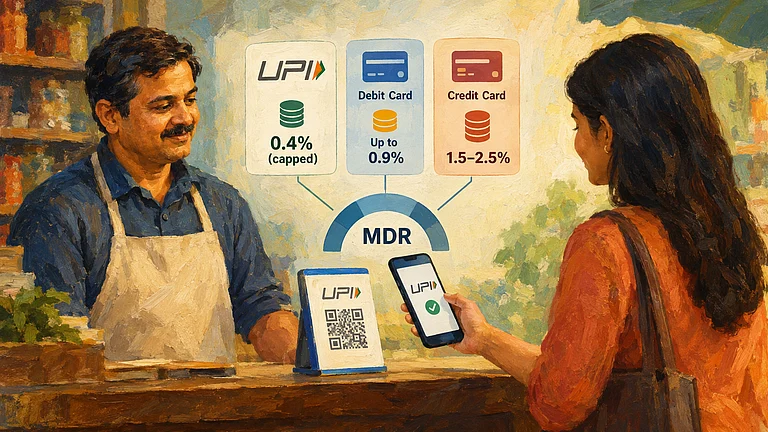
GTRI Questions Need For UPI Charges
Ajay Srivastava, the founder of GTRI, has argued that the introduction of MDR is not linked to a shortage of government revenue. In a social media post on X (formerly Twitter) he said that keeping UPI free costs the government an estimated Rs 2,000-2,500 crore each year.
He compared this with major government subsidies, including Rs 2.03 lakh crore for food, Rs 1.68 lakh crore for fertilisers, Rs 22,800 crore for agricultural credit, and Rs 12,500 crore for petroleum and LPG.
Advertisement
Srivastava has also pointed to the financial position of the National Payments Corporation of India (NPCI). According to his post, NPCI earned Rs 3,270 crore and retained a surplus of Rs 1,552 crore in FY2025. He has argued that introducing MDR may not reduce public spending if greater use of cash follows.
The new charge could also influence how small merchants accept payments of bigger value. Merchants operating on thin margins may prefer cash for transactions above Rs 2,000 to avoid the MDR charges.
Cash Costs Also Add To Payment Expenses
The Reserve Bank of India (RBI) has spent Rs 4,875 crore on printing banknotes in FY2026, according to figures cited by Srivastava. This excludes expenses related to transporting, storing, guarding, counting, and replacing currency notes.
The GTRI founder has argued that a shift from digital payments to cash could, therefore, create additional costs across the payments ecosystem. The new MDR structure applies to merchant payments above Rs 2,000. Consumer-to-consumer UPI transfers are not covered by the merchant payment charge.
Advertisement
UPI Charges And US Trade Concerns
Srivastava has also linked the UPI MDR debate to concerns raised by the US Trade Representative (USTR) over India’s digital payments ecosystem.
According to him, the USTR’s 2026 report raised objections over the preferential position of UPI and RuPay, RuPay card payments through UPI, and NPCI's proposed 30 per cent market-share cap.
He has also pointed to competition between India’s domestic payment networks and global card networks, such as Visa and Mastercard. Card networks generally earn network fees from transactions, while UPI has operated with a different pricing structure.
Srivastava cited Brazil’s Pix payment system as another example of a public digital payments network facing pressure from the US.
Show comments
Published At:
Tags