Gold offers stronger stability amid macro and geopolitical uncertainty
Silver rally driven by demand but carries higher volatility risks
Balanced allocation helps manage risk across different market cycles
Gold Maintains Edge Over Silver As Volatility, Macro Concerns Rise: Umeshkumar Daila
Gold is emerging as a better hedge amid global uncertainty, while silver's steep rally raises questions about near-term volatility and entry timing

Summary
Advertisement
At a time when precious metals are experiencing an upsurge in investor interest, gold seems to be reclaiming a spot as the better bet than silver. Speaking at the Outlook Money 40After40 event, Umeshkumar Daila, Head (ETF Sales), Mirae Asset Investment Managers (India), discussed the current reasons why gold is a compelling investment given the sharp rally of silver, which has attracted attention from both investors and traders.
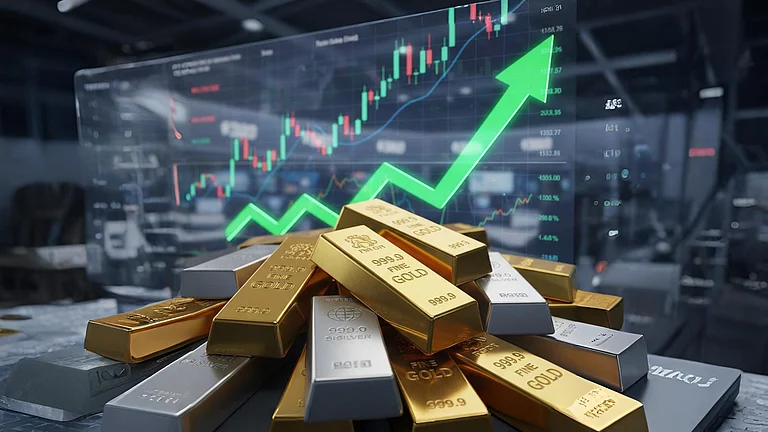
Gold’s Strategic Hedge Strengthens
Daila said that gold is not just a trading opportunity but a strategic hedge against macroeconomic risks. Geopolitical risks, inflationary uncertainty, and changes in interest rate cycles continue to support gold prices across the globe.
Central bank purchases have become a major pillar for the strength of gold. Sustained accumulation by central banks is helping to create a price floor which limits the downside risks but is supporting long-term momentum.
Advertisement
Gold’s low correlation with equities is another factor that is making it an attractive option. During periods of market stress and volatility, it helps to be a stabiliser in a portfolio, which helps to smooth overall returns. This is particularly important where the entire global market is witnessing sharp reactions to macroeconomic developments.
Silver's Rally
However, silver has experienced a strong rally due to a combination of investment and industrial demand, especially in the renewable energy and manufacturing sectors. However, this strong rally has also led to higher volatility.
According to Daila, silver is a "cyclical amplifier," which means that it outperforms during strong periods but also corrects more sharply during changes in macroeconomic trends.
The current rally, he said, is also driven by supply constraints and increasing industrial demand. However, this also makes silver more susceptible to corrections, especially if global growth trends change.
He warned investors that it is not a good time to enter the silver market, as the metal may experience sharper corrections during that time. Instead, he said that investors could look at taking partial profits and waiting for price corrections to enter the market.
Advertisement
Gold vs Silver: Risk-Reward Profiles
One of the most important points that Daila made was the diverging risk-reward profiles of the two metals in the current market conditions.
While gold enjoys strong macroeconomic uncertainty and central bank demand, silver's price action is more closely linked to economic cycles and industrial demand. This inherently makes silver more volatile.
High Prices And Timing Puzzle
Both gold and silver are presently trading at high prices across the globe, making timing a key puzzle for investors.
Daila explained that the problem of timing the entry and exit in precious metals is always difficult. This is because market prices are often driven by a combination of factors that work simultaneously, such as currency movements, interest rates, and geopolitical events.
This makes the problem of regret even more challenging for investors who attempt to time the market. This is particularly true for volatile markets such as silver, where the timing of entry and exit can have a material impact on investment returns.
Advertisement
Portfolio Strategy Is More Relevant
While gold may have the upper hand in the current environment, Daila did not rule out completely the role of silver. Instead, he proposed that a balanced deployment to both metals might help investors to benefit from different phases in the market.
Gold can help generate stability through uncertain times, while silver can help improve returns during economic recoveries and industrial upcycles. Together, they provide diversification benefits that may not be available through an individual asset.
However, he clarified that investment decisions should be made in accordance with the risk profile and investment horizon of the investor, rather than being driven by short-term market trends.
Overall Outlook Remains Positive, But Selective
The overall future of precious metals is positive, thanks to macroeconomic developments around the globe. However, the way to invest in gold and silver needs to be pickier.
Gold, with its defensive characteristics and good institutional demand, seems to be better placed in the current situation. Silver, although providing more upside potential, comes with greater volatility and needs to be timed carefully.
Advertisement
Show comments
Published At: