Higher circle rates raise property costs
Impacts stamp duty and registration charges
May affect buyer affordability and demand
What Gurugram’s New Circle Rates Mean For Property Buyers In 2026
Gurugram’s revised circle rates in 2026 can drastically change the city’s property prices. Here’s how this would be impacting the stamp duty, resale pricing, and overall affordability for homebuyers in the region

Summary
Advertisement
Gurugram’s real estate is poised for a major shift in 2026 with new revised circle rates. The new rates signal a decisive move towards market-aligned pricing. According to a square yards report, Gurugram is likely to see price increase in the range of 15-75 per cent across the residential, commercial and industrial units, indicating a strong demand and rapid infrastructure-led growth.
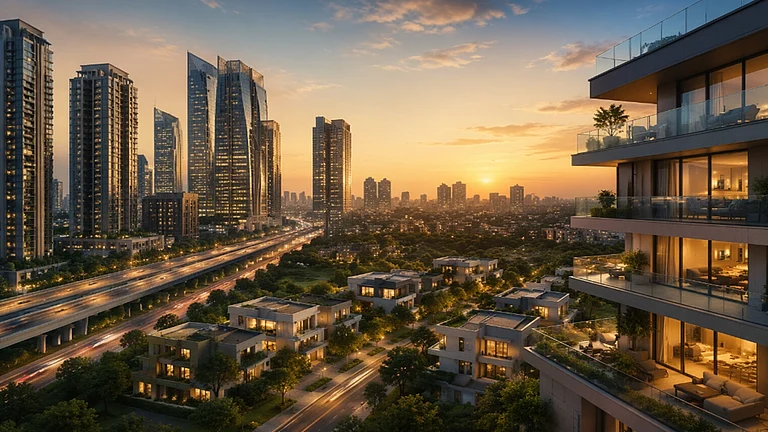
Circle rates are the minimum value set by the government and are assigned to an area for benchmarking them for the purpose of sale. However, this is not the seller’s price. These rates determine how much tax one has to pay on the transaction, stamp duties, and registration fees. Every state revises these rates periodically, based on the broader market trends, urbanisation, and infrastructure of the area. These rates, however, cannot match the pace of the market rates, which tend to move faster and are defined by the hyperlocal demand. In several cities, the government rates may lag by several years.
Advertisement

These rates haven’t been uniform in several parts of Gurugram. It is hoped that with the revision of circle rates, the shortcomings of the market will be corrected, which will create a more transparent pricing ecosystem across Gurugram in a uniform manner.
Kartikeya Sharma, associate principal partner, Square Yards said: “The 2026 revision reflects a clear shift toward market-aligned pricing, with circle rate increases ranging from 15-75 per cent across Gurugram. Key growth corridors, such as Dwarka Expressway and Southern Peripheral Road are witnessing hikes of up to 75 per cent, while emerging residential sectors are seeing 30-45 per cent appreciation. In contrast, established locations like Sector 29 are recording relatively moderate increases of around 15 per cent, highlighting a maturing and stabilising market.”
According to the report, the most prominent trend that is emerging from the revision is the variation between the growth corridors and the established sectors in the city. Infrastructure-led belts, such as the Dwarka Expressway and the Southern Peripheral Road are seeing the steepest hikes in prices across all realty segments. Some areas even recorded a hike of 75 per cent. These locations have seen continuous, sustained interest from the investors. This is primarily due to improved connectivity and proximity to commercial hubs and the ongoing urban development.
Advertisement
The residential sectors along the Southern Peripheral Road, including Sectors 63, 63A, 64 and 67, are expected to witness a growth of 45 per cent, according to the upcoming circle rates. Sectors, which are close by, such as Sectors 62, 65, 66, and 70, are likely to register a growth of 30 per cent. The commercial rates in the region are following the same trend.
Established localities present a watered-down expectation; areas like Sector 29 are about to witness a subtle increase of 15 per cent, which shows their stability. However, the premium pockets like DLF Phase V and Sector 25 are some exceptions, as the predicted hike for them is expected to be around 75 per cent.
Show comments
Published At: