For decades, the majority of the Indian working class population has depended on the Employees’ Provident Fund (EPF) for not just a retirement corpus, but also as a fund to help them fulfil financial goals, such as children’s education and buying a house, owing to its partial withdrawal facility. At the same time, a large number of people have struggled with the poor infrastructure in terms of access and practical and operational challenges (Read Changed Jobs? Where Is Your EPF Money? https://sl1nk.com/sn3o7i8, and Delayed Claims Chip Off EPF Popularity? What You Can Do https://l1nq.com/2jhhgai).
EPFO 3.0: Hits and Misses: What EPF Subscribers Need to Know
EFPO has upgraded its system to make it more member-centric. However, subscribers are still facing glitches. Here are the changes and the issues that need to be fixed

Advertisement
The Employees’ Provident Fund Organisation (EPFO) covers around 80 million members to ensure their social security in retirement. It also ensures they can access their funds while in job in case of medical or other emergencies. However, there are caps on withdrawals so that they don’t face financial uncertainty in retirement.
EPFO, however, seems to be on the path of course correction. It started discussing reforms and termed it as EPFO 3.0 version in 2024-25. A major part of it culminated into updating EPFO’s web portal in July 2026 to make it easily accessible and convenient for subscribers to use EPFO services.The Centralised IT-Enabled System (CITES) 2.01, a cornerstone of the EPFO 3.0 initiative, finally went live on July 3, 2026, following around seven-day downtime that started on June 26, 2026.
Now that the upgrade is done, subscribers are eager to see if the new system actually offers seamless services, in case they get stuck with claim hurdles, missing or incorrect data, or errors in recorded joining and exit dates, among other issues.
Advertisement
In addition to these technology-based upgrades, EPFO has also made other changes since 2025 to make its services more accessible, flexible, and fast. Yet, some of the most awaited features are yet to be launched. For instance, ATM- and Unified Payments Interface (UPI)-based withdrawals. Let’s take a look on what’s changed on the ground and what is waiting in the wings.
What Is EPFO 3.0?
EPFO 3.0 involves a comprehensive digital revamp of its IT infrastructure to transform it into a member-centric, technology-driven organisation.
There are two broad aspects to it: technological upgradation of the systems, and operational and administrative aspects. The CITES 2.01 project deals with the technological aspect, ranging from software and system upgradation, replacing decentralised databases with a centralised modern platform, and bringing in automation. The operational and administrative aspect addresses improvements in the processes, including streamlined claim processing, more flexible and faster withdrawals, reduced manual verification, improved stability of backend systems, and more.
Advertisement
The two services go hand-in-hand when it comes to serving members in the digital world. For instance, a mere change in withdrawal rules or offering one more option on the digital platform can’t serve the purpose until there is an effective mechanism in place to implement the rule.
Long Journey
The discussions on overhauling EPFO and the proposed reforms formally began in 2025. In February 2025, the Executive Committee (EC) of the Central Board of Trustees (CBT) of EPFO, at its 112th meeting, reviewed the developments under EPFO 3.0 and directed EPFO to prepare a Vision Document by March 31, 2025. It also reviewed the progress under CITES 2.01, which was scheduled to be completed by March 31, 2025.
In April 2025, Union Labour and Employment Minister Mansukh Mandaviya, who is also the chairperson of the CBT, said in an interview with PTI that EPFO 3.0 is set to launch by May or June 2025, and that it will simplify the services, offer auto-claim settlements, digital corrections, and ATM-based fund withdrawals.
Advertisement
There are two broad aspects of EPFO 3.0—technological upgrade, and operation. The first deals with IT-infra, and the latter with re-engineering the processes
By June 2025, the auto-settlement limit for withdrawals was increased from Rs 1 lakh to Rs 5 lakh to reduce manual intervention and delays in processing. Further, EPFO offices adopted the centralised pension payment system (CPPS) for fast-track pension disbursal.
The full version of EPFO 3.0 was then expected to be rolled out before April 1, 2026. However, instead of the full version, only partial changes were finally implemented, and that too only in mid-2026. The upgradation of the Web portal, UMANG app, and the backend data consolidation were conducted at the end of June. The new version of the portal was made available to members for use, albeit in a phased manner, with initial hiccups, that have reduced over the period but remain persistent.
Almost at the same time, the new EPF and Employees’ Pension Scheme (EPS) or EPF 2026 and EPS 2026 were notified in the Gazette, formalising the new withdrawals rules, withdrawal categories, changes in the minimum and maximum amount, and mandatory holding period, among other changes. These are all part of EPFO 3.0 reforms, aimed at making the EPFO’s schemes more member-centric.
Advertisement
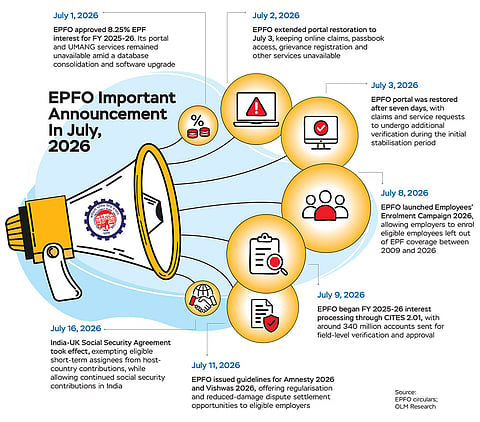
What’s Been Implemented So Far?
Under the upgraded unified digital interface portal, members can check their EPF details, such as PF balance, benefits already availed, service record, and track claim settlement. However, the claims function was not working till the time we went to press.
Claims processing (both partial and full withdrawals) are expected to be faster as funds will be paid through electronic payment channels.
EPS claims processed at a regional EPFO office can now be paid to any bank account. Earlier, members could receive their pension only through a branch where their Pension Payment Order (PPO) was linked.
Employees who have an Aadhaar-linked Universal Account Number (UAN) do not need to submit EPF transfer requests when changing jobs. It will be done automatically.
The Passbook Lite option is now available under UAN. Members don’t need to visit a different portal to access passbook details. The “passbook view” option shows the PF balance, recent contributions, and older transactions.
One significant change is the UAN activation and allotment option. These two features have been moved to the UMANG app. Now, if a member wants to generate a new UAN or activate an existing one, it can be done only through the UMANG app using face authentication technology (FAT).
The auto-settlement limit for advance withdrawal claims has been enhanced to Rs 5 lakh.
Advertisement
What Is Yet To Be Implemented?
The most-awaited feature under EPFO 3.0, the withdrawal facility through ATMs and UPI is yet to be launched. There is, as yet, no official update regarding the timeline.
Anurag Jain, CA and partner, ByTheBook Consulting LLP, Gurgaon, says, “After the technical glitches that followed the platform migration, EPFO’s priority in the interim has been stabilising the core portal before adding a new payment framework.”
Ketan Das, business head, FinRight Technologies says that the ATM and UPI-based withdrawal facilities are likely to be implemented only when EPFO has the required infrastructure and reconciliation mechanisms.
Says Das: “If EPFO introduces UPI- or ATM-based withdrawals, it will need robust transaction tracking, reconciliation, failure handling, and customer-support mechanisms alongside the payment channel. Otherwise, it could create a new layer of complaints.”

Implementation Glitches
The website seems to be having teething troubles.
Says Das: “The recent technical transition has created friction across several parts of the EPFO ecosystem. While the broader objective of digitisation is to make processes more automated, we are currently seeing members face issues at different stages of their PF journey.”
Advertisement
Some of the common technical glitches that EPF subscribers are facing after portal upgradation are related to delay in PF transfer and claims settlement, as well as incorrect record of their details that was previously corrected in the earlier system. Also, for many members the claims are showing as settled a week or 15 days ago, but are yet to be credited in their account.
Subscribers are facing issues related to delay in PF transfer, claims settlement, as well as incorrect details cropping up in their EPF records after the upgradation
Says Jain: “Members have reported login failures, slow portal performance, and problems in auto claim settlement processing, with many of the auto-generated claims reportedly pending for more than 20 days. Transfers and passbook updates have seen similar delays.”
Das highlights that while transfer of proceeds from one employer to another has become automatic in the new system, in case of inconsistency in details of name, date of birth, etc., members aren’t able to correct it.
Advertisement
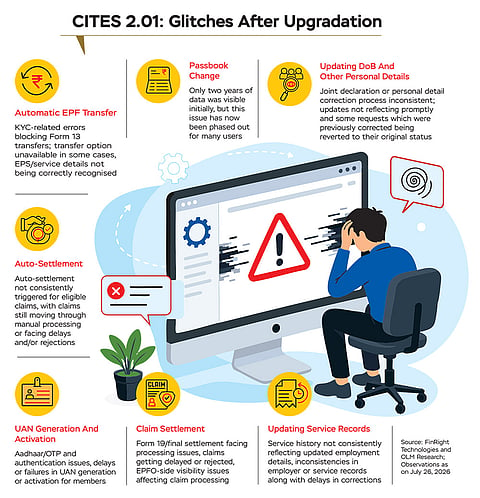
Members are also facing issues even in initiating claims. Says Das: “In matters of advance or partial withdrawal claims, we have observed instances where claims have been filed but remained stagnant for longer than expected. Even settled claims are taking significantly longer to reflect in the member’s bank account.”
Das highights the reappearance of older data following the system migration is another concern. In many cases, members are being asked to re-verify know-your-customer (KYC) details that have previously been submitted and verified. These automated checks can also prevent a member from proceeding when the underlying data itself needs correction.
Even EPFO had acknowledged disruptions in the claims filing process to continue for some time post-migration. The EPFO’s unified member portal showed: “Members and Employers are requested to kindly bear with us, as they may experience slightly longer-than-usual processing times for claims and certain services during this period. Members are also requested to avoid repeated attempts to access online services during peak hours or submitting repeated requests.”
Advertisement
Recently, the EPF Officers’ Association sent a formal request to the labour minister, urging immediate intervention to strengthen CITES. It said the CITES project was handed to the Centre For Development of Advanced Computing (CDAC) in January 2023 with a 10-month timeline, but it kept getting delays, and the final implementation in July has only been in a piecemeal manner.
The association said EPFO is facing a shortage of technical staff. CITES 2.01 is designed to improve EPFO’s service delivery and bring the settlement time down to 2-3 days, but in reality, many claims remain pending for more than 20 days, it highlighted.
EPFO 3.0 is a significant change in the journey of EPFO, but the ultimate success of this rollout will be determined in the coming months, depending on how soon EPFO is able to plug the loopholes. The immediate result, however, is a more user-friendly interface.
versha@outlookindia.com
Show comments
Published At: