When you hear about financial independence, you automatically assume it’s about retiring early. The dream is about building a large enough retirement corpus, quitting the 10-to-6 routine by your 40s, and letting your money work for you.
Financial Freedom, Redefined
With rising job uncertainty and costs, and easy access to debt, the concept of financial freedom has been redefined. It’s no more about early retirement but a stress-free financial life

Advertisement
But the global phenomenon of FIRE (Financial Independence, Retire Early) is now on the wane. Job uncertainty, easy credit and rising costs have made financial freedom a distant dream for many households. Ask a young couple repaying a home loan, parents saving for their children’s education, or a mid-career professional worried about job security about their aspirations and the answer is unlikely to be: “I want to retire at 45”. Instead, they are more likely to say they want the freedom to change jobs without worrying about equated monthly instalments (EMIs), take a break without exhausting their savings, start a business without carrying multiple loans, or simply reach the end of every month without constant financial anxiety.
Let’s understand how changing realities and aspirations are redefining the concept of financial freedom as stress-free financial life, and what you can do to achieve it.
Changing Realities
Job Uncertainty: According to financial experts, until a few years ago, investors were largely focused on returns—which fund would deliver the highest growth or which asset class would outperform. Today, the first question is often much simpler: “How long can I manage if my income stops?”
Advertisement
“Layoffs, economic uncertainty, rapid technological change and evolving career aspirations have made people value financial resilience over high returns,” says Akshat Garg, assistant vice president, product and research, Choice Wealth, a wealth management company. In fact, someone with a high income but heavy EMI commitments can feel far more vulnerable than a person earning less with minimal fixed obligations, he adds.
A larger retirement corpus is now required to maintain the same standard of living, forcing many households to either save more, work longer or both
As a result, more households are prioritising emergency funds and paying down expensive debt before stepping up investments or thinking about retiring at 40.
Rising Cost: The cost of essentials, such as food, housing, healthcare, education, and even lifestyle expenses is rising much faster than headline inflation. This has fundamentally changed the nature of retirement planning. A larger retirement corpus is now required simply to maintain the same standard of living, forcing many households to either save more, work longer or both. The days when fixed-income investments alone could comfortably fund retirement are almost over.
Advertisement
Says Santosh Joseph, chief executive officer, Germinate Investor Services LLP, a boutique financial services outfit: “To keep pace with rising costs, there is a need to increase retirement contributions as incomes grow and adopt a well-diversified investment strategy.”
Easy Access To Credit: Today, consumers can finance everything from smartphones and appliances to holidays through EMIs, credit cards and buy-now-pay-later (BNPL) schemes. This is a boon and a bane. While easy access to credit solves immediate financial crises, it can come back to bite in the long term if not handled properly.
The biggest concern is short-term, high-cost borrowing—personal loans, credit card debt, BNPL schemes and consumer durable loans—which often finance depreciating assets while eating into monthly cash flows.
Changing Aspirations
As housing becomes more expensive, education and healthcare costs continue to rise, and easy credit makes borrowing almost effortless, monthly repayments have become a permanent feature in household budgets. The real milestone is no longer accumulating crores in investments but reducing the fixed financial commitments that limit choices. It is less about escaping work and more about reclaiming the freedom to make life’s important decisions without being dictated by debt.
Advertisement
Says Arun Patel, founder & partner, Arunasset Investment Services, a wealth management company: “Today, for many households, the more relevant question is simpler: after paying for regular expenses, EMIs, insurance premiums, and investments, is there enough money left to live comfortably, pursue opportunities and handle life’s uncertainties without financial stress?”
How To Achieve Financial Freedom
1. Understand Debt
The question of debt is the largest as it’s pulling down most households. For instance, India’s household debt rose to 41.3 per cent of GDP at the end of March 2025, up from a five-year average of 38.3 per cent, according to the Reserve Bank of India’s (RBI’s) Financial Stability Report released in December 2025. Consumption-led borrowing continued to dominate, with non-housing retail loans accounting for 55.3 per cent of total household borrowings as of September 2025, reflecting faster growth than housing, or business loans.
When It’s An Obstacle: Every rupee spent on servicing expensive debt is a rupee that cannot be invested for the future. “Easy access to credit has made it tempting to finance everything from gadgets to holidays, but every new EMI reduces financial flexibility. When interest rates rise or incomes come under pressure, these fixed obligations become harder to manage,” says Joseph. In such cases, it’s SIPs and other long-term investments that often take the first hit because EMIs are non-negotiable.
Advertisement
Says Patel: “EMIs are often the biggest culprit. By breaking a purchase into small monthly instalments, they make borrowing seem affordable, but the total repayment can be significantly higher than the original cost. The longer the loan tenure, the more interest is paid.”
The real concern is high-cost borrowing for depreciating purchases. Says Joseph: “Personal loans, appliance financing, credit card debt and BNPL schemes often come with steep interest costs, while creating little or no long-term value. Such debt can erode cash flows, delay wealth creation and add unnecessary financial stress. These liabilities, therefore, should be cleared as early as possible while using long-term, asset-backed debt judiciously.” For example, credit card rollover interest rates are high and often run between 30 per cent and 45 per cent a year, making even modest purchases far more expensive over time.
When It’s A Partner: Debt can also be an enabler. For example, a long-term home loan, especially one spread over 20-30 years, can be part of a sound wealth-building strategy. That’s because it’s helping you create an asset that has the potential to appreciate over time. Similarly, a loan taken for a car meant for genuine work, business or family needs can support your earning capacity and day-to-day life.
Advertisement
Understanding the nature of debt and how it can affect your financial life can solve a large part of the problem, and help you start your journey towards financial freedom.
2. Put Learnings Into Action
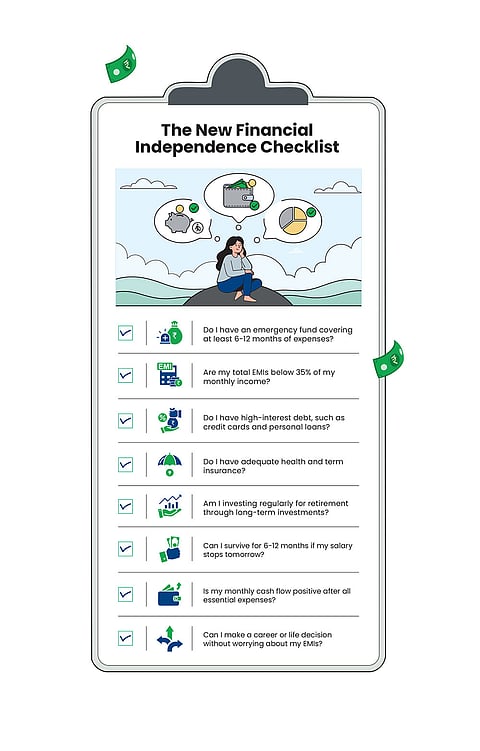
Step 1: If you are overburdened with debt and not being able to invest, start with eliminating high-cost debt, such as credit card balances and personal loans. The interest saved is a guaranteed return, something no investment can assure.
Says Joseph: “While investments add to wealth, outstanding loans work in the opposite direction by reducing it. That’s why clearing high-cost debt often becomes the first step towards financial independence, allowing households to save, invest and plan for retirement from a much stronger financial position.”
Every rupee spent on servicing debt is a rupee that cannot be invested for the future. Then, long-term investments take the first hit as EMIs are non-negotiable
Step 2: Once you are free of excessive debt, practise moderation. Ideally, you should keep total EMIs—including home, vehicle and personal loans—within 30-35 per cent of your monthly income. Crossing the 40 per cent mark can start putting pressure on household finances, leaving less room for savings, investments and unexpected expenses.
Advertisement
If a household consistently spends more than it earns, it would create debt leaving little room to build long-term wealth.
Says Joseph: “The objective should be to borrow wisely, keep fixed obligations manageable and maximise savings. The faster unnecessary debt disappears, the sooner financial independence stops being a distant dream and starts becoming a practical reality.”
Step 3: Strike a balance between low-cost long-term debt and investing. “With lower-cost, long-term loans like a home loan, there’s usually no need to stop SIPs. Instead, continue investing regularly while using bonuses, annual increments or other windfalls to make partial prepayments and gradually reduce the loan burden,” advises Garg.
Step 4: Build an emergency fund that can cover six to 12 months of household expenses. Next comes adequate health and term insurance to handle any health emergency in case it occurs.
Without an emergency fund or sufficient insurance cover, a single medical emergency, job loss or unexpected expense can derail years of disciplined investing.
Advertisement
While you cannot control economic pressures, you can still achieve a financially stress-free life by controlling your cash flow and debt, and investing systematically and consistently.
sanjeev.sinha@outlookindia.com
Show comments
Published At:
Tags