Gone are the days when opening a demat account meant signing multiple pages of forms and waiting endlessly for approvals. Today, the entire process has become seamless and quick, and can be completed in just a few clicks from your smartphone. With electronic know-your-customer (e-KYC), Aadhaar verification and digital signatures, investors can start their journey within minutes. Little wonder that the number of demat accounts is also going up—from 40 million as on March 31, 2020, to 224.50 million as on March 31, 2026.
Full-Service Vs Discount Brokerages: Get Your Partner Right
The broking industry is now in a price-war phase, but cost is no longer the key differentiator. The choice will depend on how you plan to use a broking platform

Advertisement
What has also changed is how you invest in stocks. There was a time when trading meant calling your broker, placing orders verbally, and waiting for confirmations. Previously, full-service brokers dominated the broking space, offering research, relationship managers, and advisory services. All at a steep cost.
That changed in the 2000s, with the rise of online trading platforms, powered by Internet penetration and regulatory advancements.
However, the real disruption came with the emergence of discount brokers. Says Shripal Shah, managing director and chief executive officer at Kotak Securities, a bank-based broker: “Discount brokerages have played a meaningful role in democratising investing in India. By simplifying onboarding, lowering brokerage costs, and building digital-first platforms, they brought a large number of first-time investors and traders into the capital markets.”
Discount brokerages forced existing full-service traditional broking companies to rethink their business model. “Their emergence challenged the traditional broking model and pushed the full-service and bank-backed brokers to modernise technology, improve digital experience, and rethink pricing,” says Shah.
Advertisement
In many ways, they expanded the market. The real beneficiary, though, has been the investor, who has access to better investing platforms, pays lower costs, and has more choice than ever before.
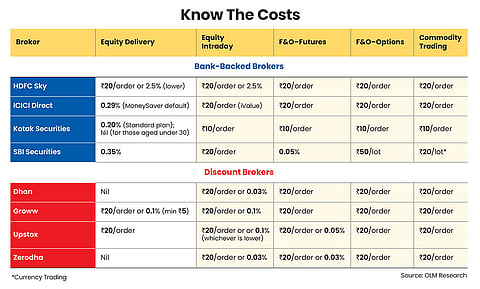
As brokerage costs have fallen sharply due to the price war sparked by discount brokers, the big question for investors is: which one is the right choice for me? That’s because selecting a broking partner is not just about finding the cheapest option, but about finding the right fit for your investing style.
The Options
Discount brokers, typically, offer you a trading platform where you can buy and sell stocks. They also offer mutual funds and allow you to trade in derivatives, commodities, forex, and other investment products.
Full-service brokers, on the other hand, do all that and more. They also prepare and distribute detailed research reports regularly. They offer a wide array of services, including wealth management, portfolio management services (PMS), financial planning, investment planning, tax planning and estate planning, among others.
Advertisement
Over the years, full-service brokers have also changed the perception that they lag behind fintech players in terms of technological advancement and pricing. Says Shah: “Today, leading full-service brokers offer digital experiences, execution speed, and pricing that are comparable with any modern platform.”
The real differentiator now lies in understanding customer behaviour and delivering value beyond execution, he adds.
Know What You Want
The important question to ask yourself is: Am I opening a demat account for long-term investing or for active trading?
Trading in India has become more expensive over time due to repeated increases in statutory levies such as securities transaction tax (STT), particularly in derivatives. In Budget 2026, Union Minister of Finance Nirmala Sitharaman announced a hike in STT on futures and options (F&O) to curb excessive speculation. The STT on futures is 0.05 per cent, up from 0.02 per cent, and that on options premium is 0.15 per cent, up from 0.10 per cent, effective April 1, 2026. As a result, trading has become more expensive.
Advertisement
If you are an active trader in the intra-day and F&O segments, cost remains extremely important. Since traders typically operate on very small spreads and execute multiple trades in a day, the transaction cost can multiply quickly. So, if you are a trader looking for trade execution, you can opt for the broker that has the lowest cost.
However, for long-term investors, the equation is different. Long-term investing, typically, involves fewer transactions, and brokerage becomes negligible relative to the overall portfolio returns. In that segment, customers value research, advice, trust and service, far more than marginal savings on brokerage.
If you do not have a clue where to invest, discount broking firms may not be able to help you. They simply execute an investment at a low cost. So, if you are new to investment, it may make sense to invest with full-service brokers, whose services can help you plan your wealth and finances.
Advertisement
Investing is all about growing your wealth and, it requires research. A single wrong investment can derail your entire financial plan. In this context, full-service brokers provide you in-depth analysis of the economy, sectors and companies in their research reports, which are typically, prepared by economists, analysts and other experts and are based on facts and analysis, making them reliable to a large extent. If you are an investor looking to invest across products and want personalised services, the slightly higher amount of brokerage will be worth paying.
Says Roop Bhootra, wholetime director, Anand Rathi Shares and Stock Brokers: “The choice between a discount broker and a full-service broker is essentially a choice between execution and guidance. While discount brokers have captured the high-volume retail segment, full-service brokerages remain indispensable for investors seeking long-term wealth creation and preservation. By providing institutional research, a diversified product basket, and the essential human element, full-service firms justify their fees by delivering superior risk-adjusted returns and operational ease.”
Advertisement
Look At Total Costs
You also need to look beyond brokerage costs. While many platforms advertise nil or low trading fees, other charges can quietly add up. For instance, Zerodha levies an annual maintenance charge (AMC) of Rs 300 for demat accounts if your holding value is Rs 10 lakh and above. On the other hand, Groww does not charge AMC at all. There may also be costs such as depository participant (DP) charges on sell transactions, call-and-trade fees, or platform subscription fees. A DP charge is a fee applied when securities are sold from a demat account. Both the depository and the DP levy this fee to cover the costs of maintaining and transferring securities electronically. For instance, if you hold a demat account with Zerodha, your DP charges depend on the gender of the primary demat account holder. When men are primary holders, it is Rs 13 per stock; for women, it is Rs 12.75 per stock. These charges can impact your overall returns over the long term.
Advertisement
Previously, discount brokers had a clear edge on cost and digital experience, but that gap has narrowed down now. Most platforms offer fast execution, intuitive apps, and competitive pricing. Full-service brokers outperform discount brokers on products and services, but decide if you need those.
How To Choose The Right Broker
Selecting a broking partner is not about finding the cheapest option, it is about finding the right fit for your investing needs.
Define Your Needs
Are you a long-term investor, a trader, or a beginner seeking guidance? Your answer will determine whether you need a full-service or a discount broker.
Evaluate Costs Holistically
Look beyond brokerage. Consider account opening charges, annual maintenance fees, and other costs.
Test The Platform
Most brokers offer demo versions or detailed previews. Explore the interface to ensure it’s convenient for you.
Check Reviews
User experiences often reveal what marketing brochures don’t.
Show comments
Published At:
Tags