The first time Sujith Gopinath, 35, a communications professional based in Gurugram, saw the market hit the lower circuit, he did not understand what had happened. A lower circuit is the threshold set by the stock exchange to prevent further downfall in the stock’s price or index to prevent panic selling, extreme losses or market manipulation. He had opened a demat account only recently, and terms such as lower circuit, options and derivatives meant little.
Have India’s Equity Investors Matured?
Some of India’s pandemic era equity investors have moved from chasing quick trading gains to embracing more disciplined, mutual fund-led wealth creation

Advertisement
It was March 2020. The pandemic had shut cities, offices and airports. News channels were carrying counts of Covid cases through the day and financial headlines sounded alarming.
The crash made the stock market seem intimidating and distant to Sujith but curiosity got the better of him. He started tracking regularly. The eventual market recovery was equally dramatic. Telegram groups that he had joined exploded with screenshots of profits.
A few days later, he bought his first options contract for about Rs 1,000. The position expired worthless on the same day, but the loss did not discourage him; instead it pulled him deeper into the market.
Sujith entered the financial markets during the pandemic when everything seemed to be changing simultaneously. Markets were rebounding from historic lows and brokerage apps had made investing frictionless. Social media had turned stock discussions into daily conversation. The lockdown had created both time and curiosity. The wave of investors that entered the market then marked India’s retail investing boom, riding on huge profits.
Advertisement
Sujith withdrew a large chunk of his Employees’ Provident Fund (EPF) corpus during the pandemic and invested in stocks including Tata Power, Adani Enterprises, SBI and PFC. He couldn’t have imagined what happened next. His portfolio rose six-fold in two years. “I believe luck played a huge role,” he says.
The market, however, rarely stays generous forever. The recent crash and volatility has chased away investors. But many others have stayed back and are learning to approach equities differently and maturely.
Roughly half of Sujith’s investment is in direct equities, but the rest sits in mutual funds along with allocations to gold and silver.
The Subtle Shift To MFs
NSE’s June 2026 edition of the Market Pulse report shows that the number of individual investors who traded at least once during the 12 months ending May 2026 declined to 37.80 million from 39.40 million a year ago. Participation in both cash and derivatives segments fell sharply.
Advertisement
Investors who actively traded both segments declined by roughly 22 per cent over the year. Monthly activity has also weakened. The number of active investors dropped below 2.50 million for the first time since August 2025. The decline has been especially visible in participation in the derivatives segment.
Says Kinjal Shah, vice president, Bombay Chartered Accountants’ Society (BCAS): “The recent regulatory changes effective April 1, 2026, including increased securities transaction tax (STT) on derivatives and Sebi’s strict 50:50 cash-to-collateral margin rules, have curbed speculative direct trading.”
At first glance, such numbers may suggest that retail investors are leaving the market, but another set of numbers tells a different story.
A study by the Securities and Exchange Board of India (Sebi) on household savings shows that mutual funds accounted for nearly Rs 5.44 lakh crore of household investments or 80 per cent of the total savings in the securities markets during FY25. Direct equity investments continued through initial public offerings (IPOs) and primary issuances, but secondary market flows remained negative.
Advertisement
This means money is still entering equities, but the route has changed from direct equities to mutual funds.
Ravi Kumar Jha, managing director and chief executive officer of LIC Mutual Fund, believes the shift reflects a deeper change in investor behaviour. “We believe this reflects a structural shift in investor behaviour, driven by deeper financialisation of savings in India and growing trust in regulated investment avenues like mutual funds,” he says.
What’s Driving The Shift
According to industry data, mutual fund assets have quadrupled since the pandemic. Contributions through systematic investment plans (SIPs) remain robust despite periods of volatility (see Mutual Funds Vs Direct Equities).
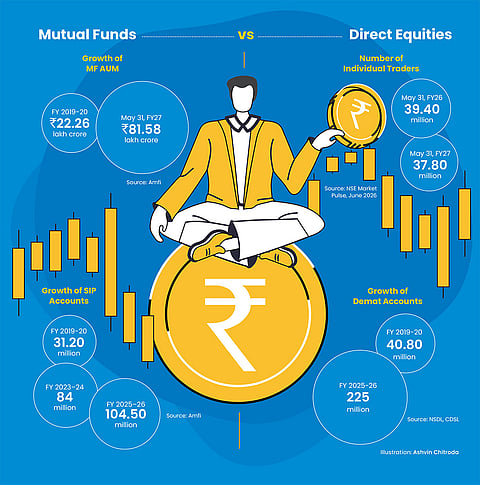
At the same time, difficult market conditions have reminded investors that stock selection is not easy.
Sriram BKR, senior investment strategist at Geojit Investments, says retail investors increasingly recognise the advantages that mutual funds bring to equity investing. “Stock selection is the key to success in equity investing. Mutual funds bring a professional and research-based approach for stock selection,” he says.
Advertisement
Manasvi Garg, founder of Moneyvesta Wealth Management, says SIP is driving this change. “It makes investing automatic, small-ticket and less dependent on timing.”
Changing Mindset: For Sujith, the decision to switch to mutual funds partly was a decision led by a combination of factors: lack of time, increasing costs and taxes and the thrill of trading getting replaced by the realities of life. He had taken a sabbatical and traded full-time during the period, but the transition followed once he returned to work.
“When I entered the market, I had the same mindset many beginners have: how do I double or triple my money quickly; but the market teaches you that wealth creation doesn’t work that way,” he says.
“Many retail investors who faced losses in direct equity or complex derivatives markets have consciously shifted to safer, managed products,” says Shah.
There are signs of growing maturity as holding periods have increased and SIP contributions remain resilient despite volatility
Advertisement
Past Lessons: Shikhar Singh, 30, a full-time investor and trader, entered the market in 2020 for a side income. A UPSC aspirant, he worked as a freelance teacher on educational platforms, but income was uncertain. He grew up hearing his father talking about stocks and mutual funds. So when one of his friends nudged him to invest during the market crash, he opened a demat account.
The market environment made almost every decision look intelligent. “The first benchmark I had for myself was very small, around Rs 500-800,” he says. By 2022, his profits had grown substantially. But as older return-generating sectors stopped performing and newer themes emerged, his capital got trapped in stocks that no longer participated in the rally. Eventually, he had to book losses of around Rs 5 lakh.
The experience forced him to reconsider his approach. “One thing the last two years have taught me is the importance of asset allocation,” he says. He has begun prioritising capital preservation, liquidity, and rotating funds across asset classes. “If I feel the market has become excessively heated, I move some money out and park it in safer instruments.”
Advertisement
Anand K Rathi, co-founder of MIRA Money, an investment management platform, says this evolution is common. “During bull markets, many investors tend to be highly confident about their stock picking abilities because rising markets make most decisions appear successful. However, when markets become challenging, they start to compare their outcomes with those generated by fund managers .”
Practical Approach: Swetamber Priyadarshi, 41, a professional working in the education industry, started investing in direct equities nearly a decade ago. He enjoyed researching companies and building positions on his own. What opened his eyes was a large investment in a stock that suddenly declined. “It made me realise how difficult it is to get stock selection and timing right consistently,” he says.
Today, his entire equity allocation sits in mutual funds. For him, the decision is less about fear and more about practicality. “To do stock picking properly, you need to track businesses, management quality, valuations and industry trends.”
Advertisement
He feels mutual funds provide a better balance between returns, diversification, and peace of mind. “I have become much more process-driven and patient. Earlier, I spent more time looking for the next winning stock. Today, I focus on consistency, diversification and staying invested for the long run.”

Going Strong
Not every investor has moved away from direct equities. Some have evolved their investing acumen based on research and practical investing.
Nirmal Saini, 29, assistant manager at a leading public sector undertaking, too, began investing during the Covid crash, and his investments generated strong returns. Today, nearly 80 per cent of his investments are in stocks and the rest in SIPs. He says he gets the time to study companies, track sectors and monitor market developments, which makes stock investing practical for him. “For investors who don’t have time to conduct research, mutual funds are a more practical option,” he says.
Advertisement
What changed for him was not the preference for stocks but the style of investing. Earlier, he simply bought companies and held them. Over time, he realised that sectors move through cycles, valuations matter and momentum changes. He now follows sectoral themes more actively.
Conclusion
Though financial awareness has improved, have Indian investors matured?
Several experts point out that today’s investors have largely experienced rising markets interrupted by relatively short corrections. A prolonged period of muted returns would test whether the new investing habits remain intact.
Says Jha, “The real test of this shift will be how investors respond across a full market cycle, particularly during extended periods of weaker returns.”
Even so, there are signs of growing maturity as holding periods have increased and SIP contributions remain resilient despite market volatility. The investor who entered the market in 2020 came searching for quick gains. The investor emerging in 2026 appears more concerned about diversification, discipline and asset allocation.
Advertisement
India seems to be producing not just more investors, but more experienced ones. And that may be the most important outcome of the post-pandemic investing boom.
rishabh.raj@outlookindia.com
Show comments
Published At:
Tags