For the residents of Ivy County, a 28-storey high-rise in Delhi-National Capital Region (Delhi-NCR), June 5 was like any other weekday morning. The working professionals were getting ready for work, children were packing their school bags and the elderly taking their customary morning walk. That routine was suddenly disrupted when some residents noticed thick smoke billowing out from the 12th floor of one of the towers. Families rushed down stairwells, carrying young children and helping elderly relatives navigate the chaos, while neighbours watched anxiously from balconies as flames and smoke spread across the building.
How Safe Are India’s High-Rises?
For homebuyers, skyscrapers and high-rises are symbols of security, amenities and a better quality of life. Yet every major fire incident exposes an uncomfortable reality: the infrastructure designed to protect residents often struggles to keep pace with the height and density of the buildings

Advertisement
The fire started due to a short circuit in an air-conditioner unit, gutting one flat and affecting several others. The accident is not an isolated one. Similar scenes were witnessed recently at other places, including Lotus Boulevard in Noida, Gaur Green Avenue apartment complex in Ghaziabad, a couple of high-rises in Pune, and a bed-and-breakfast (B&B) facility at Malviya Nagar in Delhi. The last accident claimed 22 lives, according to reports.
These and many more accidents, which often end in tragedies and/or massive losses, raise a critical question: How safe is life hundreds of feet above the ground? They have exposed a vulnerability that can put millions at risk, with India embracing vertical living.
Says Santhosh Kumar, vice chairman, Anarock Group: “By 2030, more than 600 million Indians are expected to live in cities, putting immense pressure on land and housing infrastructure. As a result, vertical housing is no longer an option, but a necessity, and the number of high-rise residential towers is expected to multiply significantly over the next decade.”
Advertisement

At the same time, fire-related accidents claim thousands of lives across India every year, and experts warn that dense residential apartment structures present a unique challenge where a single failure—an electrical short circuit, a blocked fire exit or a non-functional sprinkler system—can escalate into a life-threatening crisis.
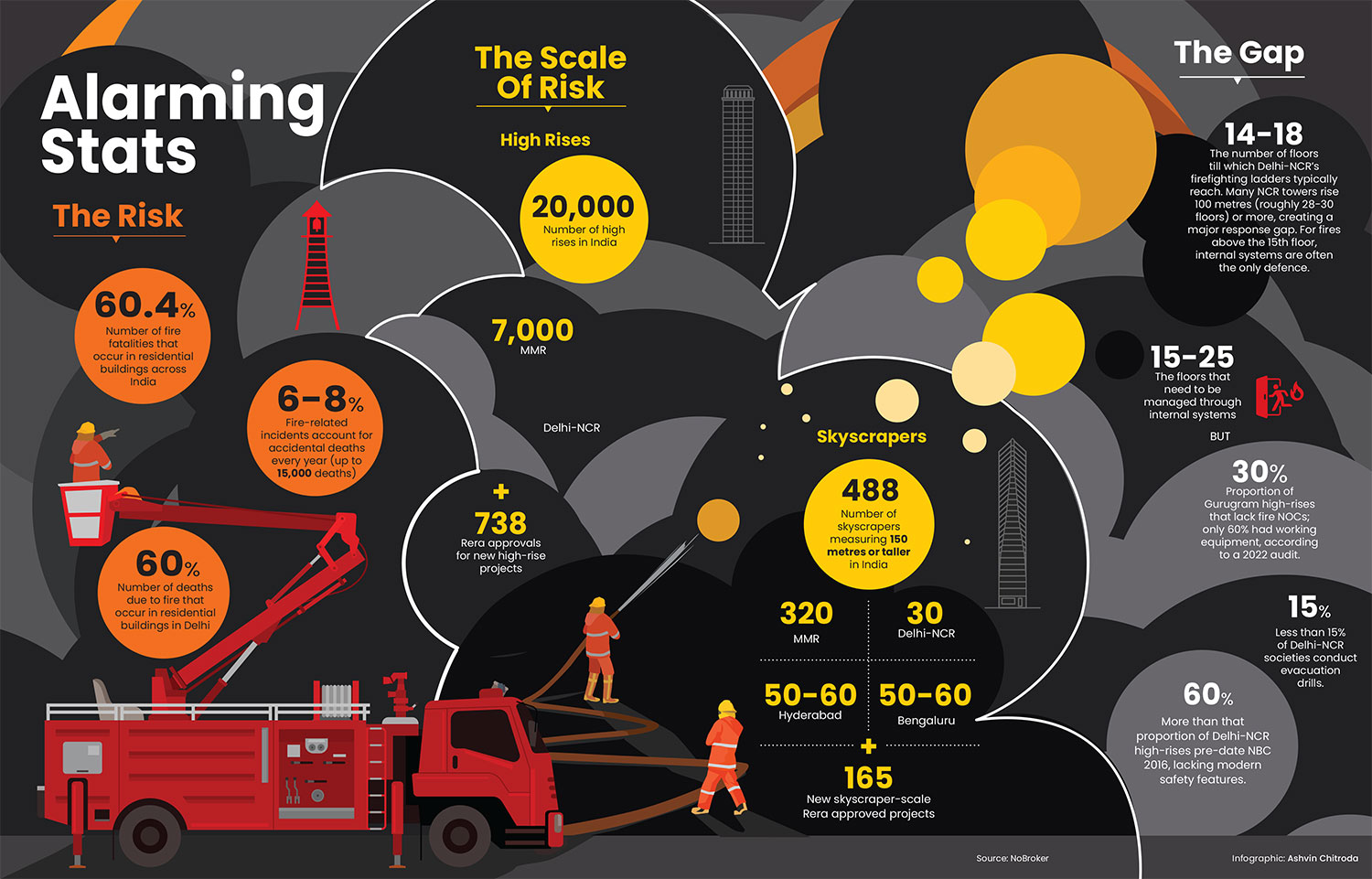
According to a recent report by NIST Global, India’s leading safety organisation, fire-related incidents account for 6-8 per cent of accidental deaths every year, claiming between 13,000 and 15,000 lives annually. The growing severity of recent fires is largely a result of higher electrical loads, increased use of combustible materials, and the expansion of dense urban infrastructure, including high-rise residential towers.
Even as concerns over fire safety in high-rises continue to mount, the Haryana State Industrial and Infrastructure Development Corporation (HSIIDC) is reportedly planning India’s tallest mixed-use tower, expected to rise between 620 and 700 metres, as part of its Global City project. The ambition reflects India’s growing vertical skyline, but also raises an important question: are safety standards rising as high as the buildings themselves?
Advertisement
Are Fire Safety Protocols Keeping Pace?
After the recent incidents, questions were raised whether fire alarms functioned as intended, evacuation protocols were adequate, and emergency responders possessed the necessary equipment needed.
Fire services are primarily the responsibility of state governments, while the Centre plays an advisory role through frameworks, such as the National Building Code (NBC) 2016.
Apartment structures present a unique challenge where a single failure, such as a short circuit or blocked fire exit, can lead to crisis
On the positive side, fire safety regulations and enforcement are becoming stronger, with governments investing heavily in emergency response infrastructure. Recognising the challenges posed by taller buildings, the Delhi government has allocated Rs 674 crore to its fire department in the 2026-27 budget, a 30 per cent increase over the previous year. The funds will be used to build new fire stations, deploy 26 additional Quick Response Vehicles (QRVs), and procure advanced firefighting equipment.
Advertisement
In some other states, fire departments have digitised the fire no-objection certificate (NOC) process for builders, making approvals faster and more transparent. Several states, including Maharashtra and Delhi, have also begun mandating Internet of Things (IoT)-based real-time fire monitoring systems in high-rise buildings, signalling a shift towards smarter fire safety infrastructure.
For instance, Maharashtra has mandated IoT-based Automated Continuous Monitoring Systems (ACMS) for high-rise buildings above 22 floors, enabling real-time monitoring of critical fire safety equipment. Delhi has introduced a similar requirement for IoT-enabled fire safety monitoring.
At the national level, NBC 2016 provides the technical foundation for fire safety standards, while proposed revisions to the code signal a move towards making smart, IoT-driven fire monitoring a nationwide norm.
Some of the major cities are gradually upgrading their firefighting capabilities, but it’s still a work in progress. Chennai already operates a 104-metre hydraulic firefighting platform capable of reaching some of the city’s tallest buildings. Mumbai, where skyscrapers increasingly dominate the skyline, is in the process of acquiring similar 104-metre aerial ladders to strengthen its high-rise emergency response network.
Advertisement
According to Rahul Sundaram, partner, IndiaLaw LLP, a law firm, many cities continue to face shortages of high-reach aerial platforms, specialised equipment and trained personnel, while congested roads and limited access can delay emergency response.
After the recent fire incidents, Delhi, too, is looking to bridge the gap between building heights and firefighting capacity. The capital is planning to procure two specialised fire tenders designed to tackle emergencies in buildings up to 200 metres tall, equivalent to 50 storeys.
Firefighting capabilities are being scaled up to meet the demands of a changing urban landscape, but how comprehensive they are currently and how long it will take for the approvals to get translated into action is unclear.
The Big Gaps
India does not suffer from a shortage of fire safety regulations, but compliance and preparedness on ground are the biggest problem, along with glaring gaps.
Says Astha Sharma, partner, AQUILAW, a full-service law firm: “India’s NBC 2016 matches the UAE code on paper. Dubai succeeded because compliance was non-negotiable and systems were “always on”. India’s shift, therefore, must be from external rescue to internal, enforced containment.”
Advertisement
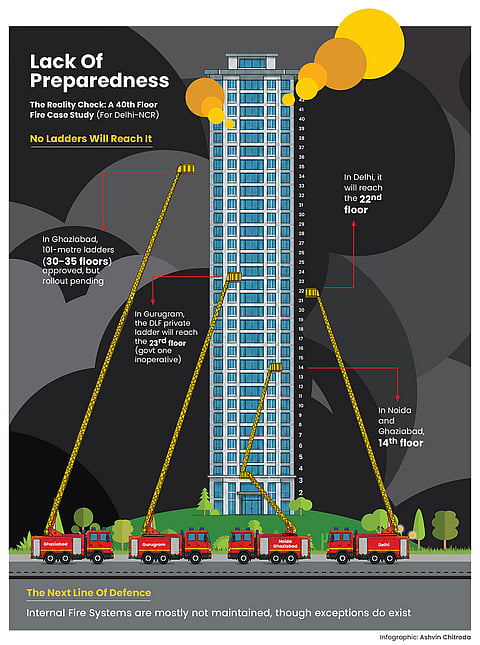
Some gaps are glaring. For instance, while many high rises in Delhi-NCR stretch well above 100 metres, the region’s firefighting equipment reportedly has a much shorter reach, highlighting the gap between urban ambition and emergency preparedness.
The situation in Delhi-NCR is alarming, but not unique. Says Kumar: “In Noida and Ghaziabad, buildings can range from 100 metres to as high as 307 metres, yet the available hydraulic platforms can reach only about 42 metres, roughly the 14th floor. Gurugram’s lone hydraulic platform has reportedly remained non-functional for years, while Hyderabad has just two government-owned skylifts capable of reaching 54 metres (18 floors). Even Nagpur’s recent acquisition of a 70-metre platform is being celebrated because such equipment is rare.”
Other gaps are about implementation. “There is a lot of progress in approvals, but fire safety is still playing catch-up,” says Kumar.
Experts agree. Saurabh Garg, co-founder and chief business officer of NoBroker, a proptech company, says that the issue is less about regulations and more about implementation. Niharika Karanjawala Misra, associate partner, Karanjawala & Co, a dispute resolution firm, says the challenge is not always the absence of rules, but the failure to sustain them. Fire exits may be blocked, safety equipment may become non-functional, evacuation plans may remain untested, and routine inspections may not translate into daily preparedness.
Advertisement
External ladders and hoses can reach up to a certain level. So, it’s necessary to instal firefighting capabilities within high-rises
Sharma says, “On paper, India’s NBC 2016 is a robust document mandating everything from smoke management, safety audits, electrical fire prevention, and automated detection. However, once an Occupancy Certificate (OC) is issued, this rigour evaporates. Mandatory six-monthly audits are often ignored, and Fire NOC renewals, required every five years, become mere box-ticking exercises with little to no physical verification.”
Adds Shankey Agrawal, partner at BMR Legal, a boutique law firm: “India’s deeper challenge is not necessarily the absence of rules but the failure to enforce them consistently. There’s also a shortage of firefighting infrastructure and trained personnel. Even the best-drafted regulations will have limited impact if municipal authorities lack the capacity to inspect, monitor, and enforce compliance.”
Besides, the fines in India are nowhere near global standards. For instance, while Dubai levies fines starting at AED 50,000 (roughly Rs 11.4 lakh) for blocked stairwells, penalties in Delhi range from a negligible Rs 500-5,000. “Thus, safety systems are treated as one-time hurdles rather than operating standards,” says Sharma.
Advertisement
What Can Fix The Problem
Internal Safety Systems: Inadequate firefighting system at the state level is just one part of the problem. When a fire breaks out in a high-rise, internal safety systems and not fire engines are often the first and most important line of defence.
Most fire departments still rely on aerial ladders that can reach only around 20-22 floors, making external rescue or firefighting difficult in taller buildings. Instead, cities need to invest in compact, high-pressure Compressed Air Foam Systems (CAFS) that can pump fire-suppressing foam through a building’s internal risers, enabling firefighting operations even at heights of 100 storeys or more.
Says Sharma: “The reality is that in most Indian cities, rescuing people or fighting a fire from outside a building above the 25th floor is rarely practical. The focus must, therefore, shift to strengthening internal firefighting systems and equipping responders to attack fires from within.”
Advertisement
Garg says it is important to shift the focus towards building hyper-advanced internal infrastructure capable of handling emergencies independently. “Once buildings reach a certain height, they must function as their own fire stations,” he adds.
Since external ladders and hoses can reach only a limited number of floors, systems such as automated sprinklers, smoke extraction units, fire lifts, zonal pressure controls, diesel-powered back-up pumps, fire-resistant compartmentalisation and pressurised stairwells play a critical role in containing fires and enabling safe evacuation, say experts.
Says Garg: “The moment sensors detect smoke or heat, sprinklers and internal firefighting networks are expected to respond automatically. Refuge areas provide safe waiting zones, while protected staircases and fire elevators help ensure evacuation routes remain usable.”
Evacuation preparedness is another aspect that has to be worked upon. Safety features, such as pressurised staircases and refuge floors are only effective if residents know how to use them. Without regular drills, clear signage and unobstructed escape routes, even well-designed buildings can struggle during emergencies.
Advertisement
Proper Maintenance: For many buildings, the buck stops at poor maintenance. High-rises are required to instal smoke detectors, sprinklers, pressurised staircases and alarm systems, but following the rules during construction and keeping up with maintenance afterwards are two very different things.
High-rises need to instal smoke detectors, sprinklers, and alarms, but following rules and keeping them working are different
Along with approvals and equipment, the real test lies in ensuring that systems remain operational, residents know how to respond during emergencies, and enforcement keeps pace with the country’s rapidly changing skyline. “The real question is whether these systems are installed correctly, tested regularly, and kept fully operational year after year,” says Garg.
Sundaram points that common failures include non-functional sprinklers and alarms, blocked or locked fire exits, poor electrical maintenance, unauthorised structural modifications, and evacuation plans that are rarely tested.
Says Kumar: “Builders tick the necessary boxes to secure occupancy certificates, but over time, many resident welfare associations (RWAs) fail to maintain the system. As a result, critical equipment can become non-functional when it is needed the most. Real preparedness requires functioning equipment, trained residents and regular evacuation drills.”
Notably, premium residential towers typically invest far more in safety infrastructure and management. “A luxury high-rise in areas such as Lower Parel in Mumbai is likely to have a dedicated fire command centre, trained facility managers, advanced suppression systems and clearly-marked evacuation routes,” says Kumar.
Large gated communities generally maintain strong safety standards because they have professional facility management and dedicated budgets.
In contrast, many mid-income and affordable projects tend to focus on meeting the minimum statutory requirements. Sprinklers, refuge areas and other safety features may be provided as mandated, but their upkeep can suffer over time due to budget constraints, weak enforcement, or lack of resident awareness. In some buildings, refuge areas are illegally occupied or converted into storage rooms.
Kumar, however, believes the issue is also about accountability. Buyers in premium projects, where apartments cost several crores, are more likely to question developers about safety systems, maintenance protocols and compliance records. In lower-priced projects, homeownership itself often becomes the primary concern, with fire safety receiving less attention during the purchase decision.
The introduction of the Real Estate Regulatory Authority (Rera), greater transparency in real estate, stricter due diligence by lenders, and informed buyers have further raised the stakes. So, reputable developers today have far more to lose by compromising on safety standards.
Retrofitting Ageing High-Rises: Retrofitting ageing high-rises with modern fire safety infrastructure is necessary, but challenging. Older buildings require special attention through cladding replacement, safer escape routes, and periodic electrical audits. Many towers were designed for much lower power consumption and now face added risks from increased air-conditioning loads and EV charging infrastructure.
Older buildings and constructions are clearly more vulnerable. Sharma says over 60 per cent of Delhi-NCR’s high-rises were built before the NBC 2016 came into force and lack mandatory sprinklers or refuge floors.
“The vulnerabilities are concentrated in older standalone buildings, mixed-use structures, and projects where maintenance becomes an afterthought,” says Garg. Or where such standards don’t exist at all because the earlier rules didn’t mandate so.
NBC 2025 requires IoT-based fire alarm upgrades for buildings built between 2018 and 2022. In case of non-compliance, fire departments can go to the court as a last resort.
Retrofitting ageing high-rises with modern fire safety measures is challenging and expensive, so most RWAs tend to avoid it
The biggest hurdle is often not technology, but cost, disruption and the unwillingness of housing societies to invest in upgrades. Says Kumar: “Most RWAs simply do not have the financial reserves, technical expertise or sense of urgency required for such large-scale upgrades until an incident forces the issue,” he says. The costs are steep. Installing a full sprinkler system in a 20-year-old 25-storey residential tower can cost between Rs 50 lakh and Rs 80 lakh or more, he says. “The work itself can be highly disruptive, requiring new pipes to be routed through finished apartments, walls and common areas.”
Sharma pegs the cost of retrofitting at Rs 30 lakh to Rs 50 lakh. “Without state-backed funding or legal powers to enforce phased upgrades, these older towers remain the ‘biggest blind spot’ in urban safety,” she says.
However, experts point out that technology is making retrofits easier and less intrusive than before. Rather than relying solely on expensive plumbing and wiring upgrades, many buildings are now adopting wireless, AI-enabled fire safety systems. Battery-powered smoke and heat detectors can be installed across corridors and common areas without tearing down walls, significantly reducing both cost and disruption.
These systems connect to centralised digital platforms that can instantly alert residents, facility managers and emergency responders upon detecting smoke or abnormal heat patterns. Garg confirms that such upgrades can be implemented within days and at a fraction of the cost of traditional retrofits.
Separate Framework For Super Tall Housing: There is a strong case for having a separate framework for super tall buildings. India continues to regulate high-rises under a common framework catering to 15-24 metres, but modern buildings are much taller.
“The reality on the ground is stark. Many towers rise between 150 and 300 metres, but firefighting ladders in Delhi-NCR can reach only about 42 metres. Thus, external rescue beyond the 15th floor becomes largely theoretical. That is precisely the kind of gap that should trigger much stricter internal safety requirements,” says Agrawal.
A laddered regulatory framework could address this by imposing higher safety standards as buildings grow taller. Beyond certain height thresholds, requirements could include additional refuge floors, redundant pressurised stairwells, full-building sprinkler coverage, dedicated firefighter-access lifts, and mid-level water storage systems.
The 2025 draft standards recommend gravity-fed mid-level water tanks for buildings above 45 metres. Such a framework could also mandate non-combustible façades without exceptions and introduce stronger accountability mechanisms. One option would be to adopt a model similar to Singapore’s, where certified fire safety managers are legally responsible for ensuring that active firefighting systems remain functional and compliant.
But it will all finally depend on enforcement.
What Should Buyers Do?
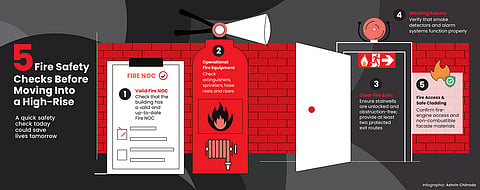
Check Compliances: A developer cannot legally occupy or hand over a building without obtaining key approvals, including an NOC and the OC. “A developer who ignores fire safety norms and risks not getting an OC effectively makes the project uninhabitable,” says Garg.
Buyers must also insist on checking approved building plans, including designated refuge areas, before signing up.
Says Agrawal: “An audit in Gurugram in 2022 found that 30 per cent of high-rises lacked fire NOCs, and only 60 per cent were running the mandatory equipment.” If it is an older building, check fire audit reports, evacuation plans, and maintenance records along with the NOC and OC, among others.
Follow Up On Maintenance: Legal experts say that compliant buildings are not a permanent guarantee of safety. A building may pass an audit today, but emergency readiness can quickly deteriorate if fire equipment is not maintained, exits are blocked, floor plans are altered, or unauthorised constructions are added later.
“Continuous maintenance and vigilance are the real safeguards,” says Misra of Karanjawala & Co.
In many towers, sprinklers are disabled to prevent water damage, fire doors are wedged open for ventilation, and refuge floors meant for life-saving shelter are illegally repurposed as gyms or party halls. Security guards double as the firefighting team. All that can lead to chaos in emergency situations.

| Photo: Tribhuvan Tiwari
Know Who Is Accountable: Transparency is the key and you must take updates from the authorities concerned (see Who Is Held Responsible?).
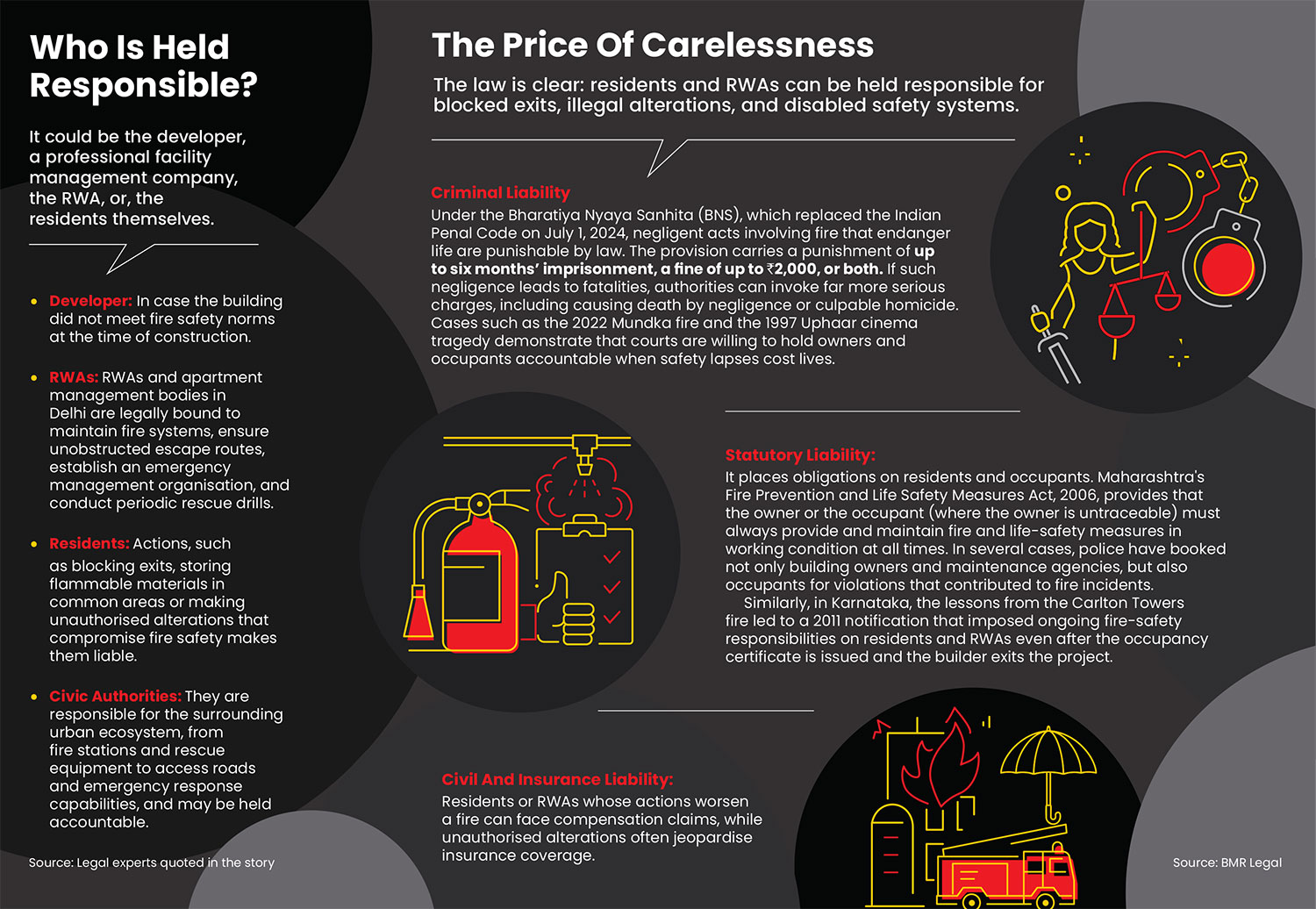
RWAs and apartment management associations in Delhi are legally bound by the Delhi Fire Service (DFS) Act, 2007, the Delhi Fire Service Rules, 2010, and the Unified Building Bye Laws of Delhi (UBBL 2016), which integrate the NBC. In particular, according to Rule 38 of the Delhi Fire Service Rules, 2010, RWAs are legally responsible for maintaining fire systems, ensuring unobstructed escape routes under UBBL 2016/NBC Part 4 norms, establishing an emergency management organisation, and conducting periodic rescue drills under the NBC Part 4 and DFS operational guidelines.
Says Misra, “Disclosures on audit and maintenance would allow occupants to assess whether safety systems are being properly maintained rather than relying solely on a certificate issued years earlier.”
“Yet, RWAs remain volunteer bodies with no technical expertise or earmarked budgets,” says Sharma of AQUILAW.
Moreover, to save costs, many RWAs compromise on maintenance contracts. “A 30-floor tower requires Rs 8 lakh-15 lakh annually for an NBC-compliant contract, but most societies spend only Rs 1 lakh -2 lakh, covering only basic pump checks while leaving smoke detectors and alarms untested for years. Actual compliance for mandatory evacuation drills is even below 15 per cent in Delhi-NCR,” says Sharma.
In many high-rises, sprinklers are disabled to prevent water damage and fire shelters are illegally repurposed as halls
“Without statutory liability for RWA office-bearers and mandatory fire safety line items in society budgets, the entity closest to the risk, remains the least equipped to handle it,” adds Sharma.
Become Accountable: Sometimes, the fault lies in the practices of residents themselves. “Practices, such as locking staircases, storing materials in corridors or altering apartment layouts can undermine safety by obstructing escape routes and compromising fire-resistant barriers,” says Sundaram.
In fact, residents should periodically review evacuation procedures, participate in fire drills and remain aware of emergency protocols. In a high-rise fire, awareness and preparedness can be just as important as the safety systems themselves.
For the families living dozens of floors above the ground, fire safety is not just a regulatory requirement; it is a matter of trust. And in towers that stretch far beyond the reach of conventional firefighting equipment, that trust rests largely on the building’s own systems and the people responsible for maintaining them.
As India continues to build upwards, ensuring that safety keeps pace with ambition will be critical for safe living.
sanjeev.sinha@outlookindia.com
Show comments
Published At:
Tags