Start young. Every financial expert you talk to about wealth creation will give that advice. But for the middle-class younger cohort that is gripped with the fear of missing out (FOMO) and the idea that you only live once (YOLO), the expenses are often far higher than salaries, closing the window for investment. Even those who do follow the advice find themselves chasing get-rich-quick schemes or hacks like stock market trading, which are highly risky and are often followed by losses.
Is Your Pay Cheque Pain Real?
If you are a victim of comparison culture, you need a reality check, but if your budgets are indeed squeezed, you can look at negotiating your salary and upskilling

Advertisement
The Internet culture is only adding to the anxiety about not having enough income. Instagram stories showcasing luxury vacations or extravagant purchases define a new normal. Eventually, this new normal leads to a sense of disappointment and the pay cheque pain creeps in. But in which cases is it justified and how does one steer through it?
Reality Check
While the comparison culture has existed since time immemorial, the Internet takes it to the next level as you end up comparing your lifestyle with not just your peers but people with significantly more wealth and spending capabilities.
There are regular debates on LinkedIn and Reddit about whether people with a salary of Rs 60 lakh per annum form the new middle class. While, in this context, many may feel their income is inadequate, the actual threshold for middle-class income is vastly different.
Seeing peers posting about high-end purchases can make a salary that comfortably covers your bills suddenly feel inadequate
Advertisement
There are multiple ways of estimating what middle-class income is, but a credible way is basing it on the government’s taxation policies and official statements by Finance Minister Nirmala Sitharaman. In her 2026 Budget Speech, she reiterated the new income tax structure introduced in the previous fiscal and added that the tax relief given to individuals earning up to Rs 12.75 lakh will reduce the tax burden on the middle class.
Based on government estimates, the Rs 4-8 lakh per annum bracket can be seen as the emerging middle class and the Rs 8-12.75 lakh per annum bracket as core middle class, as they receive the benefits of the rebate, resulting in tax relief.
Harshit Patel, a certified financial planner and founder of Invest Wissen, a Mumbai-based financial planning and wealth management firm, says that the actual middle class is likely to earn between Rs 12 lakh and Rs 25 lakh.
Advertisement
“The Rs 60 lakh per annum figure is social media distortion. It represents the top percentile of earners, not the middle class... The true metro middle class is operating within the Rs 12-25 lakh band. They are the ones feeling acute pay cheque pain,” says Patel.
The Real Pain Point
In the world of social currency, salary isn’t just for survival. When you see peers posting about luxury watches or high-end dining, a salary that comfortably covers your bills suddenly feels inadequate.
The other reason why salaries may feel inadequate is income stagnation, even as the cost of living is rising.
Consider the following: In 2020, average salary hikes witnessed their lowest lows as they dipped to 4.40 per cent in India amid the spread of Covid-19, according to the 2021 Workforce Increment Trends Survey by Deloitte India. While the average salary increment in India has increased post the pandemic, it is nowhere near the double-digit growth (10.60 per cent) seen in 2022, according to a report by Aon Plc, a global professional services firm.
Advertisement
Recent years reflect a decline and stagnation, wherein the annual salary hike has dipped consistently to 9.70 per cent (Korn Ferry Survey) in 2023 and to 8.90 per cent in 2024-25 (Aon). Aon’s Annual Salary Increase Survey 2025-26 projects a nominal salary hike of 9 per cent for 2026.
At the same time, the cost of living in urban India is increasing. According to a report by Ghar.tv, a real estate media and proptech platform, residential property prices in major Indian cities are expected to rise around 6-7 per cent annually over the next three years and rents in urban India are expected to grow by 6-8 per cent in key employment hubs.
Even as non-discretionary costs like food, utility bills and rent weigh heavy on salaries, rising discretionary expenses such as the money spent on conveniences shrink the pay cheque.
According to a report by CareEdge Analytics & Advisory, the fee-based revenue earned by quick commerce companies is Rs 10,500 crore in financial year (FY) 2025 compared to just Rs 450 crore in FY22. Notably, the platform-fee based revenue is projected to increase to Rs 34,500 crore by FY28 on account of increased platform charges by leading players.
Advertisement
Says Dr. Rahul Chandhok, head consultant at mental health and behavioural sciences in Artemis Hospital, Gurugram: “Because these services save people time and effort, they start to see them as necessities instead of luxuries. Over time, this will change how we think about and spend money on everyday things.”
Returns Vs Realitya
According to the Economic Survey for 2025-26, equity and mutual funds account for 15.2 per cent of annual household savings in India as of FY25, a dramatic rise from just 2 per cent in FY12, indicating growing participation and increasing financial awareness. The Securities and Exchange Board of India (Sebi) Investor Survey 2025 highlights that the average household allocates approximately 24 per cent of its monthly income toward savings and investments cumulatively.
However, this investment boom comes at a time when the average Indian budget is tightening. The younger cohort is either pulling its hands away or chasing risky schemes promising unrealistic returns.
Advertisement
Spurred by anecdotes of great returns in the future and options (F&O) segment, India’s young workforce (under 30 years of age) is increasing its participation in the segment, only to incur losses. This has led to intervention by Sitharaman, who announced a hike in securities transaction tax (STT) surcharge on F&O trades in the Union Budget 2025 to 0.05 per cent for Futures and to 0.15 per cent for Options. The policy decision came after Sebi disclosed that 91 per cent of retail traders incurred losses in the F&O segment in its Comparative Study of Growth in Equity Derivatives Segment vis-à-vis Cash Market After Recent Measures report in July 2025. Another Sebi report titled Analysis of Profits and Losses in the Equity Derivatives Segment, in September 2024, found that 43 per cent of the F&O participants were under 30 years of age.
Says Vaibhav Agarwal, chartered financial analyst and founder of Accelt Asset Management, a Mumbai-based PMS firm: “Investors under 30 are increasingly drawn to high-risk segments like F&O, driven by easy access via apps, along with social media narratives on platforms like Instagram that glamorise quick gains. Many are motivated by the appeal of leverage, the desire to accelerate wealth amid rising aspirations, and behavioural biases like overconfidence and thrill-seeking.”
Advertisement
How To Cure The Pain
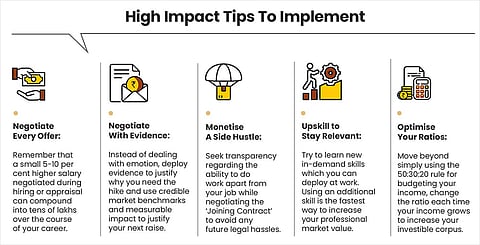
Negotiate: As incomes remain more or less stagnant, your best bet is to negotiate at the time of hiring.
Anjali Raghuvanshi, chief people officer at Randstad India and Global Capability Centre, says that even a minor salary negotiation during the hiring phase can significantly change the income. She adds that while the negotiation involves a fair bit of awkwardness, it is still worthwhile. “The starting salary becomes the foundation for future earning potential. As a result, even a 5-10 per cent increase in the initial CTC can have a meaningful compounding effect over time.”

That minor increase can help you create an investible surplus. Says Agarwal: “Over long time horizons, even small increases in income can have a meaningful impact. If a professional invests Rs 5 lakh annually and earns around 12 per cent returns, they could accumulate roughly Rs 4-5 crore over 20 years. Increasing that annual investment by just 10 per cent can add tens of lakhs to the final corpus. What appears like a minor salary increase early in one’s career can translate into significantly higher wealth two decades later.”
Advertisement
It also gives a psychological boost, says Prabir Jha, founder and CEO of Prabir Jha People Advisory and a veteran HR strategist. “It is human to try and negotiate the best one can. The 5-10 per cent range depends on the existing pay range. At senior levels, it is less consequential. But at junior levels, it makes a psychological, if not a big financial impact,” Jha said.
Given the salary projection for the current year and the ongoing geopolitical conflict, the salary negotiation in 2026 is not likely to be easy. Raghuvanshi advises employees to negotiate their appraisal by highlighting their performance and its impact on the company’s business.
Financial experts advocate the 50:30:20 rule for needs, investments and discretionary spends. But factor in the salary brackets and relevant taxation to tweak the ratio
Says Raghuvanshi: “When it comes to negotiating a market correction raise in a year where corporate budgets are tight, the conversation needs to shift from entitlement to evidence. Professionals who bring credible market salary benchmarks highlight expanded responsibilities, and demonstrate measurable impact on business outcomes are more likely to have productive discussions.”
Advertisement
Explore A Side Hustle: While moonlighting was once taboo, it has now become par for the course for many companies.
Says Raghuvanshi: “In India, moonlighting is not governed by a single overarching law. The boundaries are typically defined through employment contracts and company policies. Most organisations permit external engagements if they do not create a conflict of interest, compete with the employer’s business, or affect productivity and confidentiality. In some cases, professionals can negotiate transparency clauses or seek written approvals for freelance or consulting work.”
Upskill: Another way to assuage one’s pay cheque pain is through upskilling. “If you think it helps you learn and stay relevant, pick wisely. Most importantly, finish the course. What typically gains acceptance is the deployment of a skill or leadership competence at your existing workplace,” Jha says.
Build Discipline: Focus on building strong financial habits instead of chasing returns in complex financial instruments in the initial stage.
Advertisement
“Think of this stage like laying the foundation of a house. The structure built later depends on how solid the base is,” says Agarwal.
It is prudent to limit lifestyle spends to 15-20 per cent of monthly income and invest 35-40 per cent after deducting (40-45 per cent) for essential expenses. While most financial experts advocate the 50:30:20 rule (50 per cent on needs, 30 per cent on investments and 20 per cent on discretionary spends), Patel advises individuals to factor in their salary brackets and the relevant taxation to tweak the ratio.
He advises: “For Rs 15 lakh bracket, the ratio should be 45:35:30. For the Rs 24 lakh-plus bracket, which hits the 30 per cent slab, it should be 35:45:20. The focus here heavily shifts to maximising investment rates to outpace the 30 per cent tax bite.”
Fight FOMO: Dr. Chandhok says digital comparisons can severely distort one’s sense of financial security. “When you look at pictures of rich people online, a salary that used to seem good may suddenly seem too low.” Psychologists warn that viewing salary as part of your self-worth can lead to income dysmorphia, a psychological state where a statistically respectable income feels inadequate.
What can cure the pay cheque pain is resisting instant gratification and not seeking short-term returns.
ayushkhar@outlookindia.com
Show comments
Published At:
Tags