Better connectivity and relatively lower property prices compared to Gurugram and Noida are beginning to influence buyers looking to invest in Faridabad.
While property prices in Gurugram and parts of Noida have climbed sharply in recent years, Faridabad still offers more accessible entry levels across categories.
As regional projects move ahead under agencies such as the National Capital Region Transport Corporation, cities like Faridabad are likely to benefit from closer economic integration and smoother mobility.
How Faridabad Is Emerging As Delhi-NCR’s Next Real Estate Investment Hotspot
Faridabad, long seen as an industrial extension or small satellite town of Delhi, has started drawing investor attention in the last few months, driven in part by large infrastructure projects, such as the Namo Bharat RRTS linking it to Gurgaon, Noida and Greater Noida, and relatively lower prices compared to other NCR areas

Summary
Advertisement
Faridabad, long seen as an industrial extension or small satellite town of Delhi, has started drawing investor attention in the last few months, by becoming a serious contender in the region’s real estate market. The recent rise in activity has been driven in part by large infrastructure projects. Real estate experts say better connectivity and relatively lower prices compared to Gurugram and Noida are beginning to influence buyer decisions in favour of Faridabad.
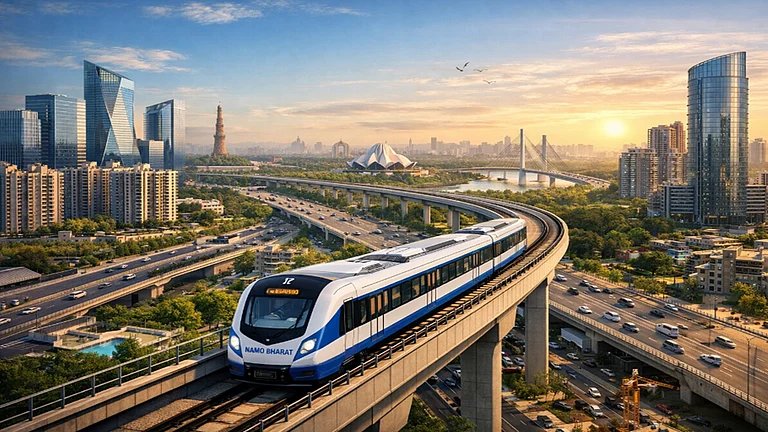
The shift further gained momentum last week when Haryana Chief Minister Nayab Singh Saini told the state assembly that the final alignment of the Namo Bharat Regional Rapid Transit System (RRTS)-cum-metro corridor linking Gurugram, Faridabad, Noida and Greater Noida had been approved. He said the detailed project report (DPR) is being finalised, and directions have been issued to the National Capital Region Transport Corporation (NCRTC), the central agency executing the project.
Industry experts believe this corridor could change daily travel patterns between office hubs and residential pockets across Delhi-National Capital Region (Delhi-NCR).
Advertisement
Infrastructure Developments Driving Faridabad's Growth
Improved connectivity has also increased Faridabad’s appeal among homebuyers, investors and developers. The Faridabad-Noida-Ghaziabad (FNG) Expressway is nearing completion, and is expected to ease movement between key cities. The proposed Faridabad-Jewar Expressway is also significant. It will provide quicker access to the upcoming Noida International Airport at Jewar, and strengthen the city’s regional links.
Road upgrades along the Delhi-Mathura corridor and better internal networks have already supported housing growth in Greater Faridabad, especially Naharpar. Developers have introduced both mid-income apartments and premium projects here. Buyers, who might find Gurugram or central Noida expensive, will likely see Faridabad as a practical option.
Mohit Malhotra, founder & CEO, NeoLiv, said that infrastructure improvements are influencing investment decisions. “Faridabad has emerged as a high-potential micro-market, driven by accelerated infrastructure development and dramatically improved connectivity across Delhi-NCR. The opening of the Jewar Airport, connecting Faridabad by expressway cutting travel time to just 30-45 minutes along with the upcoming metro extensions and the nearly completed FNG Expressway have fundamentally repositioned the city on the region’s realty map. With healthcare, education, and industrial ecosystems expanding rapidly, and pricing still meaningfully below comparable NCR micro-markets, Faridabad is entering a phase of high investor return growth market,” he says.
Advertisement
Property analysts say that while prices in Gurugram and parts of Noida have climbed sharply in recent years, Faridabad still offers more accessible entry levels across categories.
Namo Bharat RRTS Effect: Delhi-Ghaziabad-Meerut Corridor Operational Now
The 82-km Delhi-Ghaziabad-Meerut corridor under Namo Bharat has already shown how faster rail links can reshape housing demand. Travel between Meerut and Delhi now takes less than an hour. The reduction in commute time has made suburban living more practical for many professionals.
A similar impact is expected if the Gurugram-Faridabad-Noida-Greater Noida RRTS-cum-metro corridor progresses as planned. By linking major employment centres with developing residential zones, it could influence where people choose to live and where businesses decide to lease space.
Sam Chopra, president and country head, eXp Realty India, says the DPR milestone is important for the region’s growth story.
“The finalisation of the detailed project report (DPR) for the Gurugram–Faridabad–Noida Namo Bharat RRTS corridor is a pivotal moment for Delhh-NCR’s next phase of urban and real estate growth. Regional transit systems of this scale redefine how people live and invest by reducing travel time and unlocking well-planned growth zones. As connectivity strengthens across key NCR hubs, demand will naturally shift towards emerging, transit-linked corridors. In this evolving landscape, accurate data and transparent advisory will be essential,” he adds.
Advertisement
Developers say being part of the regional transit network gives Faridabad stronger long-term relevance in Delhi-NCR’s property cycle.
Emerging Hotspots
Several neighbourhoods are seeing higher enquiries. Naharpar in Greater Faridabad, Surajkund, Greenfields Colony, Ashoka Enclave, Charmswood Village and stretches along Mathura Road are among the areas brokers mention frequently. Improved mobility and the expectation of metro expansion are key reasons behind this increase in buyer interest.
The commercial segment could also benefit. Shorter travel time to Gurugram and Noida may attract back-office operations, with logistics players and organised retail looking for lower rentals without losing access to Delhi-NCR’s workforce.
Broader Economic Backdrop
As regional projects move ahead under agencies, such as the NCRTC, cities like Faridabad are likely to benefit from closer economic integration and smoother mobility.
For investors, the appeal rests on three simple factors: better connectivity, improving civic infrastructure, and prices that remain below several established Delhi-NCR markets. How this momentum sustains will depend on project execution and demand on the ground. For now, though, Faridabad has clearly moved back into the conversation.
Advertisement
Show comments
Published At: