During times of war investors need to be patient and avoid unnecessary churning in portfolio
Global diversification of assets can be a useful strategy to limit losses during war
Retail Investing In The Time Of Wars And Geopolitical Rupture
Markets have seen wars before. They’ve seen far worse uncertainty than what we are witnessing today. And yet, they have always moved forward

Summary
Advertisement
Wars don’t just test nations; they expose investors.
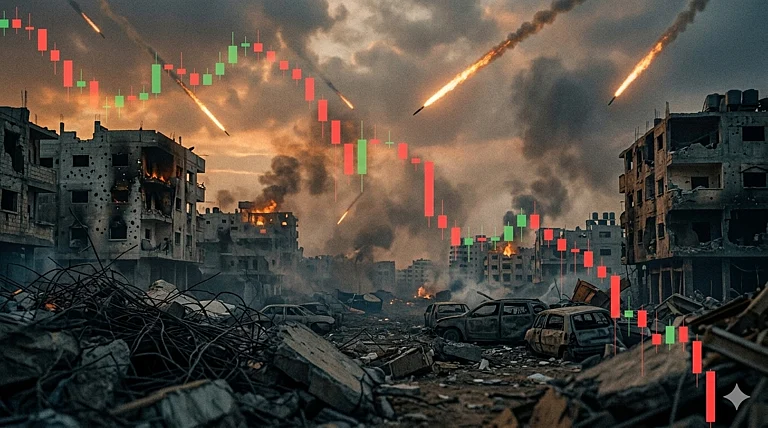
The moment geopolitical tensions rise, markets stop behaving the way people expect them to. Assets that “should” go up don’t, safe havens disappoint, and portfolios built on recent winners start showing cracks. In such times, the biggest risk is not the war itself; it’s the investor’s reaction to it.
Retail investors often believe they need to act fast in uncertain times. In reality, this is when doing less but doing it right matters the most.
Wars don’t follow timelines. They can stretch far longer than anyone anticipates. As an investor, your job during such phases is simple in theory but difficult in practice: sit patiently and avoid unnecessary churning in your portfolio.
The instinct to “do something” becomes strongest when markets turn volatile. Prices swing, narratives change overnight, and every move feels like an opportunity. But excessive action often leads to poor outcomes. In uncertain environments, the cost of mistakes is far higher than the benefit of being occasionally right.
Advertisement
One of the harshest realities of such periods is the punishment for buying at elevated levels. If you have entered assets after a sharp rally, you are the most vulnerable when uncertainty hits. Momentum reverses quickly in times of stress, and assets that have run up without a strong fundamental base tend to correct the most.
And this is where strategy comes in.
A loose approach to investing works in bull markets, but in uncertain times, you need a tighter framework. Portfolios built on high-conviction bets without valuation discipline often see the deepest drawdowns. Conviction is important, but it must be backed by fundamentals, earnings visibility, balance sheet strength, and sustainable cash flows.
Another key lesson from such phases is the importance of global diversification. When your domestic market performs well for years, it creates a sense of comfort, almost an assumption that this performance will continue indefinitely.
Advertisement
History tells a different story.
There have been long periods where entire markets have underperformed for decades. Japan is one such example. While it may feel unlikely that such a scenario could play out elsewhere, prudent investing is not about certainty; it’s about preparedness.
Diversifying across geographies ensures that your portfolio is not dependent on a single economic outcome. It is not about chasing returns globally, but about having alternatives in place if your home market goes through a prolonged phase of underperformance.
Another interesting lesson from current geopolitical tensions is how markets react to gold.
Many investors are often surprised when gold does not behave as expected during times of war. The common belief is simple: uncertainty rises, gold rises. But markets are rarely that linear. There are phases where gold can correct even when geopolitical risks are elevated, leaving investors confused and overexposed.
The mistake is not owning gold. The mistake is overallocating to it after a strong rally.
Advertisement
Gold is a hedge, primarily against currency depreciation, especially the US dollar. It has a role in the portfolio, but that role is limited. Many investors tend to fill their portfolios with gold and silver after witnessing a strong bull run in metals, assuming the trend will continue.
Nothing goes up forever.
A disciplined allocation of around 5 per cent is more than sufficient for most investors. If your hedge starts delivering higher returns than your core assets, it is not a sign to increase allocation; it is a signal to rebalance and book profits. A hedge is meant to protect your portfolio, not dominate it.
In times of uncertainty, one principle becomes even more critical: follow the cash flows.
As the environment becomes volatile, money tends to flow into companies that have consistent and reliable cash flow. These are companies that can survive irrespective of the environment. Any speculative stories and high-growth stories without earnings support tend to become irrelevant in a short period of time.
Advertisement
As an investor, if you can match your portfolio to cash-generating companies, you will be in a much more stable position. It does not promise you high returns in a bull market, but it will promise you stability in a difficult market.
The reality is that in times of war and geopolitical churn, investors have limited control over outcomes. You cannot predict how long the conflict will last. You cannot control global reactions. And you certainly cannot time every market move.
What you can control is your behaviour.
Asset allocation, diversification, discipline, and patience are the only levers you truly have. Avoid panic. Resist the urge to overtrade. Stick to a well-defined strategy.
The truth is, in times of war, you don’t win by being aggressive; you survive by being disciplined.

You won’t predict the bottom. You won’t avoid volatility. But you can control how much risk you take and how you respond when things don’t go your way.
Advertisement
Stick to asset allocation. Diversify beyond comfort zones. Follow cash flows. And most importantly, don’t let short-term uncertainty force long-term mistakes.
Markets have seen wars before. They’ve seen far worse uncertainty than what we are witnessing today. And yet, they have always moved forward.
The question is not whether the markets will recover.
The question is, will you still be positioned to benefit when they do?
(Written By Piyush Khatri (Sebi RIA): The author is the Principal Officer and Managing Director of Sahastha Investment Advisers Private Limited)
(Disclaimer: Views expressed are the author’s own, and Outlook Money does not necessarily subscribe to them. Outlook Money shall not be responsible for any damage caused to any person/organisation directly or indirectly.)
Show comments
Published At: