This article is authored by the HDFC Mutual Fund team.
FPI Flows Turn Positive After 5 months – Is A Sustained Recovery In Sight?
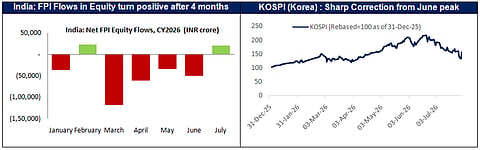
Foreign portfolio investors turned net buyers of Indian equities in July-26, at Rs 20,200 crore (USD 2.1bn), after four consecutive months of selling that peaked at Rs 1,17,775 crore (USD 12.8bn) in March-26. Various factors have played a part here in what could be called early signs of recovery in FPI flows.

Sponsored Content
Advertisement
What’s the Point?
FPIs turned net buyers of Indian equities in July-26, at ~Rs 20,000 crore (~USD 2bn), after four months of selling that peaked at Rs 1,17,775 crore (USD 12.9bn) in March-26.
Korea and Taiwan have seen elevated volatility recently, with foreign outflows of about USD 100bn and USD 40bn respectively so far in CY26 (upto 31-Jul-26), with their indices correcting ~30% and 10% from their June peaks.
Some of the key factors responsible for India’s earlier outflows have changed recently
Foreign portfolio investors turned net buyers of Indian equities in July-26, at Rs 20,200 crore (USD 2.1bn), after four consecutive months of selling that peaked at Rs 1,17,775 crore (USD 12.8bn) in March-26. Various factors have played a part here in what could be called early signs of recovery in FPI flows. Crude prices down from their April-26 peak of near USD 120 (although still above pre-war levels), a correction in equity valuations that had turned stretched, pick-up in IPOs and a steadier Rupee have collectively helped July-26 FPI flow numbers. On the other hand, Korea and Taiwan have seen elevated volatility recently, with FPI outflows of about USD 100bn and USD 40bn respectively so far in CY26 (upto 31-Jul-26), with their indices correcting ~30 per cent (KOSPI) and ~10% per cent (TAIEX) from their June-26 peaks. From India’s perspective, while it is too early to say if FPI flows into India are seeing a sustained turn, it is worth taking a closer look at factors which triggered FPI outflows in the first place.
Advertisement
How are the factors that triggered FPI outflows from India poised now?
As of 31-Mar-2026, FPIs held 16% of Indian Equities versus 21% as of 31-Mar-2016, after continuous FPI outflows over the past few years. Few of the key factors responsible for FPI outflows are witnessing a change now.
Currency: INR depreciated from ~ Rs 85 in Mar-25 to ~ Rs 97 in May-26 against USD. This impacted dollar-denominated returns for foreign investors and reduced the attractiveness of Indian equities. A series of measures undertaken by the RBI and the government, including subsidising the hedging cost on fresh FCNR(B) deposits, easing ECB norms, and removing capital-gains and withholding tax on FPI investment in G-Secs, have helped stabilise the rupee.
Valuation: After a sharp run-up in Indian equities up to Sep-24, valuations had turned expensive. With a correction over the past few years, in both time and price, valuations are closer to fair value, with the Nifty trading at a 1% discountto its 10-Year average (As of 31-Jul-26) vis-à-vis a 14% premium it traded at as on30-Sep-24.
AI trade: India has negligible direct revenue exposure to the AI theme vis-à-vis other EM peers. Valuations and expectations built up in AI-linked names had run ahead of fundamentals, leaving a thin margin of safety. Recently, with the theme’s exuberance showing signs of cooling, India could once again gain mindshare among foreign investors.
Oil: With the Middle East conflict still to be resolved, Oil continues to remain a key monitorable. Elevated Oil prices have weighed on foreign investors’ sentiment on India owing to India’s dependency on the Middle East for its energy imports. Crude oil prices though have come down from USD 100+ levels seen in March-April this year.
Advertisement
India’s Growth Backdrop Remains Supportive
India’s domestic activity indicators point to healthy momentum. GST collections rose 15.4 per cent year-on-year in July to Rs 2.11 lakh crore (the fastest pace in 14 months), with April-July collections up 10.1 per cent year-on-year. Auto sales have been strong too, with passenger vehicle dispatches up 34% year-on-year in July, aided by lower repo rates, income tax relief and GST rationalisation. Monsoon has recovered from a weak start, with the season deficit narrowing from around 40% as of30-June-26 to roughly 10% as of 31-Jul-26, although regional disparity persists.Alongside this, India’s equity market is diversified, with sizeable weightage for financials, consumption, industrials and healthcare, and has a mix of old-industry and new-age tech companies. That breadth, together with a deepening domestic investor base, has meant Indian equities have absorbed this foreign selling without sharp single-day moves. The Nifty 50 has not had a 5 per cent-plus single session move this year and has in fact recorded only one such session in the last three years, even as India saw Rs 2,54,072 crore of net FPI outflows in CY26(Upto 31-Jul-2026). SIP contributions have been above Rs 30,000 Crore for 4 months in a row amidst global volatility, up from Rs ~Rs 3,000 Crore 10 years ago (Jun-16). Domestic ownership in Indian equities is now higher than foreign ownership. As of March 2026, DIIs owned about 20%of Indian listed equities against 16% held by FPIs. In March 2016, it was the other way around, with DIIs at around 12% and FPIs at 21%.
Advertisement
Bottom line
FPI flows into India turned positive in July after 4 months. Some of the factors that had triggered the selling viz. a weakening rupee, stretched valuations, the pull of the AI trade and elevated oil prices are now turning relativelyfavourable. At the same time, India’s diversified market structure, growth potential and the growing share of domestic ownership could mean that India continues to present a viable investment opportunity for investors going forward.
Sources: NSDL, AMFI,Bloomberg
Disclaimer: Views expressed herein are based on information available in publicly accessible media, involve known and unknown risks and uncertainties that could cause actual results, performance, or events to differ materially from those expressed or implied herein. The information herein is for general purposes only. Stocks/Sectors/Views referred are illustrative and should not be construed as an investment advice or a research report or a recommendation by HDFC Mutual Fund (“the Fund”) / HDFC Asset Management Company Limited (HDFC AMC) to buy or sell the stock or any other security. HDFC AMC is not indicating or guaranteeing returns on any investments. Past performance may or may not be sustained in the future and is not a guarantee of any future returns. The recipient(s), before taking any decision, should make their own investigation and seek appropriate professional advice.
Advertisement
MUTUAL FUND INVESTMENTS ARE SUBJECT TO MARKET RISKS, READ ALL SCHEME RELATED DOCUMENTS CAREFULLY.
Show comments
Published At:
Tags