For immovable property sold on or after July 23, 2024, long-term gains are taxed at 12.5 per cent without indexation, provided the holding period exceeds 24 months.
Long-term gains on physical gold and other physical assets held for more than 24 months are taxed at 12.5 per cent without indexation.
Short-term losses can be set off against both short-term and long-term gains. Long-term losses can only be set off against long-term gains.
Capital Gains Tax Explained: How Different Investments Are Taxed
Capital gains tax varies sharply across equity, property, debt funds, gold and other assets, with holding period, indexation benefits and recent tax changes determining how much of your profit ultimately goes to the tax department.

Summary
Advertisement
Selling an investment at a profit triggers a capital gain. How much tax that gain attracts depends on two things - what you sold and how long you held it. The rates are not the same across asset classes. They changed in 2024 and again in 2026. Here is where each category stands today
Equity Shares And Equity Mutual Funds
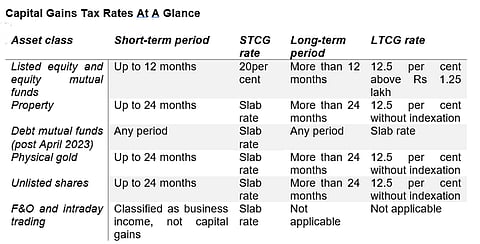
The Budget 2026 raised the short-term capital gains tax on listed equity shares and equity-oriented mutual funds from 15 per cent to 20 per cent under Section 87 of the Income Tax Act, 2025 (previously Section 111A of the Income Tax Act, 1961). Short-term means held for 12 months or less.
Long-term gains on these assets, held for more than 12 months, are taxed at 12.5 per cent under Section 90 of the Income Tax Act, 2025 (previously Section 112A). The annual exemption on long-term equity gains stands at Rs 1.25 lakh per financial year. Gains up to that limit are tax-free. Gains above it are taxed at 12.5 per cent without indexation.
Advertisement
Property And Real Estate
For immovable property sold on or after July 23, 2024, long-term gains are taxed at 12.5 per cent without indexation, provided the holding period exceeds 24 months. “For property bought before July 23, 2024, taxpayers can choose between 12.5 per cent without indexation or 20 per cent with indexation. In most cases, where the property was held for several years, the 20 per cent with the indexation route works out lower. Short-term gains on property, where the holding is 24 months or less, are taxed at the individual's applicable slab rate,” says Parag Jain, Tax Head at 1 Finance, a personal finance platform.

Debt Mutual Funds
Debt mutual funds, where more than 65 per cent of assets sit in debt and money market instruments, lost their long-term capital gains treatment entirely from April 1, 2023. Gains are now taxed at slab rates regardless of how long the units are held. Units bought before April 1, 2023, continue under the earlier holding-period rules.
Advertisement
Gold And Physical Assets
Long-term gains on physical gold and other physical assets held for more than 24 months are taxed at 12.5 per cent without indexation. “Short-term gains are taxed at slab rates. Sovereign gold bonds held to maturity by original subscribers remain fully exempt. Those bought from the secondary market are taxed as capital gains based on the holding period,” says Jain.
What Investors Frequently Get Wrong
The Rs 1.25 lakh LTCG exemption on equity is a per-year limit, not a per-transaction one. An investor who books profits across ten different stocks in a year gets a Rs 1.25 lakh exemption across all of them combined.
“Section 80C investments do not reduce capital gains tax. The tax is computed on the gain itself, not on total income after deductions. Many investors assume their tax-saving investments will offset capital gains liability. They will not,” informs Jain.
Capital losses follow a specific set of rules. Short-term losses can be set off against both short-term and long-term gains. Long-term losses can only be set off against long-term gains. F&O losses cannot be set off against capital gains at all, since F&O income is classified as business income.
Advertisement
Show comments
Published At:
Tags