Indians are shifting money from savings accounts to higher-yielding fixed deposits.
It pushed the overall bank deposits up by 11.5 per cent as of March 2026, RBI data shows.
The share of savings deposits has fallen while term deposits climbed to 61.6 per cent of the overall deposits.
Indians Move Savings To FDs, Large Deposits In Demand, Senior Citizens' Share Remains Steady: RBI Report
Indians are moving their money from savings accounts to fixed deposits. While the overall deposits grew 11.5 per cent over the year as of March 2026, deposits in FDs grew, and in savings bank accounts reduced

Summary
Advertisement
Fixed deposits (FDs) are becoming the favourites again for Indians. Savers are moving their money from savings bank accounts to the FDs with banks. According to the Reserve Bank of India (RBI) data, while the overall deposit growth has accelerated, it also shows that deposits have shifted from the liquid savings accounts to the higher-yielding term deposits.
The latest Annual Basic Statistical Return report by RBI shows growth of 11.5 per cent in the scheduled commercial banks’ (SCBs) deposits at the end of March 2026. Compared to this, the deposit growth at the end of March 2025 stood at 10.6 per cent. This indicates a 0.90 basis points (bps) overall growth year-over-year (YoY). Notably, this upward trend is not limited to the bank branches in urban centres but also across rural areas and metropolitan hubs.

Money Moving From Savings To Fixed Deposits
The report also reveals the deposit trend since 2020, and shows a steady decline in the share of savings bank deposits in the overall deposits. Over the last five years, the savings deposits dropped from 34.6 per cent in 2022 to 28.7 per cent in March 2026.
Advertisement
In their place, the fixed deposits, which typically offer higher interest rates, have increased. The share of term deposits increased from 55.2 per cent in March 2022 to 61.6 per cent in March 2026. This indicates that depositors are increasingly prioritising returns over quick liquidity.
Public Sector Banks Adding New Money
The report shows that public sector banks remained the primary engine when it comes to adding new money to the system. They contributed 50.8 per cent of all incremental deposits, whereas private sector banks contributed 38.6 per cent. The regional rural banks’ (RRBs) share in deposit mobilisation remained moderate with 2.9 per cent at the end of March 2026.
Higher Value FDs Gaining Ground
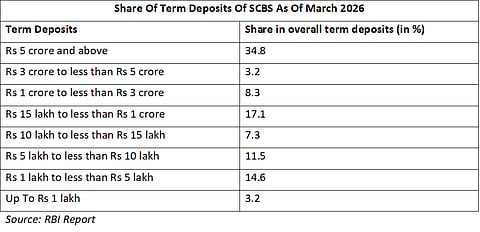
Moreover, within the term deposit category, the Rs 1 crore and above value FDs now account for 46.3 per cent of the total. Of this, the Rs 5 crore and above value FDs alone make up the highest (34. 8 per cent), followed by Rs 1 crore to less than Rs 3 crore FDs (8.3 per cent), and Rs 3 crore to less than Rs 5 crore) of the total term deposits. The data clearly indicate the growing number of large-scale depositors, financial awareness among depositors, and a preference for higher interest.
Advertisement
Household Sector Remains The Primary Contributor
As per the report, the household sector remains the bedrock of the Indian banking system. Despite their gradually moderating share in the deposits, they contributed 59.3 per cent of the total deposits as of March 2026.
‘One To Three Years’ FD Is The Preferred Choice
As per the report, the depositors are showing a preference for medium-term commitments. Of the various FD tenures, the FDs with maturity of ‘one to three years’ rose sharply over the years, from 50.4 per cent in March 2022 to 69.8 per cent in March 2026. The short-term deposits (less than one year) are no longer attractive to savers. As per the report, these deposits have declined from 16.7 per cent to 8.8 per cent during the same period.

Amid the changing interest rate scenario, the share of ‘less than 7 per cent’ interest rate FDs has risen to 61.8 per cent of the total compared to just 27.3 per cent in the previous year.
Advertisement
Senior Citizens Like Stability
Senior citizens' investment in FDs remained steady over the last four years and stood at around 20 per cent in March 2026. Their share has hovered between 19.8 per cent and 20.2 per cent over the last four consecutive years.
FAQs
What is the overall growth rate of bank deposits in the financial year 2025-26?
The overall growth in deposits with Scheduled Commercial Banks stood at 11.5 per cent as of end-March 2026, compared to 10.6 per cent the previous year.
Which sector contributes the highest to the total deposits in Indian banks?
The household sector remains the largest contributor. It contributed 59.3 per cent of total deposits as of March 2026.
Which FD tenure is the most popular?
According to the RBI report, 'one to three years' FD maturity is the most popular, accounting for 69.8 per cent of all term deposits in March 2026.
Show comments
Published At: