UPI payments for consumers will not attract transaction charges.
Future MDR may cover select merchant transactions above thresholds.
Person-to-person UPI payments will stay free under proposed framework.
UPI Transactions To Stay Free For Consumers, Government Clarifies
The Centre clarified that consumers will not have to pay UPI charges, while any future merchant fee would cover only select transactions above a threshold

Summary
Advertisement
Consumers will not have to pay for using the Unified Payments Interface (UPI), and most merchant transactions will also remain free, the Government of India clarified on August 9.
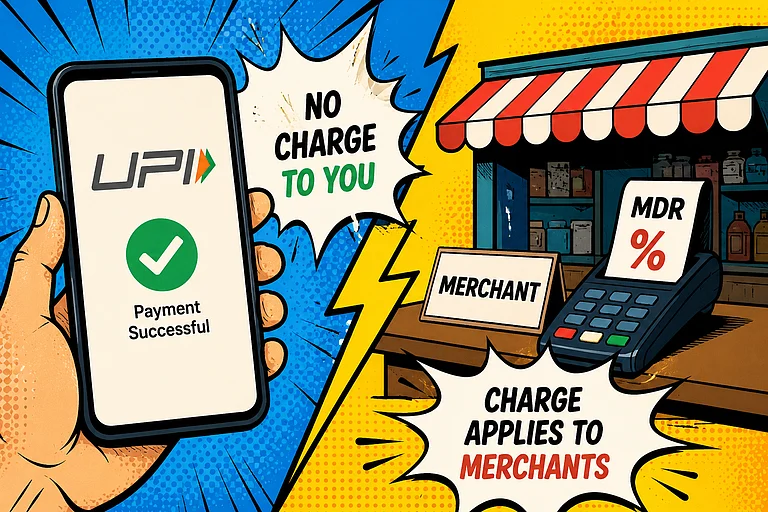
If a merchant discount rate (MDR) is introduced in the future, it will apply only to a limited category of merchant payments above a specified threshold according to the clarification . The rate will also be lower than the usual MDR on debit and credit card transactions.
According to a recent social media post on X by the Ministry of Finance, person-to-person (P2P) UPI payments will not attract any charges. The Centre has also clarified that the proposed amendment to Section 10A of the Payment and Settlement Systems Act, 2007, does not itself introduce an MDR on UPI payments.
Charges To Be Limited To Select Merchant Payments
The clarification follows questions over changes proposed to the Payment and Settlement Systems Act and whether they could result in charges for UPI users. The Taxation and Other Laws (Amendment) Bill, 2026, has already been passed by the Lok Sabha. If it is cleared in the Parliament, the UPI and Services Steering Committee, headed by the National Payments Corporation of India (NPCI), will take a call on the MDR, if any.
Advertisement
Any such charge will be linked to a transaction threshold and will not apply across the UPI network. Most merchant payments will therefore have no MDR.
Government Points To Infrastructure Costs
The government has linked the proposed framework to the rising cost of running and upgrading the UPI network. Higher transaction volumes require regular spending on cybersecurity, fraud prevention and payment infrastructure.
It has also flagged the limits of depending solely on subsidies to fund the next phase of UPI's expansion. A revenue model could give payment companies greater scope to expand and compete in the market.
The government also rejected claims that external pressure prompted the proposed changes, calling such claims false and misleading. UPI was launched in 2016-17 and has been free for citizens and merchants since January 2020.
UPI Processes Rs 29.9 Lakh Crore In July
UPI has processed over 23 billion transactions worth Rs 29.9 lakh crore in July 2026 itself. The payment system is now available in 11 foreign countries, including Singapore, UAE, France, Mauritius, Nepal, Bhutan, Qatar, Sri Lanka, Cambodia, Greece, and Malaysia.
Advertisement
The Centre also highlighted that UPI will remain free for citizens and that the proposed framework is intended to support the long-term financial sustainability of the payment network.
Citizens have been advised to check information from the Ministry of Finance, the Reserve Bank of India (RBI) and NPCI before sharing messages about possible UPI charges.
Show comments
Published At:
Tags