Traders are reducing leverage on Bitcoin and crypto after market crashes.
Derivatives tied to traditional financial assets are gaining increased market adoption.
Economic uncertainty and delayed regulations continue to weigh on market sentiment.
Crypto Traders Turn To Other Assets As Leverage In Bitcoin Bets Declines
Crypto traders are reducing leveraged bets on Bitcoin and other tokens, while derivatives markets are increasingly offering exposure to traditional financial assets

Summary
Advertisement
Cryptocurrency derivatives markets are seeing a change in trading activity with leveraged positions in Bitcoin, Ethereum and smaller tokens declining while contracts linked to traditional financial assets are gaining ground.
Crypto leverage trading allows traders to control positions larger than the margin they deposit, thereby boosting potential gains and losses. Perpetual futures are derivative contracts without a fixed expiry date that provide leveraged exposure to an asset’s price.
According to Bloomberg, Bitcoin perpetual futures have lost around $8 billion in open interest, while Ethereum contracts have shed approximately $5 billion and smaller tokens another $10 billion. The growth in contracts linked to traditional assets has only partly offset the decline in crypto-native positions.
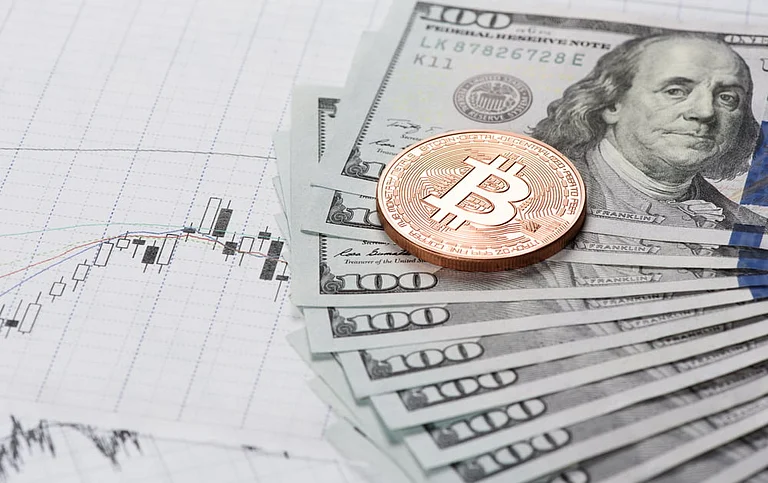
Crypto Leverage Remains Below Last Year’s Level
The shift comes after the October 10, 2025, market crash, when around $19 billion worth of leveraged positions in the perpetual futures market were wiped out within 24 hours. The event was one of the largest deleveraging episodes in crypto market history.
Advertisement
Leverage remained subdued even as cryptocurrency prices recovered from August 2026 onwards.Traders continued to contend with higher interest rates, geopolitical risks, and uncertainty surrounding US crypto legislation. Bitcoin was trading at $82,680, up 0.87 per cent over the previous 24 hours, as on October 21, 2026, at the time of writing.
Despite lower overall open interest, the composition of the market has changed considerably, according to Samar Sen, head of international markets at Talos. Yuan Rong Tan, head of asset-liability management at QCP, described the market as being in a stalemate. He cited interest rates, delays surrounding the CLARITY Act, and Middle East risks as factors weighing on prices, while exchange-traded fund (ETF) demand and risk appetite continued to provide support.
Perpetual Futures Expand Beyond Crypto Assets
The changing mix of contracts points to crypto-native trading infrastructure being used increasingly to gain exposure to traditional financial assets. However, the growth in these contracts has not fully compensated for the decline in open interest across Bitcoin, Ethereum and smaller tokens, the report added.
Advertisement
Sen said the boundaries between traditional and digital asset markets were becoming less distinct, adding that assets beyond cryptocurrencies could contribute to the next phase of growth. The shift comes amid years of institutional adoption and closer links between digital assets and the stock market, which have made cryptocurrencies more accessible to mainstream investors.
Show comments
Published At: