Metal stocks climbed on hopes of US Fed rate cuts, stronger demand outlook, and supply disruption concerns
Gold and Silver prices touched new record highs on MCX
Copper prices hit its all-time high in global markets
Tin futures rallied more than 5 per cent on London Metal Exchange
Metal Stocks Extend Gains For Third Consecutive Day Amid Rising Global Prices
Metal stocks rallied up to 6.60 per cent in today’s session amid firm global metal prices and supply disruptions in key mining regions

Summary
Advertisement
Metal stocks rallied up to 6.60 per cent on January 14, 2026, extending gains for the third straight session in an otherwise muted market. The Nifty Metal index, which tracks 15 of the most valuable and actively-traded stocks from the sector, rose by as much as 3.20 per cent today.
From the index, the state-owned Hindustan Copper rallied by 6.50 per cent to Rs 574.35 apiece on the NSE. Vedanta stock rallied 6.63 per cent to hit its new all-time high of Rs 679.45 per share. National Aluminium Company (NALCO) also rose as much as 4.72 per cent to touch its life-time high. Hindustan Zinc, a subsidiary of Vedanta, too, contributed to the rally, rising up by 6.52 per cent to Rs 670.95 per share.
Other metal stocks such as Tata Steel, Steel Authority of India, Jindal Stainless Steel, NMDC and Hindalco also rallied between 2 per cent and 4 per cent.
Advertisement
Why Metal Stocks Gained On Jan 14?
Metal stocks extended their gains, tracking firm global metal prices, as optimism over demand prospects and concerns around supply disruptions in key mining regions rose.
Meanwhile, the US inflation data offered some relief to the markets. The consumer price index (CPI) rose 0.30 per cent month-on-month (m-o-m) in December on account of higher shelter costs and food prices. The overall inflation reading, however, came in below expectations, according to a Reuters report.
The softer inflation print has strengthened the market’s conviction that the US Federal Reserve (Fed) could pivot towards rate cuts later in the year.
According to Chicago Mercantile Exchange’s (CME’s) FedWatch, there is a 97.20 per cent probability that the US Fed will leave rates unchanged at its upcoming meeting on January 28 and only 2.80 per cent probability that the Fed will cut rates by 25 basis points (bps) to the 3.25-3.50 per cent range.
Advertisement
At present, the key interest rate is in the range of 3.50-3.75 per cent. However, this probability increases to 26.80 per cent in the March meeting, and to 34.40 per cent in the April meet. June and July meets shows a probability of 47.90 per cent and 41.90 per cent, respectively, of a 25 bps cut.
The rising US Fed rate cut bets have strengthened the case for base metals, such as copper, aluminium and tin.
At the same time, demand for precious metals are also being supported by geopolitical uncertainties, including the ongoing protests in Iran, the US capture of Venezuela’s President Nicolas Maduro, the Russia–Ukraine conflict, among several other macroeconomic uncertainty.
In addition to these macro drivers, central banks across the globe are continuing with their gold buying spree, and silver is seeing rising industrial demand from sectors, such as solar energy, electric vehicles, artificial intelligence (AI)-related infrastructure and electronics.
Advertisement
Vaqarjaved Khan, CFA, senior fundamental analyst at Angel One said: “Metal stocks are up today primarily on the back of stronger commodity price signals and improved risk appetite in global markets. A combination of higher base metal prices internationally, easing concerns around global growth, and sustained domestic infrastructure momentum has lifted sentiment. Additionally, expectations of stable or lower interest rates ahead are supporting cyclicals, where metals benefit from positive demand outlook and improved balance sheets. Overall, the move reflects a mix of sector-specific fundamentals and broader market risk-on positioning.”
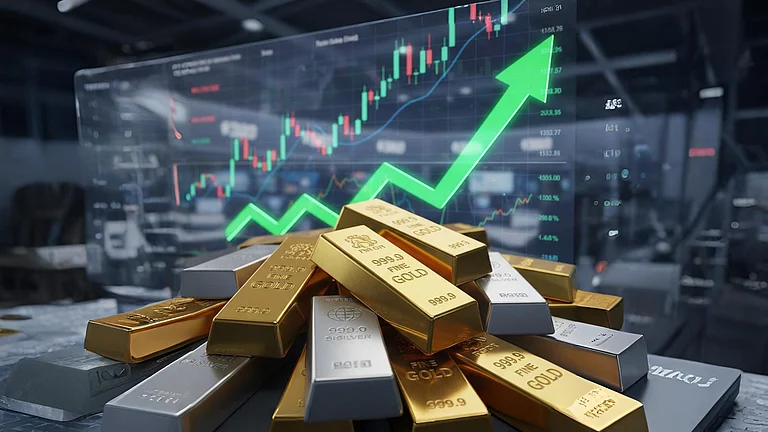
Gold and Silver Prices At Record High
Gold and Silver prices touched new record highs today after rising hopes of a US Fed rate cut. At the time of writing, February Gold futures rose as much as 0.88 per cent to its fresh lifetime high of Rs 1,43,500 per 10 grams on the Multi Commodity Exchange (MCX). The March Silver futures on the MCX also jumped as much as 4.65 per cent to its all-time high of Rs 2,87,990 per kilogram.
Advertisement
In the international markets, February Gold futures on the CME jumped more than 1 per cent to a record high of $4,647.60 per ounce, and CME March Silver futures zoomed up to 5.82 per cent to an all-time high of $91.37 per ounce.
Copper Prices Hit Lifetime High
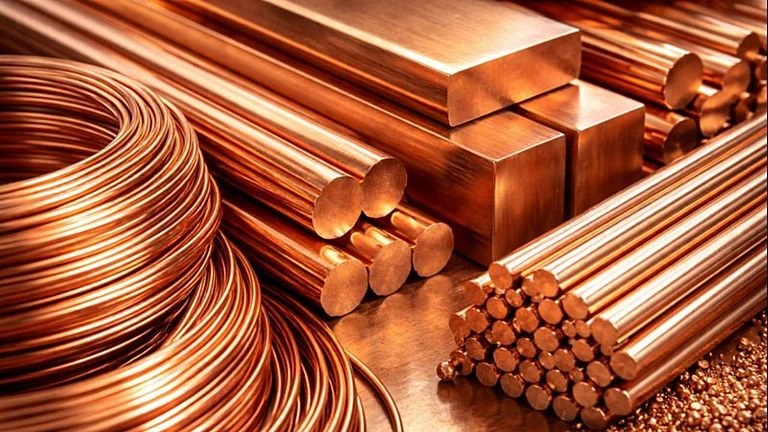
Copper prices are rising, as markets factor in tighter supply conditions due to production disruptions at major mines, declining ore grades, and delays in new capacity, which have raised concerns over its availability, thereby lending support to the reddish-brown metal’s prices.
Consumption demand from electric vehicles, renewable energy projects, power grid expansion and data centres are also lending support to copper’s price.
January Copper futures on the MCX rose 1.64 per cent to Rs 1,331 per kilogram, while on the CME, March Copper futures advanced by 2.30 per cent to hit its lifetime high at $6.15 per ounce.
Advertisement
Tin and Aluminium Prices Soar
January aluminium futures on the MCX rose by around half a per cent to Rs 320 per kilogram, hovering near its record highs. Aluminium prices have climbed more than 27 per cent since the end of August, led by tight global supply conditions. Production curbs in China and operational issues at smelters, such as Mozambique’s Mozal, and rising demand from the green energy and electric vehicle sectors, have led to a rally in aluminium prices.
On the London Metal Exchange (LME), Tin futures surged more than 5 per cent to $47,870 per tonne. Tin prices have been gaining due to supply disruptions in key producing countries, such as Myanmar and Indonesia. Further, industrial demand is also strong from electronics manufacturing, AI applications and renewable energy projects.
Show comments
Published At:
Tags