Indian consumers sold fifty tonnes of old gold recently.
Industry experts call the retail price panic premature.
Strong global institutional demand keeps gold outlook bullish.
Panic Or Profit-Booking? Indian Households Rush To Liquidate Gold As Prices Cool from Peaks
For the average investor who has gold in their portfolio, this correction creates panic after having witnessed the sharp rise in gold prices last year

Summary
Advertisement
Gold has a traditional, sentimental and strong economic value in India. For generations, the yellow metal has been held as a ‘lifetime asset’ which is only meant to be liquidated in the most dire circumstances or ideally passed on to the next generations. However, these notions are shifting as the price of gold corrects from historic highs.
Investors are fearing that gold’s stellar run might be nearing an unexpected close. Amid the fears, households across India are unlocking their safes and rushing to jewellery counters to liquidate or exchange their holdings before valuations slide any further.
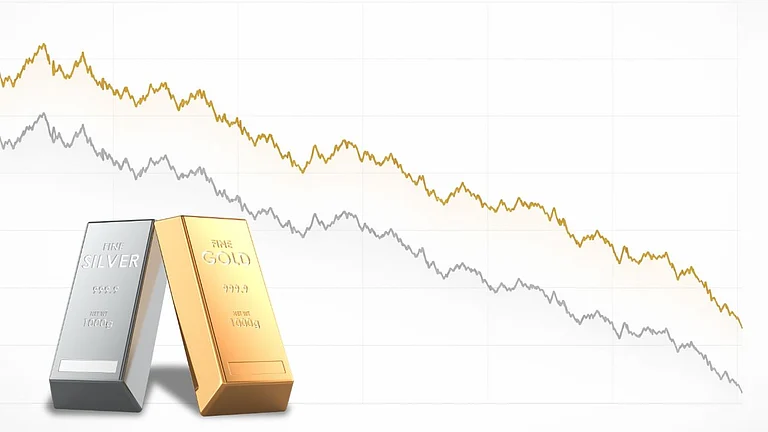
Notably, physical gold prices have corrected nearly 18 per cent from their record highs achieved earlier this year as they currently trade around the Rs 1,40,130 per 10-gram mark. On the Multi Commodity Exchange, the drop looks steeper as Gold Futures with August 5 expiry traded around the Rs 1,41,144 per 10-gram mark, down nearly 31 per cent from a record high level of Rs 2,04,375 per 10 grams achieved earlier this year.
Advertisement
For the average investor who has gold in their portfolio, this correction creates panic after having witnessed the sharp rise in gold prices last year. The correction has also spurred fear among investors about prices sliding further, with some investors anticipating a major price crash. The net effect of this shift has transitioned the perpetual gold holders into aggressive sellers seeking to make the most of their holdings.

The 50-Ton Surge: Breaking Down the Numbers
According to the India Bullion & Jewellers Association (IBJA), consumers have sold nearly 50 tonnes of old gold during the April-June quarter, marking a massive 43 per cent increase from a year earlier. Prithviraj Kothari, Managing Director at RiddiSiddhi Bullions Ltd. (RSBL) and the National President of IBJA, confirmed that a highly measurable spike in gold selling is underway across the country.
Kothari told Outlook Money that while changing sentiments are driving the rising scrap gold inflows, the re-selling of gold lacks the characteristics of economic desperation.
Advertisement
"Yes, a measurable spike in scrap gold inflows is firmly underway, driven primarily by retail fears of further price drops from the current Rs 1.4 lakh per 10 grams level. However, it is absolutely vital to understand that this remains well below distress-sale thresholds," Kothari said.
Kothari highlighted the psychological nature of this market movement and clarified that the liquidations are a panic response to volatility in gold prices rather than financial duress.
"This is a panic-driven scare regarding price volatility, not a sign of financial distress among Indian households," Kothari said.
Data from the World Gold Council (WGC) for the first quarter of 2026 also supports the elevated recycling or reselling of gold. India witnessed net recycling of 31.2 tonnes in the first quarter of 2026, increasing 20 per cent year-on-year and 44 per cent quarter-on-quarter.
While this jump seems alarming, the phenomenon is largely a base-effect recovery from a relatively weak first quarter in 2025. Kothari outlined that despite the big percentages, the absolute volume hitting the market remains minuscule compared to the country's total hoard of physical gold.
Advertisement
"In 2025, recycled gold contributed between 125 and 150 tonnes to the market. Our projections indicate that if current trends continue, this could rise to 200–250 tonnes in 2026. But even if we hit those higher numbers, this liquidation is minor when viewed against the macro picture; it is still entirely marginal against India's estimated 30,000-tonne household gold stock," Kothari said.
Additionally, the data shows that consumers are optimising value rather than abandoning gold as an asset entirely. Exchange activity at retail outlets remains elevated, demonstrating that households are upgrading rather than pocketing the cash.
"We are seeing some retailers report that over 40 per cent of their current jewellery sales are being driven entirely by old gold exchanges. This clearly indicates that consumers prefer value-recycling and upgrading their jewellery assets over outright liquidation. The spike is very real, but it is not historically anomalous at a structural level," Kothari said.
Advertisement
Why the Price Scare Might Be "Premature"
While the rush at retail counters indicates anxiety among gold owners, the underlying macroeconomic indicators which led to the rally in gold prices remain structurally in place. Kothari emphasised that retail investors selling their gold holdings might be reacting to market noise rather than looking at the solid demand coming from major financial institutions.
"The retail fear of a sustained price crash is premature and largely unsupported by institutional fundamentals," Kothari asserts. "While global prices are currently trading near USD 4,037 per ounce—which is well below most year-end targets—the long-term structural floor for gold remains incredibly secure," Kothari said.
To illustrate how unlikely a severe market downturn is, Kothari shares the strict conditions required for a bearish shift to materialise. He added that the possibility of a bear market for gold remains around 20 per cent.
Advertisement
"Global analysts currently assign only a meagre 20 per cent probability to a true bear market scenario where gold drops into the USD 3,800– USD 4,200 range," Kothari points out. For that downward crash to actually manifest, the global economy would need to see an aggressive, hawkish Federal Reserve pivot, sustained global dollar strength, and full geopolitical de-escalation all occurring at the exact same time.
The mathematical probability of all three happening simultaneously is incredibly low," Kothari said.
The Danger of Exiting Too Early
It is likely that the current price correction is a normalisation from previous spike highs rather than a structural breakdown of gold's bull run. For Indian households rushing to cash out their lockers at the Rs 1.4 lakh mark, market leaders warn that reacting to short-term headlines could carry a heavy financial penalty. Kothari warned that selling off gold during a routine cooling period could cause long-term financial regret.
Advertisement
"The current correction reflects a normalisation from the peak highs we saw in January, not a structural breakdown. By succumbing to this panic-driven scare, retail sellers run a very high risk of permanently exiting a long-term bull market at what is likely a cyclical trough, effectively leaving future gains on the table," Kothari said.
Show comments
Published At: