Motorcycling can well be considered the modern successor to horse riding. The rhythm, the speed, the thrill, the connect with nature, are all the same, especially if you are off city roads. Of course, with a motorcycle, you can’t leap across ditches, jump over fences (unless there is a ramp and the bike is designed to do so), or ford across a 3ft shallow stretch of water.
10 Memorable Motorcycling Road Trips In India
A motorcycling road trip could be the ultimate adrenaline rush combining adventure along with relative comfort

Advertisement
The hat has evolved into the helmet, the long leather dusters into riding jackets, and the Colt on the waist into a mobile or satellite phone (where such phones are allowed) or a Swiss Army multi-utility tool. The rider’s personal belongings, instead of hanging on heavy haversacks on the sides or the lap are now neatly balanced on either side of the motorcycle in designated carriers known as saddlebags or tied on the back.
The best part: the horse or the motorcycle does most of the hard work, while you soak in the nature. You feel numb when it’s snowing; dry and itchy in a sandstorm; and wet in rain. You also smell the sweet petrichor as it wafts through the air as the first droplet hits the dry earth.
If you are an avid motorcyclist and are not sure of which trail to hit next and how to plan your trip, we have a guide for you and a list of 10 trails that will blow your mind away.
Advertisement
Skill And Safety First
Just like riding, motorcycling also needs skills. The more powerful the machine (higher cc, greater power and torque), the more skill it will require for you to handle it right. A novice rider will not only endanger himself/herself, but could also turn the machine into a lethal weapon for others on the road. But it’s not just skill, a long ride takes dollops of patience and riding etiquette.
Says Sachin Chavan, an industry veteran, who has spearheaded many rides and other motorcycling community initiatives: “You need common sense and presence of mind while on the road, especially on long rides.”
The dangers on the road are real. Samik Chakraborty, 43, a supply chain professional in the petro-chemical industry based out of Mumbai, who has been on long distance rides to Ladakh, Kutch and a few other places has a word of caution for those planning long rides: “Do not race on the road with fellow riders or locals; do not overspeed or overtake on blind turns.”
Advertisement
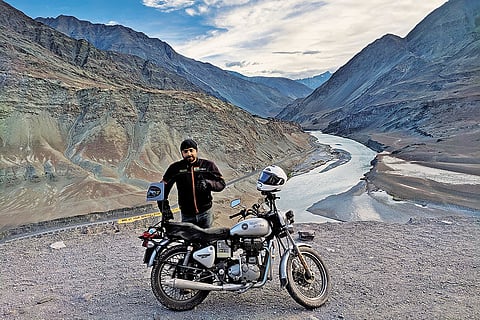
Samik Chakraborty, 43, Mumbai with his motorcycle during his 5,500 km ride from Mumbai to Ladakh in 2018
Overspeeding on turns can lead to a wash out, with the cornering angle too steep to allow for a gentle turn hugging the road. The vehicle slides on the outward curve (in the face of oncoming traffic) or the edge or wall (if it’s a mountain road) to maintain stability or crashes if you brake hard. With extra luggage and weight, handling requires a bit of skill.
According to the Ladakh Traffic Police, the number of motorcycle-related accidents have shown an increase in the Union Territory during the summer season from June-October, when the traffic increases as the landlocked region opens to motorists and motorcyclists who come here in droves.
Planning Comes Next
This is the difference between making your ride enjoyable or agonising. A motorcycling trip requires planning down to the last detail, especially if you are not with an organiser but going with a group of friends or solo. You need to prepare for the unexpected—breakdowns, unplanned stoppages due to weather conditions—and depend on roadside eateries and homestays with bare minimum facilities in the desolate regions. In case you plan to camp, you need to be even more cautious about the weather, the distance from nearest habitation for help, food, water and other safety aspects.
Advertisement
It will, therefore, serve you well if you plan your ride in advance, including taking note of weather and road conditions, the need for permits, accommodation, repair facilities, and mobile connectivity. In many places, you will need to get your permit in advance. Some examples are Turtuk in Ladakh, Tawang in Arunachal Pradesh, Vikhagot in Kutch, Longewala in Rajasthan, Gurudongmar in Sikkim.
Sachin recounts one incident, where an unplanned trip left him stranded. “Many years ago during the Pune monsoons, I decided to go for a short ride which kept becoming longer and longer. I had recently come back from my first Ladakh ride, and my confidence was at its peak.”
He went on a trail which he had done before, but this time, he hadn’t taken the monsoon into account. Says Sachin: “I kept getting stuck and moving forward. It was just a natural ‘get on with it’. Finally, I got stuck—no phone, no wallet, no food, no help and no one around for kilometres. Eventually after a few hours of digging with my bare hands, I was able to get back on the road. My bike and I were in one colour—mud. I had to hose myself down at a friend’s place before returning home. I learnt a lot of lessons that day.”
Advertisement
Experience Matters: Many riders, typically, start with small rides before going on long-distance rides and their first ride is often unplanned, which serves as a classic blueprint of how a ride should be planned and what should not be done on a ride.
Says Samik: “One evening in 2001, my three roommates and I decided to go to Ooty from our college in Manipal. Everything went fine until we reached Mangalore (60 km away), when fatigue set in. We had not anticipated this. But we carried forward and completed our trip.” But it was the Goa ride in January 2014 that taught him and his friends how to plan a ride. “We took 20 hours to reach Mumbai from Goa, which should otherwise take 10-12 hours. We started at the wrong time, did not have proper winter wear and were ill-prepared for the cold weather. We were not even carrying proper tools.”
Advertisement
These experiences helped him hone his planning skills and he was much better prepared when he planned the long haul from Mumbai to Ladakh and back, a staggering 5,500 km run, in 2018.
Mechanic Skills Help: Having some basic mechanic skills comes handy. You may need to change a broken clutch wire, fix a puncture, and so on. But simply knowing won’t help. You must practise beforehand so that you don’t panic when you get stuck. Familiarity with tools will help. Your tool kit will only add to the load, so carry only what you require and what you know how to use. In a group ride, you can also share equipment, such as air pump or wrenches, spanners, and so on.
Get The Right Machine
Any outdoorsman will tell you that in a survival situation in the wilderness, the best knife is the one you have on you, and not necessarily the one built to hack your way out of the woods.
Advertisement
The same goes for motorcycles. Technically, any motorcycle will take you from point A to point B. However, it is advisable you get a machine with a minimum of 350-500 cc, if not more. They come with better power, torque, offer more stability and have better endurance.
Says Sachin: “The 400cc-40bhp mark is a sweet stop. The machine needs to be safe, and haul your luggage and/or pillion. Adventure bikes are best for touring since they allow for a relaxed riding posture and provision to carry luggage. They also have larger fuel tank capacity and are generally built stronger to take the knocks, and have a longer suspension for comfort. If you can afford, the new mid-size (800-900 cc) adventure bikes are the best suited for India. They would require a bit more skill and fuel, but the feeling is amazing.”
Samik too graduated from a 100 cc Bajaj KB 100 he took on his first trip to a Royal Enfield 350 in 2013 and then to an RE Himalayan 450 in September 2025, which he now rides.
Advertisement
Prepping Is Essential: Get your machine serviced ideally 2-3 days before the ride and take it out for a 100-150 km ride within the city or nearby. It will help you locate and rectify any problems, such as those related to the brakes, timing, throttle, wiring, lights, suspension, and so on. On the road, mechanic availability could be next to nil, and a breakdown can cause delay and add to the cost, including for hauling it to the nearest service station, which could be far away in the remote stretches.
If the tyres are worn, bald or show signs of crack or have many punctures, replace them. The same goes for the tube. Carry a spare tube for tube tyres, and other essentials (see Rider’s Essentials).
Know The Cost
Motorcycling is an expensive hobby, but it typically involves a one-time capital expenditure; the recurring costs are minimal. Your motorcycle will be the most expensive equipment but, if maintained well, can serve you for 10-15 years.
Advertisement
A 350 cc RE Classic will cost up to Rs 2.15 lakh, the RE Himalayan 450 about Rs 3.05 lakh, the KTM 390 Adventure Rs 3.95 lakh, and the KTM 890 Adventure about Rs 15.80 lakh (all ex-showroom, Delhi prices).
Use plastic money and digital payments for food and fuel in urban areas. It’s better to save cash for food and stay in remote locations.
You can rent bikes too, but do note that tourist associations in many places do not allow rental motorcycles from other states for sightseeing. So, for a trip to Ladakh, you can ride your rental motorcycle from Delhi or Manali to Leh, but you will have to again rent one in Ladakh, unless the agency in Delhi or Manali arranges one for you in Leh. In such a scenario, you may end up paying rentals for two motorcycles. Instead, it may be better to fly into Leh and then hire a motorcycle there for exploring Ladakh. In addition, the rental agency will typically ask you to deposit a copy of your Aadhaar.
Advertisement
For long duration rentals, you may also need to pay a security deposit. Says Deachen Angmo, who runs a tour and bike rental agency in Leh by the name of Wildyak: “For a 4-5 day trip, we take a refundable security deposit of Rs 2,000. The rentals are typically around Rs 1,200-1,800 per day depending on the type of motorcycle you are renting.”
However, you will have to bear the cost for any damage to the motorcycle arising out of an accident.
The major advantage of using your own motorcycle for a road trip is the familiarity and handling ease that your machine will provide which a rental will not offer. Besides, even if your trip gets extended due to some unforeseen circumstances, you won’t be in a rush to reach back in time to avoid missing your train or flight. You can manage your ride at your own rhythm on your own bike.
You will also spend on personal gear (see Rider’s Essentials), but these are one-time investments.
Beyond that, there’s the cost of servicing, fuel, food and stay, of which fuel will be the most expensive. Samik’s 2,800 km long 10-day ride from Mumbai to Rann of Kutch and back in 2025 cost him Rs 12,000 for fuel, Rs 1,000 per night for stay and Rs 500-700 per day on food. He spent a total of Rs 28,000.
You also need to budget for your fuel cost in advance. If your motorcycle gives a mileage of 33-35 km per litre, take the average around 30 kmpl while planning your trip. We have also taken an average of 30kmpl while calculating the fuel cost for the destinations in the following pages. Also note that since you will be gaining height while riding to high altitudes, you will get acclimatised.
The essence of a motorcycle road trip is that both the rider and the machine should return home in the same condition in which they left, barring a few broken wires, fused bulbs or nicks, tanning and dry cuticles. Ride safe!
Things To Carry
Vehicle Documents: Registration Certificate, Vehicle Insurance, Pollution Certificate
Personal Documents: Driving Licence, Aadhaar, PAN, Voter ID, Passport
Others: Permits and Environmental Fee (will be required in places, such as Ladakh, Arunachal Pradesh, Sikkim, and border areas in Rajasthan, Gujarat, etc)
Insurance: Get an accidental insurance policy for yourself specifying you are going for a motorcycle tour. You may also consider a specialised travel insurance policy (see Page 30)
Ride Safe
Don’t ride or overtake in tandem, don’t tailgate, maintain distance.
In slush or mud, avoid riding on half clutch. Shift to a lower gear and push with your feet.
On hills, give way to uphill traffic.
Shift to a lower gear before climbing uphill to avoid stalling.
Deflate tyre pressure for better traction on snow and sand. Don't brake hard on glazed ice.
While crossing streams, gauge the depth and current beforehand. Keep rev high and do not change gears midway. If vehicle stalls, do not start. Pull it out of the water and then start.
Brakes (both disc and drum) will lose friction and stopping power after crossing through water channels. Press brakes repeatedly to generate heat and evaporate the water film clinging to the disc/drum to restore braking power. Use engine braking and keep speed low to reduce reliance on wet brakes till brakes before effective again.
Tip: Planning includes prepping the machine, getting the right gear, planning the route, including stays, permits and so on, where needed.
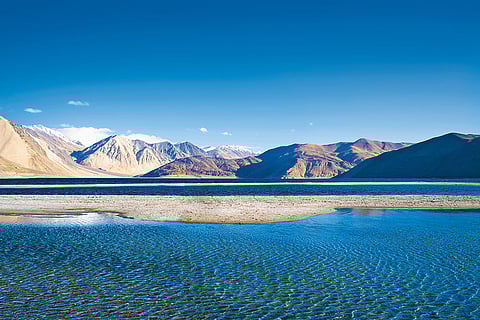
Pagong Tso lake in Ladakh
Ladakh
High passes, crystal blue lakes and rivers, 21 loops, a 40 km long flat plain and old monasteries will make the ride worthwhile
Mountain Passes: Ride to Manali on Day one. Next day, take the Atal Tunnel to bypass Rothang La (13,050 ft), across Baralacha La (16,500 ft) to Sarchu. The scenic ride will take you across the green valley of Manali to the dry trans-Himalayas of Lahaul valley. Day three will be a memorable ride. You will wind your way through 21 bends at Gata, cross three passes—Nakee La (15,547 ft), Lachung La (16,619 ft), Taglang La (17,480 ft), and a 40 km flat stretch—Morey Plains—before Taglang La. No matter, how hard you throttle, your motorcycle will not cross the 50kmph mark because of the thin air at 15,700 ft. About 50 km shy of Leh, at Upshi, you will catch the first glimpse of the Indus.
Leh: The ancient capital of the Kingdom of Ladakh with its mud dwellings and monasteries dotting barren hills stand in stark contrast to the bustling market square brimming with cafes, curio shops, and convenience stores, as the town transitions to fit into the modern capital of the Union Territory of Ladakh.
Nubra, Turtuk: Nubra is a high-altitude desert that is home to the one-humped Bactrian camels. Visit Diskit Monastery, which has a 106-ft statue of Maitreya Buddha overlooking the Shyok river. Cross the Khardung La (17,582 ft). About 85 km further lies Turtuk, once part of Pakistan before 1971. The village has two museums and a natural cold storage facility, which is used for storing food.
Pangong Tso: Stop over at Hunder, and take the route along Shyok, cross Chang La (17,586 ft) to enter Changthang plateau and descend to Pang Tso, the largest lake in Ladakh. A third of it lies in India and the rest in China. The brackish water offers a kaleidoscope of myriad hues—gray in the morning, azure in the afternoon and dark blue in the evening. On the way back to Leh, stop over at Chemrey Monastery at the village by the same name. It served as an important trading post on the ancient Silk Route. Visit the Hemis Monastery, the largest in Ladakh, and Thiksey, which is a mini replica of the Potala Palace in Lhasa (Tibet).
Aryan Village: Back in Leh, take the Leh-Kargil highway. En route, visit the Spituk Monastery, the Pathar Saheb Gurudwara, and Magnetic Hill. About 10 km further, you will see the confluence of the Indus and the Zanskar rivers near Nimmu Village. Visit Likir (30 km) through a diversion. Back on the main road, proceed to Alchi and Lamayuru. Alchi Monastery is the only in Ladakh with a distinct Kashmiri architecture. Lamayuru has a distinct landscape known as Moonscape. From there, proceed to Aryan Valley. There are four villages here —Dah and Hanu in Leh district and Garkhon and Darchik in Kargil district. You can also visit Dras, the second coldest inhabited place on earth. Return to Leh via Kargil. On the way to Manali, stop over at two lakes—Tsokar and Tsomori.
Duration: 15 days.
Distance: 3,300 km.
Cost: Fuel: 110 litres, Rs 11,000; Food: Rs 150-250 per meal; Stay: Rs 1,000-3,000 per day.
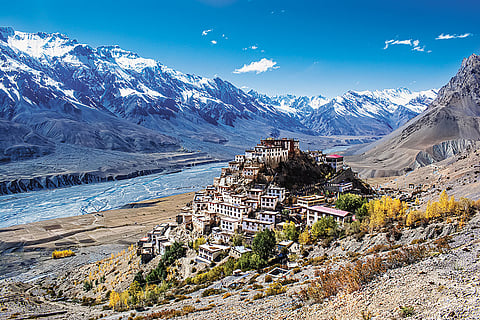
Key Monastery in Spiti Valley
Spiti Valley
The desert mountain valley of Spiti in the Trans-Himalayas between Tibet and India, The Middle Land, is a must-see
Narkanda: Ride 400 km from Delhi to Narkanda. Next morning, ride off to Hatu Peak (8 km). The road is narrow, and overlooks a green valley of pine, spruce, deodar and oak. There is a temple dedicated to Goddess Kali in distinct Himachali style. It is believed the Pandavas stayed here in the 13th year of their exile. The top offers a panoramic view of the Himalayan snow peaks.
Sangla: Sarahan, about 100 km further, is home to the famous Bhimakali Temple, considered one of the 51 Shakti Peeth. Wangtu (50 km) is a small town on the Old Hindustan Tibet Road. The road winds its way through narrow stretches overlooking a steep valley running along the Sutlej. Wangtu is also the gateway to Sangla valley. A detour from Karcham will take you to Sangla, and Chitkul, the last inhabited village on the India-China border. Chitkul is famous for its wooden houses and granaries, secured with foot-long padlocks.
Kalpa: Stop by at Kalpa and Reckong Peo. They are placed on opposite hilltops overlooking NH22, with the main road leading to Reckong, and a fork ahead to Kalpa. At 9,710 ft, Kalpa offers a splendid view of Kinnaur Kailash.
Nako: Resting on a high plateau against the backdrop of Trans-Himalayas, Nako village also has a beautiful lake and a monastery, which, along with the few mud dwellings give it a surreal feel straight out a fairy tale. Spend a day here to rewind.
Tabo: Crossing the Malling Nallah 5 km ahead, you will climb and descend a gravelly trail along the banks of the Spiti river to reach Tabo, home to a 1,000-year-old functional monastery, the oldest in India and the Himalayas.
High Landmarks: Another 50 km ride will take you to Kaza, the district headquarters (it has the world’s highest petrol pump). Then, take a short detour to visit Langza, Hikkim and Komic. Hikkim has the world’s highest post office. On your way back, visit the Key Monastery. Perched on a hill at an altitude of 13,700 ft, it offers one of the best views of the Spiti river and valley. A short ride of 8 km will take you to Kibber, the last village on the trekking trail to Mt Kanamo, the highest peak in Spiti.
On your way back to Manali, cross the Chicham Bridge 3 km further. It is Asia’s highest suspension bridge and an engineering marvel spanning across a 1,000 ft deep gorge at an altitude of 13,600 ft.
From Kibber, ride 200-plus kilometres to Manali through Kunzum La (14,900 ft), and Rohtang La (13058 ft); or bypass the latter by using Atal Tunnel. Ride back to Delhi from Manali.
Duration: 7-9 days.
Distance: 1,700 km.
Cost: Fuel: 57 litres, Rs 5,700; Food: Rs 200-300 per meal; Stay: Rs 500-2,000 per day.
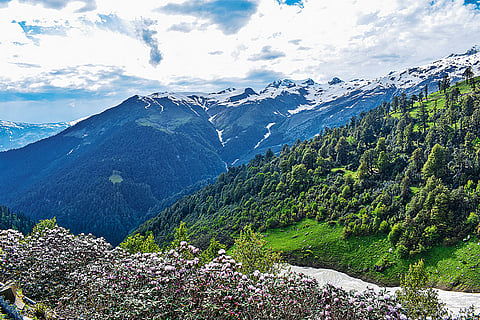
Sach Pass in Pangi Valley
Pangi Valley
A ride into the remotest corners of the Himalayas through the Cliffhanger Road is not one for the faint-hearted
Keylong: Take the road to Manali. Next day, take the Atal Tunnel bypassing Rohtang La and head to Keylong or ride 20 km further to Jispa. The ride will take you from the verdant green hills of Manali to the dark brown landscape of Lahaul valley in the rain shadow area of the Pir Panjal.
Killar: From Keylong or Jispa, ride back to Tandi and take the Tandi-Kishtwar Road to reach Killar. The road is extremely rugged, narrow and perilous at stretches, featuring tight, winding stretches clinging on to the cliffs. It is undoubtedly testing, but very scenic. At 11,000 feet, Killar lies at a tri-junction connecting the Pangi Valley to Chamba in the southwest and Kishtwar in Jammu region to the north.
Killar is also the gateway to Pangi Valley, one of the remotest regions in the Himalayas. From Killar, ride down 30 km to Sach Pass (14,500 ft) in the Pir Panjal range. This high mountain pass connects Pangi Valley to Chamba. This short ride can take up to 3-4 hours because of the extremely tough terrain. Rain, slush, and stretches of snow and glazed ice make this a gruelling ride. Return to Killar and start for Kishtwar in Jammu region the next day.
Kishtwar: This is the holy grail that most motorcyclists are unlikely to experience now. Previously, a 120 km ride would have taken you to Kishtwar in Jammu through one of the most difficult and challenging routes in India —with a section called the Cliffhanger Road because of its extremely narrow and unpaved stretch, literally carved into the sheer cliff face overlooking the Chenab river below. It was prone to landslides, rockfalls and at places wide enough for only one vehicle to pass at a time. The undulating terrain with steep rocky inclines became extremely slippery during light snowfall making it all the more precarious. Adding to the risk was that the road had no guard rails at most places.
However, this stretch has now been permanently closed because of safety reasons and a new road is being constructed by the Border Roads Organisation just above the old stretch.
From Kishtwar, the road would have taken you to Pathankot and to Delhi.
Alternate Route: Alternatively, continue on Sach Pass, riding on narrow sections, and crossing a few streams to reach Chamba. Visit the Lakshmi Narayan Temple, Chamunda Devi Temple, Church of Scotland, and Khajjiar (called Mini Switzerland). Visit the Chamera Lake on the way to Dalhousie. At Dalhousie, visit the St Francis Church, St Patrick’s Church, St Andrew’s Church, and St John’s Church. Dainkund Peak, about 10 km further, gives a spectacular 360-degree view of the mountains and the valley, including Khajjiar. Ride back to Delhi through Pathankot.
Duration: 7 Days.
Distance: 1,700 km.
Cost: Fuel: 55 litres, Rs 5,500; Food: Rs 200-400 per meal; Stay: Rs 1,000 per day.
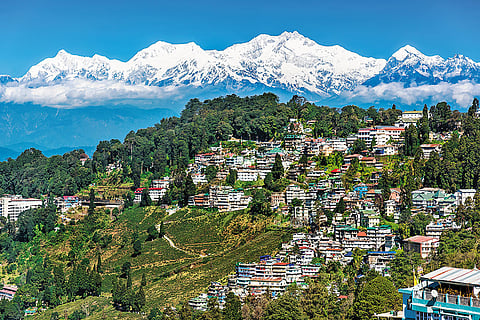
Mt Kanchenjunga
Darjeeling
Ride on misty roads winding through dark forests, lush tea gardens and along toy trains against the backdrop of an 8,000 mt peak
Malda: A 330-km run will take you to Malda. Nearby lies the ancient city of Gaur, the erstwhile capital of Bengal kingdoms over many centuries, from the Gaur, Pala, Sena dynasties to the Sultnate and the Mughal eras. The archaeological remains are worth noting for their mix of terracotta and Persian glazed tilework.
Darjeeling: A straight run of 230 km will take you to Siliguri, the last major city connecting the Indian mainland to the northeast. Cross the green forests and tea gardens of Doars and ride up to Darjeeling. The road criss-crosses the toy train track at several stretches along the way.
The road behind the mall offers a splendid view of Mt Kanchenjunga (8,586 mt). The range, known as the Sleeping Buddha, resembles a reclining Buddha.
Visit the zoological park and the Himalayan Mountaineering Institute (HMI), located within the same campus. The HMI museum is dedicated solely to mountaineering, with rare photographs and gears used by Tenzing Norgay and Sir Edmund Hillary on their ascent to Mt. Everest, along with rare artefacts from previous expeditions and surveys of the Himalayas from the 19th century.
The ride to the Japanese Buddhist Temple winds through a dark and misty forest of oak, pine and rhododendron. Tiger Hill (13 km) offers the grandest sunrise view in India in the backdrop of Kanchenjunga. Also visit the Happy Valley Tea Estate, the world’s highest, for a tour and sampling of Darjeeling tea. The Glenary's near the mall road is famous for its restaurant, bakery and bar.
Kalimpong: Kalimpong (50 km) offers stunning views of the Himalayas and the Teesta valley. Visit the Durpin Monastery, which is renowned for its architecture. If you are in need of some waldeinsamkeit (feeling of being lost in solitude in the forest), Lolegaon (30 km) with its multitude of forest walks will not disappoint the dendrophile in you, particularly the Canopy Walk and the Heritage Forest. At Lava (another 20 km), go to the Neora Valley National Park, Changey Waterfall and Rachela Peak.
Ghum, Kurseong: On the way back from Kalimpong, stop at Ghum, India's highest railway station. The museum has rare paraphernalia, including original coaches, engines, and silver cutlery, and other trivia related to the Darjeeling Himalayan Railway, a UNESCO World Heritage, and India’s first toy train service. Visit the nearby war memorial at Batasia Loop for a peak view of Mt. Kanchenjunga, and the Ghum Monastery. Take the Old British Road and stop over at Kurseong to explore the Makaibari Tea Estate. Ride off to Doars and Kolkata after a sumptuous breakfast and cup of tea.
Duration: 7-9 days.
Distance: 1,500 km.
Cost: Fuel: 50 litres, Rs 5,000; Food: Rs 200-800 per meal; Stay: Rs 2,000-5,000 per day.
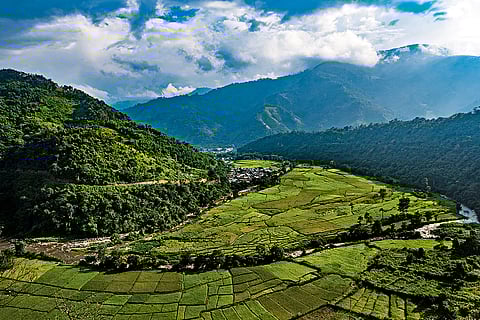
Ziro in Arunachal Pradesh
Ziro
A memorable ride to old trading posts, high lakes and quiet hamlets in remote northeast
Dirang: Day 1 will take you from Guwahati to Dirang (300 km), en route Bomdila through a scenic landscape with breathtaking views of the Kameng river and rolling green hills. Stop at the tri-point junction of Bhutan, Assam, and Arunachal Pradesh for some nice photographs. At Bomdila, visit the Bomdila Monastery, Chilipam Monastery and Bomdila View Point. At Dirang, go to the Mandala Top for a panoramic view of Dirang Valley and the Himalayas and the 108 feet Buddha and 108 stupas. The Khastung Gompa and the historic Dirang Fort are also worth exploring.
Tawang: At 11,500 ft above sea level, Tawang with its beautiful gompas and calm lifestyle in a tranquil Himalayan landscape is a traveller’s delight. The ride to Tawang is very scenic. You will cross the Sela Pass (13,700 ft). Nearby is the Sela Lake with its crystal clear water surrounded by high mountain peaks of the Himalayas. The Jaswantgarh War Memorial is 20 km further on the road to Tawang. Sela Pass was the scene of an important battle during the 1962 India-China War. The route from Jaswantgarh war memorial to Tawang winds zigzags its way through high mountains offering a pristine view of the snow-capped peaks towering over lush green valleys. The 100-metre high Nuranang waterfall is 2 km northeast of the town of Jang about 34 km short of Tawang.
Visit the Tawang Monastery, Bumla Pass (15,200 ft) near the India-China border, for which you will need a permit, the high-altitude Sungester Lake (also known as Madhuri Lake, as some scenes of the movie Koyla were shot here).
Travel down to Bomdila and halt for the day.
The 360 km ride from Bomdila to Ziro will take you from 8,000 feet in the mountains to 5,500 feet on the Apatani Plateau. The landscape will change as well as you climb down—forests of pine and orchards giving way to bamboo as you soak in the spectacular view of the West Kameng Valley. The road cuts through the Paki Tiger Reserve.
There can be no better place than Ziro to rewind after an arduous ride in the high mountains. If a landscape could describe serenity, Ziro would be that place—lush fields stretching as far as the eye can see, with mountains on the far edge of the horizon, and a tranquil blue sky that bursts into a shade of turquoise or amber as the sun plays hide and seek with the clouds. You can spend a day or two going for nature walks at the Pine Grove and Dolo Mondo, visit Apatani villages around for some cultural immersion, buy at the Hapoli Market, visit the Meghna Cave Temple, and Old Ziro Cemetery.
You can stop over at Itanagar, the state capital of Arunachal Pradesh (about 100 km down) and then proceed to Guwahati (312 km) on your way back.
Duration: 7-9 days.
Distance: 1,500 km.
Cost: Fuel: 50 litres, Rs 5,000; Food: Rs 100-300 per meal; Stay: Rs 1,000-4,000 per day.
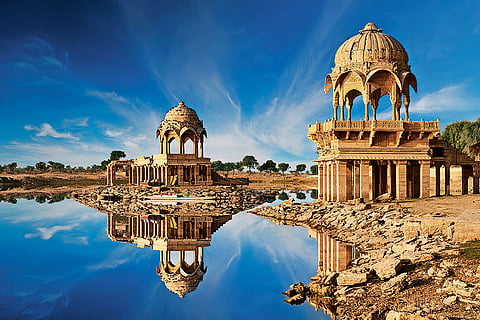
Jaisalmer
Barmer
This flint-shaped route will take you from Pink City to the goldens sands of Thar and back through the Blue City
Nagaur: From Jaipur, take the road to Sambhar through Jobner and Phulera. The Sambhar Salt Lake, also known as Shakambhari Lake, is India’s largest inland saltwater lake, 80 km from Jaipur. It holds immense cultural value. The Sambhar town is mentioned in the Mahabharata. Goddess Shakambhari was the tutelary goddess of Prithviraj Chauhan and there is a temple dedicated to her beside the lake.
Khuchaman City, 60 km further, is a historical town in the Marwar region. The Kutchaman fort, atop a 1,000 ft hill, is famous for its architecture and aesthetics. In the old city, you will also find havelis adorned with colourful frescos and murals from the old era. At Nagaur, visit the Nagaur Fort.
Jaisalmer: A straight run of 320 km will take you to Jaisalmer in the Thar Desert. En route, you can stop at Pokhran, 112 km short of Jaisalmer. Visit the Pokhran Fort and continue towards Jaisalmer. The city is famous for its blue pottery, camel leather handicraft and the 12th century Golden Fortress made of sandstone, which glimmers gold in the last blush of the setting sun.
Take a day to ride to Tanot Temple and the Longewala Border post, the scene of India’s famous battle in the 1971 War, where a company of 120 Indian soldiers fended off wave after wave of Pakistani tank attacks. You can also keep a day to visit Sam for some camping experience in the golden sands of the Thar.
Barmer: The 160 km run from Jaisalmer to Barmer will take you through the vast stretch of the Thar Desert, with sand dunes, arid stretches and sparse vegetation. If you want to experience a real ride through desert, this will be the best stretch to experience that. The stretch provides ample locations for photography. At Barmer, visit the Barmer Fort, Nakoda Jain Temple, the Kiradu Temple as well as the Chintamani Parshnath Temple (85 km) towards Ahmedabad.
Jodhpur: Ride 200 km to Jodhpur, the Blue City. Visit the 15th century Mehrangpur Fort, the Umaid Bhavan Palace, the Toorji Ka Jhalra (an ancient stepwell), Chamunda Mataji Temple, among others. In the old quarters of Brahmapuri, take a walk along the blue streets of the old settlement.
From Jodhpur, visit Ajmer and Pushkar. Visit the Taragarh Fort and the Dargarh Ajmer Sharif at Ajmer, the Brahma Temple, the Pushkar Lake and the Savitri Temple in Pushkar, and then ride back to Jaipur.
Duration: 7 days.
Distance: 1,600 km.
Cost: Fuel: 53 litres, Rs 5,300; Food: Rs 200-300 per meal; Stay: Rs 1,000-2,000 per day.
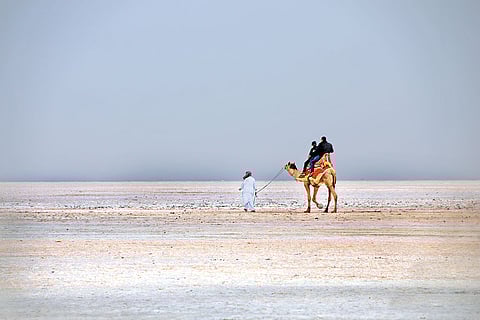
Rann of Kutch
Dholavira
From the urban clusters of Ahmedabad, ride to the white sands of the Rann of Kutch and the Harappan site of Dholavira
Bhuj: The ride from Ahmedabad to Bhuj will be about 335 km, across a flat plain with the landscape changing from urban clusters and fields to dry arid land as you get closer to Bhuj, the headquarters of Kutch district.
If you have a liking for history, Bhuj, the ancient capital of the princely Cutch State will delight you. Visit the Bhujia Fort atop Bhujia Hill, Prag Mahal and Aina Mahal, Kutch Museum and Hamirsar Lake. Other places of interest include, Chhatedi Darbargarh Fort, Sharadbaug Palace, Swaminarayan Temple, and the Tapkeshwari Temple, with its caves.
Rann of Kutch: From Bhuj, ride 80 km north to Dhordo. The ride will take you on a flat terrain with the landscape changing from one of sparsely populated thorny vegetation near Bhuj to white flats as one approaches the Rann at Dhordo, home to the annual Rann Utsav.
From Dhordo, ride 30 km to Khavda, the gateway to the Rann of Kutch. The village is famous for its crafts and serves as a starting point for exploring the Rann. At Khavda, visit the Khavda pottery village. A detour of 18 km will take you to Kalo Dungar, the highest point in Kutch at 1,516 feet above sea level. Another detour will take you to India Bridge, which is the last point up to which you can ride. No mobiles or photography is allowed after India Bridge. You will have to keep your phones in lockers and continue on your journey and collect them upon your return should you decide to proceed further to Bedia Bet Hanuman Mandir and War Memorial at Dharamshala and Vighakot Fort right on the border with Pakistan. However, you will need to take permission from the Border Security Force at least 15 days in advance.
The 58 km ride from Khavda to Dholavira, will be one of the most memorable rides of your life. The straight road cuts through the salt flats with a marsh on one side and a lake on the other. It is also known as the ‘Road To Heaven’. The wetlands are a nesting ground for migratory birds, such as flamingos during the winter season.
Dholavira: The UNESCO World Heritage Site of Dholavira contains ruins of the Harappan Civilisation. Visit the excavation site, the archaeological ruins, and the museum. It contains pottery, seals, and jewellery unearthed from Dholavira and the nearby sites. From Dholavira, travel to Mehsana and back to Ahmedabad.
Duration: 7-9 days.
Distance: 1,050 km.
Cost: Fuel: 35 litres, Rs 3,500; Food: Rs 300-400 per meal; Stay: Rs 1,000-6,000 per day.
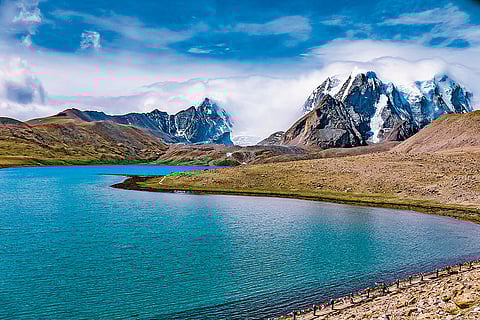
Gurudongmar Lake in Sikkim
Gurudongmar Lake
High passes, unfrozen glacial lakes—the ride to the northernmost borders of Sikkim is simply magical
Gangtok: Ride 112 km to Gangtok, the capital of Sikkim. At 5,500 ft above sea level, it is one of the most picturesque state capitals in India, with lush green valleys below and snow-capped peaks of the Himalayas, including Mt Kanchenjunga (8,586 mt) towering in the distance.
The Namgyal Institute of Tibetology has many rare statues, masks, thankas (tapestries) and religious literature brought from Tibet in the 1950s. The Rumtek Monastery is the largest in Sikkim, about 35 km away. It sits atop a hillock at an altitude of 4,900 feet surrounded by green mountains and flowing streams with the snow-capped Himalayas in the distance. It has many relics from the Tsurphu Monastery in Tibet. Other famous monasteries are Tsuklakhang Monastery, Enchey Monastery, Phodong Monastery, and Dodrupchen Monastery.
The Fambong Lho Wildlife Sanctuary, about 14 km away, is popular with wildlife enthusiasts.
Nathu La: About 40 km from Gangtok on the way to Nathu La lies Tsongmo Lake, surrounded by rugged mountains on all sides. On the way, stop by at the Kanchenjunga view point, and Kyongnosla Alpine Sanctuary, which is famous for its rare orchids, and forest of rhododendron, fir and juniper. About 18 km further from the lake, on the border with China lies Nathu La. The Baba Harbhajan Singh Mandir dedicated to Honorary Captain Harbhajan Singh, is 8 km south east from Nathu La towards Jelep La.
Lachung: Ride 85 km north to Chungthang and from there to Lachung. At 9,000 ft above sea level, on the confluence of the Lachung and Lachen rivers, it is the last village on the India-China border. In the old days, it served as a trading post with Tibet. It is also the gateway to Yumthang Valley.
Lachen: Ride back to Chungthang and take the fork to Lachen. This village (9,600 ft) is the gateway to Thangu Valley, and Gurudongmar and Tso Lhamo lakes. The other attractions include Twin Waterfalls, Seven Sisters Waterfalls, Kalapathar and the beautiful Lachen Monastery in the village.
Gurudongmar Lake: This sacred lake at 17,800 ft is named after Padmasambhava, who visited here in the 8th century. Legend has it that Padmasambhava touched the lake after locals told him about the water problem and it has remained unfrozen since then. The lake offers one of the most stunning views of the Himalayas. The visible peaks include the Kanchenjunga range, Khangchengyao, Gurudongmar West, Gurudongmar, Sangalphu and Mt Siniolchu. Tso Lhamo is another lake 11 km further, close to the Chinese border. The last bit of the stretch after leaving the main road is extremely rocky and tough.
Duration: 7 days.
Distance: 850 km.
Cost: Fuel: 28 litres: Rs 2,800; Food: Rs 300 per meal; Stay: Rs 1,000 per day.
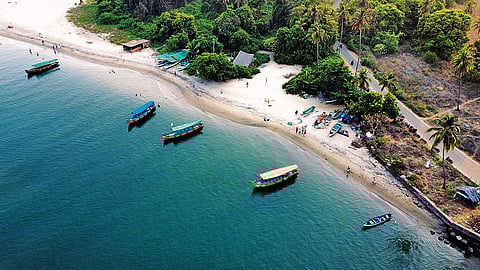
Morjim Beach in north Goa
Mangalore
A ride along the western Konkan coast of India will help you experience the perfect mix of history, nature and culinary delights
Goa: Make a straight run of 550 km from Mumbai along the Western Ghats by the side of the Koyna Wildlife Sanctuary to reach Calangute. The route passes through lush green forests, hills and coastal areas. The popular north Goa beaches—Baga, Anjuna and Orzan are nearby. Visit the Chapora Fort. Return to Calangute and ride south to Candolim. Visit the Candolim Beach, Sinquerim Beach and Fort Aguada, the oldest Portuguese fort in Goa, built around 1612.
A short ride will take you to Panaji, the state capital. Visit the historic quarter of Fontainhas for its eye-catching colourful buildings in signature Portuguese style. About 13 km further eastwards along the Mandovi River, visit Old Goa, the former capital of Portuguese Goa. It is famous for its churches. The Basilica of Bom Jesus is the most famous, Chapel of Our Lady of the Mount is among the oldest. Others include, the Church of Our Lady of the Rosary, Church of St Francis of Assisi, and Se Cathedral.
On your way down south to Karwar, you will cross Vasco Da Gama, Madgaon and Cancona.South Goa is famous for its quiet and less crowded beaches. Palolem is the most famous, and is known for its serene atmosphere, dotted with coconut palms and hills on one side and the mangrove backwaters on the other. Patnem Beach and Rajbhag Beach lie further south. Agonda Beach lies about 9 km north of Palolem.
Karwar: Ride 30 km from Cancona along the coast to reach Karwar in Karnataka. This port city on the confluence of the Kali River and the Arabian Sea is famous for its sandy beaches, rocky cliffs, caves and historic temples.
The Tilmatti Beach is famous for its black sand. Visit Karwar Beach, Kali Bridge, Kurumgad Island, Oyster Rock Lighthouse, Sadashivgad Fort, and Kot Shiveshwar, among others.
Gokarna, about 50 km south, is famous for its beaches (Paradise Beach, Om Beach, Kudle Beach), and the 4th century Mahabaleshwara Temple. The Vibhuti Falls and the monolithic limestone formations, Yana Caves, are located close to Gokarna.
Mangalore: Ride 270 km along the coast through Udipi to reach Mangalore. Visit the 10th century Kadri Manjunatha Temple, Mangladevi Temple, Panambur Beach, Tannirbhavi Beach, the Sultan Battery watch tower, Rosario Cathedral, Milagres Church, St Aloysius Chapel, Lighthouse Hill, among others. The 13th century Jain Dharamsthala Temple is about 75 km away.
Duration: 7 days.
Distance: 2,000 km.
Cost: Fuel: 67 litres, Rs 6,667; Food: Rs 200-700 per meal; Stay: Rs 2,000-5,000 per day.
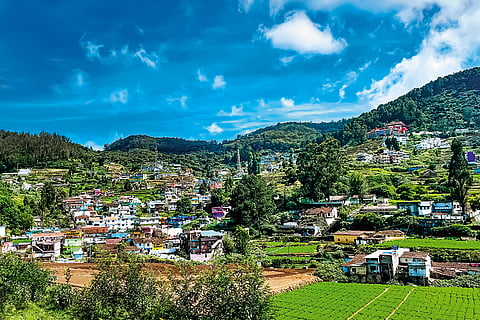
Ooty
Ooty
Blue hills, colonial buildings and tranquil trails criss-crossing through tea gardens make Ooty and Coonoor lovely destinations
Bengaluru: A straight run of 350 km by Chittoor and Kolar will take you to Bengaluru. Visit Tipu Sultan’s Summer Palace, Bengaluru Fort, Bengaluru Palace, St Mary’s Basilica, Shri Someshwara Swamy Temple, among others.
Srirangapatna: Ride 100 km to Mandya, home to a few archaeological excavations, including a few statues of Bahubali dating back to the 8th century.
A further 30 km will take you to Srirangapatna. Ranganathaswamy Temple, built around 984 AD, after which the city is named, is among the most prominent landmarks. Other places of interest include Srirangapatna Fort, Obelisk Monument, Scott’s Bungalow, Lord Harris’s House, Garrison Cemetery, Wellesley Bridge, Colonel Bailey’s Dungeon, Tipu Sultan Gumbaz, Daria Daulat Palace, and so on. The place where the British broke through the fort wall is marked by an obelisk and the spot where Tipu fell has a memorial.
Also visit the Karighatta viewpoint, Nimishambha Temple, among others.
Mysuru: Ride 20 km to Mysuru. Visit the Mysore Palace, Brindavan Garden, Chamundeshwari Temple, Keshava Temple, and St Philomena’s Cathedral.
Ooty: A 125 km ride through the Bandipur National Park will take you to the blue hills of Ooty (7,349 ft), known for its picture postcard landscape with beautiful colonial cottages nestled on misty mountains interspersed with tranquil trails criss-crossing verdant green tea gardens. Popular attractions include the UNESCO World Heritage Neelgiri Mountain Railway (the steepest railway in Asia), the Doddabetta Peak, Mudumalia National Park, Ooty Lake, Botanical Garden, Avalanche Lake, Kotagiri, Kodanad Viewpoint, Ellada, and Chinanagar (on the way from Ooty to Kotagiri), which provides breathtaking views of the tea gardens during sunset.
Coonoor: On the way down from Ooty, visit Wellington, a military cantonment known for its colonial architecture, and Coonoor (6,070 ft), often called the Switzerland of the Nilgiris, particularly the Ketti Valley located nearby. Coonoor is known for its spectacular landscape—tea gardens, rolling green hills, misty woods, and deep valleys that turn dark blue as the sun sets for the day.
Visit the Lamb’s Rock, Dolphin’s Nose, Catherine Falls, Law’s Falls, Droog Fort, Sim’s Park. The stretch between Coonoor and Ooty gives some of the best views of the Nilgiri Railway. Ooty and Coonoor are famous for their chocolates, cheese and tea. Some of the tea estates also have lodging faculities.
Start from Coonoor early for a 550 km run to Chennai, or stop at Salem.
Duration: 7 days.
Distance: 1,300 km.
Cost: Fuel: 43 litres, Rs 4,300; Food: Rs 250-600 per meal; Stay: Rs 2,000 per day.
Show comments
Published At:
Tags