Supreme Court allows claims without financial dependency on deceased.
Children can receive compensation for loss of parental consortium.
Compensation increased to Rs 12.47 lakh.
Non-Dependent Legal Representatives Can Claim Motor Accident Compensation, Supreme Court Rules
Legal representatives can seek compensation even without financial dependency, with a consortium available for spouses and children under the law

Summary
Advertisement
The Supreme Court has clarified that financial dependency on a person who dies in a motor accident is not necessary for every legal representative to seek compensation.
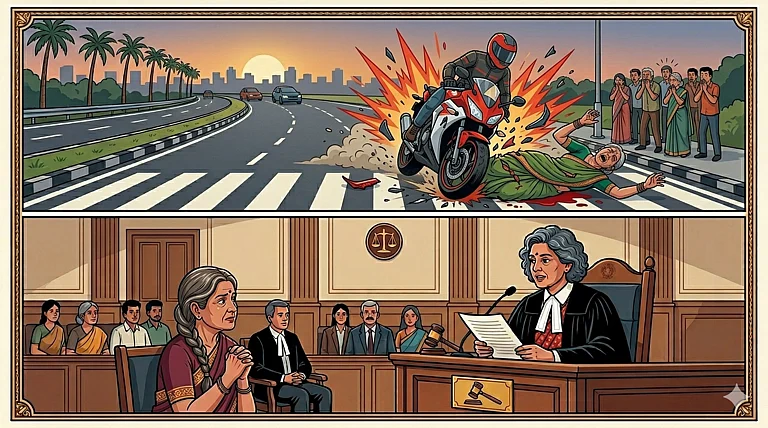
A bench comprising Justice Nongmeikapam Kotiswar Singh and Justice NV Anjaria delivered the ruling while deciding an appeal arising from the death of Shaik Janimiya. He was hit by a car while walking in Malkajgiri, Hyderabad, in June 2012.
Janimiya's wife and three children had approached the Motor Accident Claims Tribunal. The tribunal awarded Rs 8.44 lakh as compensation. The Telangana High Court later increased the amount to Rs 11,00,672, including Rs 10,23,672 for loss of dependency, according to LiveLaw.
The family then went to the Supreme Court for a further increase, including a claim of compensation for the loss of parental consortium for the three children.
Legal Representative Doesn't Have to be Financially Dependent
The Supreme Court referred to its earlier decision in Manjuri Bera vs Oriental Insurance, in which it had held that the mere absence of financial dependency does not remove a legal representative's right to seek compensation.
Advertisement
The Court also considered National Insurance Company Limited v Birender. In that case, major, married and earning sons were recognised as legal representatives under Section 166(1)(c) of the Motor Vehicles Act, although the amount payable could depend on their actual dependency.
Another earlier ruling, Gujarat State Road Transport Corporation v Ramanbhai Prabhatbhai, was also considered. It explained that a legal representative generally includes a person who legally represents the estate of the deceased or upon whom that estate devolves.
The bench therefore held that legal representatives can maintain a compensation claim and seek amounts under the heads available under the motor accident law.
Children Can Receive Parental Consortium
The judgment also dealt with consortium, which covers the loss arising from the death of a close family member.
The Court noted that the consortium includes spousal, parental and filial consortium. Parental consortium recognises a child's loss of parental care, protection, guidance, affection and companionship.
Advertisement
In Janimiya's case, his wife and three children, aged between 18 and 21 years, were eligible for consortium. The tribunal had awarded Rs 5,000 to the wife under this head, but nothing to the children.
The Supreme Court relied on Pranay Sethi v National Insurance Co Ltd, under which the conventional amount for consortium was fixed at Rs 40,000, with a 10 per cent increase every three years. Applying the applicable enhancement, the Court fixed the amount at Rs 48,400 for each claimant.
The wife received Rs 48,400 as spousal consortium. Each of the three children received Rs 48,400 as parental consortium.
What The Ruling Means For Claimants
The judgment makes a distinction between being a legal representative and being financially dependent on the deceased. A claimant may qualify as a legal representative even when the loss cannot be measured through direct financial dependence.
In practical terms, eligible family members can seek compensation under relevant heads, including consortium, even where their claim is not based solely on loss of income.
Advertisement
The total compensation was therefore increased to Rs 12,47,272. The additional Rs 1,46,600 will carry interest at 7.5 per cent from the date of filing of the claim until realisation.
Show comments
Published At: