

Summary of this article
Chhattisgarh High Court ruled triple riding alone cannot reduce accident compensation claims.
Court enhanced family compensation from Rs 6.77 lakh to Rs 18.88 lakh.
Victim's income, consortium, future prospects revised; additional payment ordered with interest.
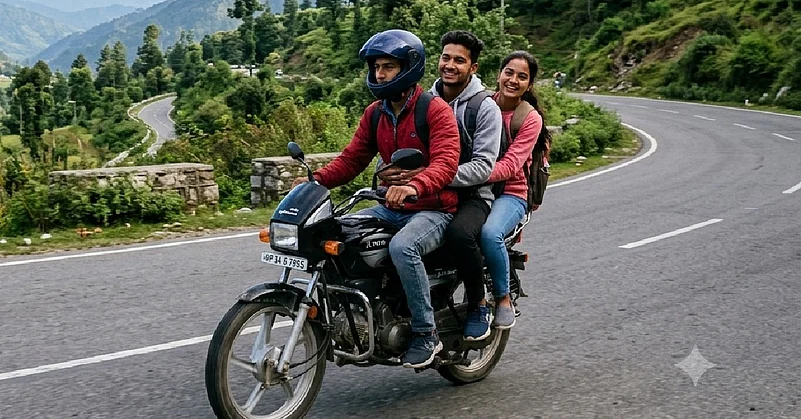
Motor accident compensation claims often involve disputes over whether a victim’s actions contributed to an accident which can impact the final amount awarded to the family. In one such case, the Chhattisgarh High Court examined whether triple riding alone could be considered a reason to reduce compensation in a motor accident claim.
The court set aside the 50 per cent deduction made by the Motor Accident Claims Tribunal (MACT) and recalculated the compensation after revising the victim’s income and other components. Following the reassessment, the compensation was enhanced from Rs 6.77 lakh to Rs 18.88 lakh.
The case was filed by the family of Shiv Kumar, who died in a road accident. In 2019, the MACT, Baikunthpur, awarded Rs 6,77,600 after applying a 50 per cent deduction, holding that Kumar had contributed to the accident as three persons were travelling on the motorcycle at the time of the crash, according to a report in The Times of India.

Challenging the tribunal’s decision, Kumar’s family argued before the High Court that the deduction was not enough. They referred to the Supreme Court’s decision in Mohammed Siddique and Another v. National Insurance Company and Others that also addressed the issue of contributory negligence in motor accident claims.
The family also opposed the tribunal’s calculation of Kumar’s income, saying it should have been based on minimum wage laws applicable in Chhattisgarh. They further claimed that the compensation awarded under the consortium head for loss of companionship was not adequate.
The driver and owner of the vehicle argued that they should not be held liable for paying compensation while the insurance company supported the tribunal’s decision and maintained that the 50 per cent reduction was justified.
While reassessing the compensation, the court revised Kumar’s monthly income from Rs 6,000 to Rs 7,930, based on the minimum wages prescribed for skilled workers under the Chhattisgarh Minimum Wages Notification issued by the Labour Commissioner. It also increased the consortium amount from Rs 40,000 to Rs 1.60 lakh and added 40 per cent towards future prospects while calculating the compensation.
Justice Sanjay K. Agrawal of the Chhattisgarh High Court set aside the tribunal’s deduction and held that triple riding alone cannot automatically establish contributory negligence. The court observed that the tribunal’s finding was contrary to the principle laid down by the Supreme Court in the Mohammed Siddique case.
After these revisions, the compensation amount was enhanced to Rs 18,88,606. The court directed the respondents to pay the additional amount within three months, along with 7.5 per cent annual interest, while keeping the remaining parts of the tribunal’s order unchanged.