Starting early with small SIPs ensures massive long-term wealth.
A Rs 1,000 monthly SIP builds crucial financial discipline.
Compounding over thirty years turns small investments into lakhs.
Independence Day 2026: Can A Rs 1,000 Monthly SIP Help You Achieve Financial Freedom?
When it comes to long-term investment, time is your biggest asset. When you start early, those tiny monthly investments are multiplied by the magic of long term compounding, eventually swelling into an effective financial safety net

Summary
Advertisement
India is set to celebrate its 80th Independence Day on August 15, 2026. As India marks 80 years of freedom, the very definition of the word freedom has evolved to include, among others, financial independence.
While financial independence can mean different things for different people, one of the core defining factors of financial freedom is having a big enough corpus to fulfil your dreams.
Different people deploy different methods to achieve financial freedom. However, one of the most popular ways to create a large corpus is to invest in mutual funds through systematic investment plans. Data from the Association of Mutual Funds in India (Amfi) also shows the enduring popularity of mutual funds and SIPs.
Data for the month of June 2026 showed that monthly SIP contributions reached Rs 31,781 crore, pushing the total SIP asset base past Rs 17.7 lakh crore.
The Power of Starting Small
It’s an accepted belief that investing more money leads to greater returns, but financial experts emphasise that it is more important to begin investing in the first place. Many young earners today hesitate to invest because they feel their disposable income is too small. But here is the truth: putting away just Rs 1,000 a month into an SIP can kickstart your journey towards financial freedom.
Advertisement

“The best time to plant a tree was 30 years ago, the next best time is today. Similarly, the best time to start a SIP is today,” explains Debashish Mohanty, Chief Strategy Officer at The Wealth Company Mutual Fund.
“The real power lies not in how much you invest, but in how long your money stays invested. Thanks to compounding—where returns earn further returns—even small monthly SIPs can grow into a substantial corpus over 15–20 years,” Mohanty said.
Says Manasvi Garg, CFA, founder and CEO of Moneyvesta Wealth Management: “A Rs 1,000 monthly SIP alone is unlikely to make someone financially independent, but it can absolutely be the first step towards financial freedom. The biggest mistake investors make is believing they need a large amount to start investing. In reality, long-term wealth creation depends more on time in the market, consistency and disciplined investing than on the initial investment amount.”
Advertisement
“A Rs 1,000 SIP also builds financial discipline,” adds Mohanty. “It turns investing into a habit rather than a one-time decision and removes the pressure of waiting for the ‘perfect’ market entry point. Starting small is always better than delaying in hopes of investing more later.”
When it comes to long-term investment, time is your biggest asset. When you start early, those tiny monthly investments get multiplied through the magic of long-term compounding, eventually swelling into a massive financial safety net.
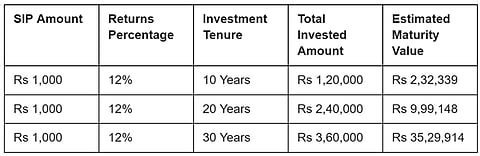
Assuming your mutual fund investment earns a return of 12 per cent per cent per annum, you can still significantly grow your monthly investments of Rs 1,000 to a large corpus over a long investment tenure.
Investors must note that while the 12 per cent return is not guaranteed, but is based on the historical returns delivered by diversified equity mutual funds and benchmark indices like the Nifty 50. Investors must understand that a long investment horizon mitigates drawdowns which might occur during volatile phases of the market.
Advertisement
Here is a look at what your investment of Rs 1,000 would grow to over different horizons. The table shows the SIP amount, returns percentage, total invested amount, and estimated maturity value over three time spans.
How Does The Rs 1000 SIP Compound
Mutual fund investments compound on a monthly basis. Here is a look at the formula through which your returns compound.
The equation is FV = P * [ ((1 + i)^n - 1) / i ] * (1 + i).

Think of FV as your final wealth at the end of your investment journey. P denotes principal, which is Rs 1,000. The variable i represents your monthly growth rate. Since we are assuming a 12 per cent annual return, dividing that by 12 months gives us a neat 1 per cent monthly growth rate to work with. Finally, the variable n represents the total number of investment months.
Advertisement
A Stepping Stone to Financial Independence
To bust a common myth, an investment of Rs 1,000 per month cannot guarantee that you will become entirely financially independent. However, accumulating over Rs 35 lakh from a total contribution of just Rs 3.60 lakh over 30 years can provide a strong base or a stepping stone for ultimately achieving financial independence.
Deciding to invest Rs 1,000 today is about much more than money. It wires your brain for financial discipline, helping you build the rock solid habit of investing consistently month after month. Once this habit forms, you can increase your investments as your income grows. Additionally, the corpus you accumulate over the years can aid you in making larger investments in the future.
"For young investors, the smart approach is to begin early with an affordable SIP and increase contributions as income rises. A 10 per cent annual step-up can significantly boost long-term wealth without straining monthly budgets,” suggests Mohanty.
Advertisement
“Perhaps the biggest opportunity is simply not stopping. Investors often redeem their corpus after reaching an arbitrary milestone. If the financial goal is still decades away, continuing the SIP or allowing the corpus to remain invested can create significantly more wealth because compounding accelerates over longer periods,” Garg adds.
Investors must understand that achieving financial independence is a patient process which requires consistency and a willingness to start exactly where you are today. This Independence Day, making the choice to invest a small portion of your monthly income can truly set you on the right path to financial independence.
“Ultimately, investors shouldn't focus only on whether Rs 1,000 is enough. They should focus on whether they are building a system that allows them to invest more every year while staying invested for the long term,” Garg further says
Show comments
Published At: