Extra home loan tax relief may boost demand
GST rationalisation to improve cost transparency
Infrastructure growth driving housing beyond city cores
Budget 2026: Additional Tax Relief On Home Loans Will Boost Real Estate Growth, Say Industry Leaders
In recent years, first-time buyers have emerged as the critical drivers of the end-user demand in residential real estate. Industry leaders say that enhancing tax relief on home loan interest can provide much-needed support to the real estate sector. Homebuyers are also looking at additional tax relief in home loan interest as existing deductions have not kept pace with the rising property prices and higher interest rates

Summary
Advertisement
Homebuyers are looking forward to the upcoming Union Budget 2026 in the hope that the Union Minister of Finance Nirmala Sitharaman may announce some tax reliefs on home loans.
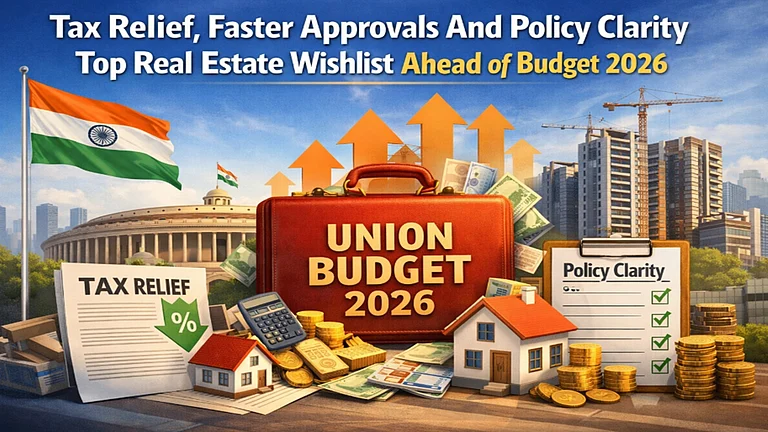
The real estate sector remained stable in 2025 and the residential and housing sector saw sustained growth as infrastructural corridors expanded across the country, tying the peripheral areas to the tier I and tier II towns. Industry stakeholders also believe that the upcoming budget is an opportunity to reinforce reforms that will further boost growth in the sector. They say this budget can benefit both homebuyers and developers, while simultaneously aligning the residential and housing growth with urban infrastructural planning.

Homebuyer Expectation
In recent years, first-time buyers have emerged as the critical drivers of the end-user demand in residential real estate. Industry leaders say that enhancing tax relief on home loan interest can provide much-needed support in this segment. The existing deductions have not kept pace with the rising property prices and higher interest rates, even if they have proven to be helpful, they add.
Advertisement
Says Ravindra Pai, managing director, Century Real Estate, “For homebuyers, enhancing tax relief on home loan interest and improving access to formal credit, especially for first-time buyers, would sustain end-user demand.” A revision in reliefs can help homebuyers benefit from affordable homeownership, while also pushing fence-sitters towards investing in the momentum in the residential market.
Developer Perspective
From the developers’ perspective, the focus remains on cost and market predictability. One of the most persistent concerns remains the Goods and Services Tax (GST) regime. Developers argue that standardising GST will allow for a smoother process for the input and output, significantly reduce malpractices while also improving pricing transparency for buyers.
“For developers, rationalising GST (including input tax credit) and moving toward faster, more predictable approvals through true single-window clearances can materially reduce project timelines and costs,” adds Ravindra.
They have also called for faster and more predictable approvals. According to them, despite repeated policy intent, real estate projects in core urban areas still face long and extensive approval timelines, all due to multiple clearances across the departments. Faster approvals would not just help the developers, but it also translate into timely delivery for buyers.
Advertisement
Urban Infrastructure Led Growth
Over the past decade, there has been significant growth in metro rail, expressway, and peripheral road networks. This led to the growth of residential expansion moving from the city centres to the outskirts. Buyers prefer areas that are well-connected to the city hubs and possess planned growth corridors. There has also been greater visibility in the growth of these areas with the introduction of international projects in the country, namely, Navi Mumbai Airport, Mumbai Trans-Harbour Link, Jewar Airport, Delhi-Mumbai Industrial Corridor, Chennai Ring Road, Bengaluru Aero-City, and GIFT City, to name a few.
The development of these micro markets into well-connected hubs has implications beyond the real estate industry. As housing now highly depends on employment nodes and transport hubs, it eases the concentration of the city centres. This leads to reducing pressure on the existing civic infrastructure in the main areas of Tier-I cities.
“A strong push on urban infrastructure like metro connectivity, last-mile roads, and planned growth corridors will further unlock well-connected micro-markets and enable integrated township-led development that eases pressure on city cores,” adds Ravindra.
Advertisement
Show comments
Published At: