EPFO’s Vishwas Scheme 2026 offers a 6‑month window (from 29 June 2026) for employers to settle long‑pending PF default cases at reduced penalty rates.
The penalty is capped at 1 per cent per month for delays of more than four months and much lower for shorter periods.
The scheme benefits employers through lower costs and employees through faster resolution of dues.
Explainer: What Is EPFO’s Vishwas Scheme 2026?
EPFO’s Vishwas Scheme has been launched to settle the long-pending litigation related to payment defaults by employers. To reduce the number of such litigations, EPFO has officially launched the scheme this year for a limited period of six months, starting from June 29, 2026

Summary
Advertisement
The Employees’ Provident Fund Organisation (EPFO) announced the ‘Vishwas Scheme’ first in October 2025 and formally launched it on June 29, 2026, as a one-time scheme for employers, offering them a six-month window to settle their claims pending as legal disputes. The scheme’s objective is to reduce the increasing number of court cases over employers’ non‑payment or delayed payment of provident fund dues. By offering lower penalty rates, it encourages employers to settle their outstanding payment liabilities quickly, which eventually benefits both workers and employers.
EPFO Vishwas Scheme
EPFO’s Vishwas Scheme is a dispute resolution scheme for employers that offers them the opportunity to amicably settle disputes.
According to the rule, when an employer deducts EPF from an employee’s salary, it needs to remit the amount to the EPFO within the stipulated time. However, failing to do so attracts a penalty on the employer, which is determined based on the amount of payment and the period of delay. When employers don’t pay the penalty for any reason, contending that it was not their fault or sometimes due to a financial crunch in paying the high rate of penalty, and so on, parties resort to litigation, which eventually drags on for years due to lengthy legal processes, and more such cases pile up.
Advertisement
So, to address this, the Vishwas Scheme offers reduced rates of penalty for employers, encouraging them to expedite settlement. Under the scheme, the penalty for a default in payment by the employers is recalculated at the reduced rates.
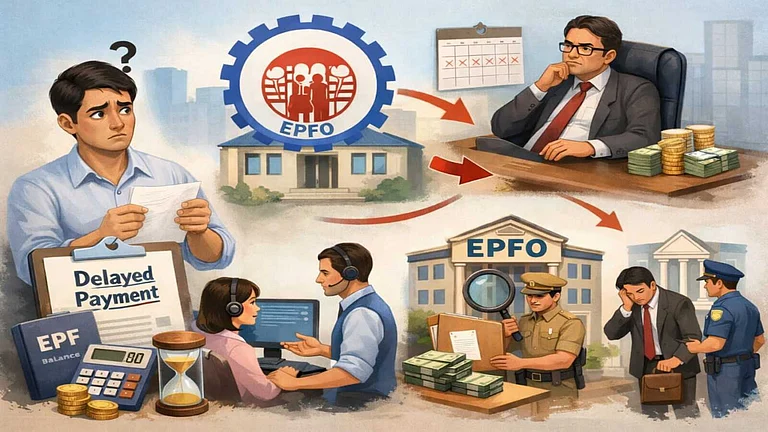
Penalty Rates Under Vishwas Scheme To Settle Pending Litigations
The Penalty rates were notified in June 2024. The rates were reduced from the previous rates, which followed a graded system, to a fixed 1 per cent per month. While the 1 per cent penalty remains in existence, considering the increasing volume of litigation, EPFO devised lower penalty rates for short-period default in payment by the employers.
Under the EPFO Vishwas Scheme, the rates were set at:
• 0.25 per cent if the default lasts for up to two months
• 0.50 per cent for defaults up to four months
Advertisement
• 1 per cent per month for a longer period of default

AI
Before the 2024 change, the penalty was based on a graded system, for which the rates were:
5 per cent for less than 2 months
10 per cent for 2-4 Months
15 per cent for 4-6 Months
25 per cent for more than 6 Months

How Can An Employer Take Advantage Of This Scheme?
The Vishwas Scheme 2026 offers an opportunity for employers to pay for the damage at a reduced rate and be free from litigation.
It applies to disputes under Section 14B of the Employees' Provident Funds and Miscellaneous Provisions Act, 1952 (Section 128 of the Code on Social Security, 2020). It applies to disputes stuck at different stages of the legal process, where only an initial notice has been served, where the order has not been passed, or where a case has been finalised but payment has not been made.
Advertisement
Employers can benefit from the scheme by agreeing to pay the penalty instead of fighting the case in court and settling the dispute. However, the reduced punitive rates under the scheme apply only after the employer has paid the applicable interest and follows the scheme’s conditions.
A faster settlement through this scheme will ultimately benefit both employers and employees and reduce the burden on the legal system.

Pending Cases
According to the union minister for Labour and Employment, Mansukh Mandaviya’s statement in May 2026, there were 27,639 pending litigations as on April 1, 2026, compared to 31,036 cases as on April 1, 2025, reflecting a reduction of 3,397 cases in one year. He highlighted that EPFO is on a mission-mode drive to reduce the litigation pendency, with a greater focus on settling cases more than 10 years old. Such long-pending cases have declined from 8,539 to 4,665 during the year.
Advertisement
Show comments
Published At: