Corporate NPS has far fewer subscribers and participating companies than the government-sector model.
Many employers avoid offering it because of operationally complexity.
The scheme has growth potential if employers are better informed.
NPS For Employees: Why Many Corporates Still Don't Offer It
The NPS is a contributory retirement planning scheme offered through different models. While the all-citizens model has witnessed strong growth in subscriber numbers, corporate NPS continues to lag because of low awareness and administrative hurdles faced by corporates

Summary
Advertisement
The National Pension System (NPS) was launched for corporates (private companies) in 2011, and since then it has gained over 2.80 million subscribers, at present. However, compared to the government sector NPS, this number is not appealing. Although the National Pension System (NPS) was introduced for central government employees much earlier, in 2004, replacing the Old Pension Scheme (OPS), and was later adopted by many state governments, it is primarily the mandatory nature of the government sector model that has helped it reach 10.45 million subscribers as of March 31, 2026, compared with just 2.75 million under the corporate sector, where the scheme is optional.

Why Is Adoption Low Among Employees?
Private sector employees are not aware of the benefits they can avail of only when subscribing to NPS through the corporate model. Notably, NPS is one of the few investments that still enjoys tax relief under the new tax regime (the default regime now). Under the new regime, employer’s contribution— up to 14 per cent of the salary (basic and dearness allowance or DA)—is eligible for tax deduction under Section 80CCD (2).
Advertisement
While the old tax regime offers tax benefits on employees’ contribution, too, it’s not available in the new regime. Under the old tax regime, an employee can claim tax deduction on their contribution as well under Section 80CCD (up to Rs 1.50 lakh), and 80CCD (1B) (up to Rs 50,000), but tax benefit on employer contribution is restricted to 10 per cent. Incidentally, the old tax regime does not remain beneficial for many now.
Another reason for lower adoption of the NPS corporate model by employees is that they can’t enrol in corporate NPS if the employer is not offering it. NPS is not mandatory for employers to offer to their employees like the Employees’ Provident Fund (EPF). So, it is up to the employer’s willingness to offer it along with EPF or avoid it completely. all

Why Is Adoption Low Among Employers?
Vishwajeet Goel, head of Pensionbazaar, a digital platform for retirement and pension planning, says that “corporates feel it will add too much operational hassle for them and there is inertia to change at some places, if not all."
Advertisement
The administrative issues can’t be neglected totally, as employers have been offering EPF for decades, and despite it not being mandatory for employees earning more than Rs 15,000 basis salary, it is offered to all. The gap possibly lies in the mindset of corporates.
Even employers’ contribution is not fixed in NPS, like it is in the case of EPF. They can either match the contribution, say 10 per cent of salary by both employer and employee, or can offer a fixed employer-only contribution, or just a voluntary employee-only contribution.

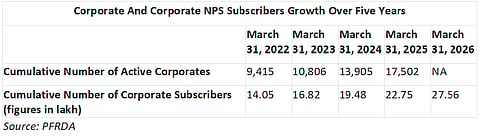
Corporate NPS Subscribers Growth Over The Years
It’s not that the corporate NPS is not growing; it is, but not at a rate like the all-citizen model, which is open to all.
On a year-over-year (y-o-y) basis, as on July 26, 2026, corporate NPS subscribers grew 16.20 per cent to 2.83 million, whereas the All Citizens Model subscriber base grew 23.30 per cent to 5.42 million, according to data from the Pension Fund Regulatory and Development Authority (PFRDA). This reflects that there is awareness about the scheme among people, but the supply of the particular model (corporate model) of NPS is low.
Advertisement
Here is the growth chart of the number of corporate and corporate subscribers:
Corporate NPS Growth Potential
Goel says, around 27,000 corporates are offering corporate NPS, which would be around 1 per cent of the total registered corporates. “There is a huge potential. Interestingly, adoption of NPS within the corporates who are offering it stands in single digits, which is a big opportunity area. The product has low awareness, but the proposition is highly attractive. With the right messaging and approach, the potential is certainly huge,” says Goel.
As far as operational and administrative hurdles are concerned, he says “technology will play a pivotal role”. “All the process steps, such as account opening, account management, payout processing, portfolio tracking, etc., will be simplified using technology,” he says.
While there is a huge scope to bring corporate NPS subscribers on board, the need of the hour is to spread awareness and make the NPS registration and maintenance processes easier for them.
Advertisement
Show comments
Published At: