Financial inclusion builds security, enabling savings, credit, and participation.
Pension preparedness crucial; India’s retirement assets lag global standards.
Digital infrastructure empowers finance, ensuring access, transparency, and safety.
Outlook Money 40After40: Financial Choices Made Today Determine Long-Term Independence, Says M. Nagaraju, Ministry of Finance
India’s pension assets are around 5 per cent of the GDP, while in many developed economies pension assets range between 70 and 100 per cent of GDP. This gap highlighted both the need and the opportunity to strengthen pension participation and retirement planning, M Nagaraju, Secretary, Ministry of Finance said at Outlook Money 40After40 Retirement Expo

Summary
Advertisement
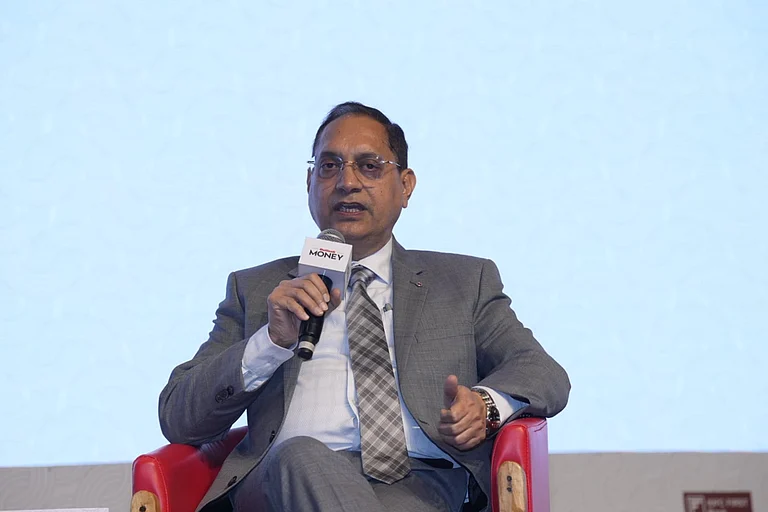
M. Nagaraju, Secretary, Department of Financial Services, Ministry of Finance, highlighted the importance of financial security at the fourth edition of IDFC FIRST Bank presents Outlook Money 40After40 Retirement Expo in Mumbai, which began on February 20, 2026. He focused his address on three topics: financial inclusion as the foundation of financial security, strengthening pension preparedness for an ageing society, and digital public infrastructure (DPI) and financial empowerment for financial security for Viksit Bharat 2047.
He described retirement as that “stage of life, which is not only about continuing growth, but also about consolidating financial strength, and protecting what has been built over decades and preparing for the future.”
“The financial choices made during this phase will determine long-term independence, stability, and dignity,” he said.
Financial Inclusion as the Foundation of Financial Security
Nagaraju said that financial inclusion has been one of India’s most important achievements over the past decade. “More than 570 million Jan Dhan accounts have been opened bringing millions of citizens into the farmer financial system for the first time. These accounts have provided a foundation for savings, credit, access and financial participation,” he said.
Advertisement
Pension Preparedness
Nagaraju also highlighted the importance of retirement planning in India’s demographic transition. He said: “India is undergoing an important demographic transition and it is estimated that by 2050 the number of citizens above the age of 60 years will nearly double. This makes retirement preparedness a crucial national priority.”
He also noted the gap in India’s pension landscape, which made retirement planning that much important. “At present, India's pension assets are around 5 per cent of the gross domestic product (GDP), while in many developed economies pension assets range between 70 and 100 per cent of GDP. This gap highlights both the need and the opportunity to strengthen pension participation and retirement planning,” he said.
He said that over 86.60 million subscribers are enrolled under the Atal Pension Yojana, which has made it a key part of India’s inclusive pension framework and underlined the need to bring more working adults into structured pension systems to ensure long-term financial security.
Advertisement
“The National Pension System (NPS) and APS together have about 92 million subscribers with an asset under management (AUM) of Rs 16,000 crore. About 290 million working adults are without any sort of security. Nearly 90 per cent of pension assets are currently concentrated with only three pension fund managers, SBI Pension Funds, LIC Pension Fund, and UTI Retirement Solutions. Greater participation and aspiration from other pension fund managers will be necessary to diversify the industry, strengthen competition and enhance long-term retirement outcomes,” he said.
Digital Public Infrastructure
Nagaraju said that India’s digital public infrastructure (DPI) has become a global model for inclusive finance. Foundational tools like Jan Dhan Accounts, Aadhaar-based digital IDs, mobile connectivity and digital payment through Unified Payments Interface (UPI) have enabled seamless banking access for millions and transformed the way India transacts, making financial services accessible, affordable and instantaneous.
“Today, financial services are no longer limited to urban centres. They are reaching every village and every household. This transformation has democratised access and created a strong and resilient financial foundation for the country. The UPI has revolutionised payments, making transactions instant, secure, and accessible,” he said.
Advertisement
He added that the Account-to-Aggregator framework has also improved access to credit and financial services while the direct benefit transfer (DBT) facility has ensured that government benefits reach citizens directly and transparently.
He further said that while digital expansion has created new opportunities, it has also brought responsibilities and risks, particularly in the form of increasingly sophisticated cybercrimes and fraudulent investment schemes.
“To address these risks, regulators and financial institutions have significantly strengthened real-time fraud monitoring, risk-based authentication and early warning systems to detect and prevent suspicious transactions,” he added.
Show comments
Published At: