India’s pension coverage remains critically low.
Ageing population demands urgent retirement planning.
NPS growth reflects rising retirement awareness.
Outlook Money 40After40: We Must Not Merely Retire; We Must Retire Right, Says PK Saxena of LIC Pension Fund
India’s aged population is predicted to increase from 10 per cent to 15 per cent, while the working-age population will increase only mildly. India is ageing gradually but steadily. However, only 29 per cent of elderly Indians receive pensions and India has one of the weakest pension coverage levels despite being the world’s most populous country, PK Saxena, MD and CEO of LIC Pension Fund said at Outlook Money 40After40 Retirement Expo

Summary
Advertisement
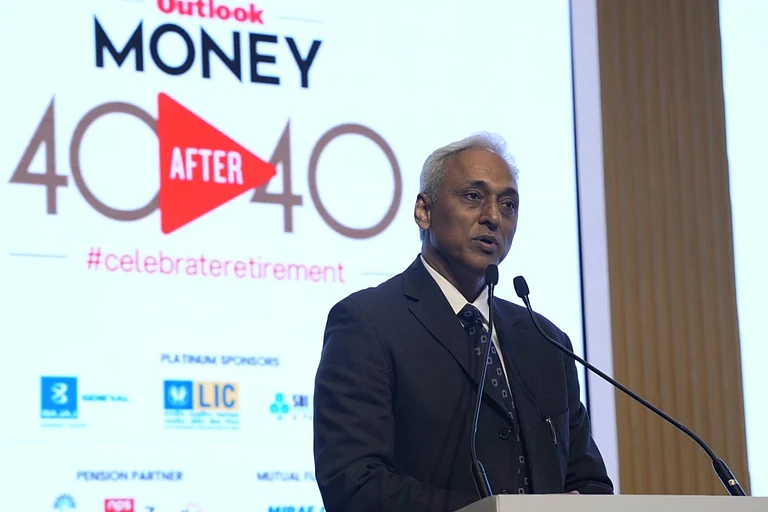
P. K. Saxena, Managing Director and CEO of LIC Pension Fund, spoke at the fourth edition of IDFC FIRST Bank presents Outlook Money 40After40 Retirement Expo in Mumbai. He discussed key aspects of India’s pension system and retirement planning for those over 40.
He highlighted the importance of starting early. “Retirement planning cannot be postponed. We must not merely retire; we must retire right,” he said.
India’s Pension Coverage Is Very Low
Saxena highlighted India’s ageing population and the pressing need for financial security in later years: “Between 2021 and 2036, the proportion of India’s population aged 60 and above is predicted to increase from 10 per cent to 15 per cent, while the working-age population will increase only mildly. India is ageing gradually but steadily,” he said.
Saxena also pointed to the coverage gap: “Only 29 per cent of elderly Indians receive pensions. We are the world’s most populous country, yet we have one of the weakest pension coverage levels. That is where our role and responsibility lie,” he added.
Advertisement
At present, the National Pension System (NPS) has around 22 million subscribers and nearly Rs 16 lakh crore in assets under management (AUM). He said that over the past decade, NPS subscribers have grown at about 9.50 per cent, whereas AUM has grown by about 37 per cent, reflecting rising confidence and growing interest among people in NPS.
He said India’s pension framework includes NPS, Employees’ Provident Fund (EPF), Atal Pension Yojana (APY), and the Unified Pension Scheme (UPS), but “pension assets in India account for only about 17-20 per cent of GDP, compared with over 60 per cent in advanced pension markets.”
“The difference is stark, almost three times, which is alarming,” he added.

Challenges To Retirement Planning
Saxena highlighted challenges to retirement planning: “A large informal workforce, irregular income, limited awareness, low long-term savings culture, fragmented systems, and low replacement rates. For many Indians, retirement planning begins too late, often after 40,” he said.
Advertisement
He also pointed at the potential for higher returns: “In the initial years, portfolios can have higher equity exposure. Many people are not aware that within NPS, options are offered up to 100 per cent equity exposure.”
Outreach Plans
He highlighted initiatives to expand reach, noting that LIC Pension Fund is working on partnerships with Farmer-Producer Organisations, micro, small and medium enterprises (MSMEs), and schemes for minors and gig workers to bring informal sector participants into NPS and APY, emphasising that this is targeted expansion, not generic outreach.
Saxena also underscored the role of digital tools and reforms led by the Pension Fund Regulatory Development Authority (PFRDA): “Digital onboarding, ENPS, digital KYC, and integration with payment platforms have simplified access. Recent exit reforms allow subscribers more flexibility in accessing their NPS funds by giving them greater control over their retirement savings.”
He further said that intermediaries play an important role in spreading awareness as even the best-designed products cannot succeed without proper distribution and guidance. “Our Association of NPS Intermediaries will work to improve training, strengthen last-mile distribution, and promote ethical, informed advisory,” he added.
Advertisement
Show comments
Published At: