



Summary of this article
Stagnant Indian equity returnspersist despite strong macroeconomic fundamentals and foreign outflows.
Balanced hybrid indices outperform pure equities with lower volatility and steadier gains.
Dynamic multi-asset allocation provides tax-efficient rebalancing and resilient long-term wealth creation.
By Jitendra Sriram, Senior Fund Manager, Baroda BNP Paribas Mutual Fund
Anybody who tracks markets, even occasionally, has heard or read that equity markets haven’t “done well” for the past two years. In January 2026, the NIFTY 50 Total Return Index briefly moved higher than the previous peak level reached on September 26, 2024.* (source: NSDL) That peak has not been reached subsequently.
Various reasons are proffered for why the equity markets have been moving sideways for almost 3 years now.

Post facto analysis
The first hypothesis for the Indian stock market malaise is that foreign investors are rushing for the exits. FII flows into equity are negative to the tune of USD 32 billion for calendar year (CY)2026. FII exits are blamed on the imposition of Long-Term Capital Gains (LTCG). But LTCG on equity investments was first introduced (or re-introduced) in 2018. Then, how does one explain the more than USD 20 Billion dollars of FII inflows in 2020 and 2023* (source: NSDL). Were FIIs not fearful of LTCG and STT then?
The second reason proffered is weak macros due to elevated prices of crude oil. Nevertheless, India has been the fastest-growing large economy for the better part of this decade. In fact, in its latest monetary policy meeting the RBI has upped its GDP estimates for India to 7.1% (source: NSDL) . Those higher growth rates, both on an absolute basis as well as when compared to the peer economies, are somehow not reflected in the equity market performance of the last three years. Inflation has been lower than long-term average levels, GDP is showing healthy growth, Interest rates are moderate, but then what gives?
Forecasting markets
The Famous economist John Maynard Keynes said, “Markets can remain irrational longer than you can remain solvent”. Basically, market prices in the near term are a reflection of multiple factors and data points. The markets as a whole may take time to recognize / price in data and information that is so obvious to many analysts. Warren Buffett said that predicting the stock market is a fool’s game. So, it’s better to diversify the portfolio across low-correlated assets to increase the potential of participating in the upside from multiple asset classes while at the same time protecting against being heavily impacted by negative returns in any single asset class.
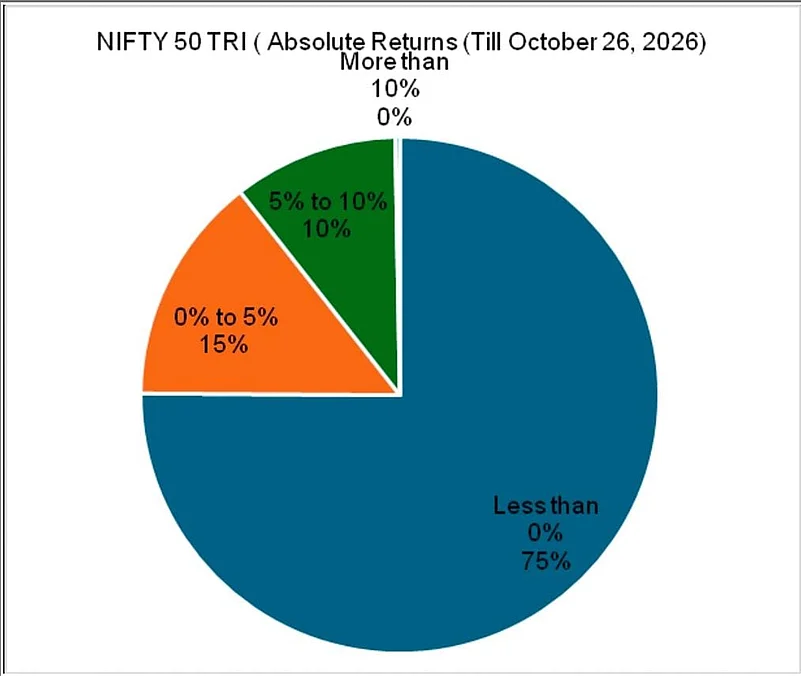
An analysis of the NIFTY 50 TR Index from the beginning of 2024 throws up some very interesting data points. Looking back, the index is up about 7.6% from the close of the last trading day of 2023, i.e. over a period of almost 34 months. (Source: NSDLand internal research)
Perhaps most concerning is that, under current conditions, there is only a 25% probability of achieving a positive financial return as on 28th September 2026 had you invested on any of the days in the period 2024-2026.
Adding to these concerns is the fact that, throughout the entire specified period, there were only two specific entry points that would have yielded a double-digit. Adding to these concerns is the fact that, throughout the entire specified period, there were only two specific entry points that would have yielded a double-digit return for an index investor."

The Diversification imperative
The Returns data of the past almost three years is a valuable empirical dataset about the virtues of diversification into low or non-correlated assets. The returns for a balanced index (NIFTY 50 Hybrid Composite Debt 50:50 Index) for the same period present a starkly different picture. The hybrid index has generated positive returns almost half the time and double digit returns almost 9% of the time. This index would also have been far less volatile.
Interestingly, the Balanced Index has beaten the equity index 678 times out of the 681 data points since December 29, 2023.

This may possibly explain why FII flows into debt are actually positive - of about USD 7 billion (as on October 26, 2026) even as they are selling equity. (Source: Internal)
The data above clearly shows that having a mix of hybrid led to both higher absolute and risk-adjusted return outcomes for investors. Just like a balanced diet and a Work-Life balance maximise health and wellness, a balanced hybrid fund helps you deal better with the volatile, uncertain times that we live in. Furthermore, actively managed balanced hybrid funds dynamically rebalance allocations in response to asset price moves and the relative attractiveness of each asset class – all without creating a tax incidence for the fund’s investors.
Furthermore, actively managed balanced hybrid funds dynamically rebalance allocations in response to asset price fluctuations and the shifting relative attractiveness of each asset class—all without triggering a tax liability for the fund's investors."
Conclusion:
When market cycles turn unpredictable, and equity returns flatten, diversification is no longer just a defensive strategy—it is the cornerstone of sustainable wealth creation. By combining the growth potential of equities with the stability of fixed income, balanced hybrid funds help smooth market volatility without compromising long-term objectives. For investors seeking a disciplined way to navigate uncertainty, these dynamic asset allocation vehicles offer an ideal core holding—delivering both risk-adjusted resilience and tax-efficient rebalancing over a three-to-five-year horizon.
Balanced hybrid funds have the potential to be a core allocation for retail investors' portfolios, particularly for those with a medium- to long-term investment horizon of three years or more but with a moderate risk appetite.
Source: NSDL, NSE and internal research as on 30th October 2026
(Disclaimer: Views expressed are the author’s own, and Outlook Money does not necessarily subscribe to them. Outlook Money shall not be responsible for any damage caused to any person/organisation directly or indirectly.)