Summary of this article
Prices for premium homes rose across most markets as demand from high net-worth buyers remained buoyant and stock of quality homes stayed limited.
The under construction premium segment saw steady growth in prices, with year-on-year average capital values rising in most top-end residential markets.
Ready premium homes and luxury floors witnessed mixed trends in major residential cities.
Despite rising global economic uncertainty, India’s luxury housing market continued to stand on solid ground during the first half of 2026. Prices for premium homes rose across most markets as demand from high net-worth buyers remained buoyant and stock of quality homes stayed limited. Apartment capital values rose by as much as 28 per cent year-on-year in certain micro-markets, Savills India reported.
This strength in the sector is visible when the world is facing heightened economic uncertainty with evolving geopolitical and trade tensions. India's strong macroeconomic fundamentals coupled with rapid infrastructure development, robust and well-supported banking system and continued wealth creation within the country have given further confidence to investors and NRIs to consider buying into premium residential property as a long-term investment option, the report noted.
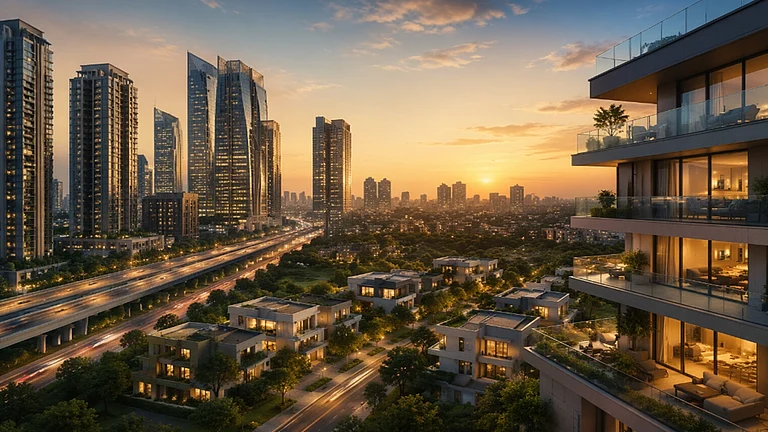
Buoyant macroeconomic conditions aided capital value appreciation in residential spaces. The under construction premium segment saw steady growth in prices, with year-on-year average capital values rising in most top-end residential markets. Mumbai saw an increase of 10-15 per cent YoY, Noida saw price rise by around 4-28 per cent YoY, Gurugram saw prices increase by approximately up to 2 per cent while Bengaluru witnessed capital value uptick of around 3-11 per cent YoY. This uptrend signifies continued investor interest in modern and future-ready projects in highly-accessible growth corridors. It also signals a market gradually shifting from frenzied repricing to stable value addition backed by premiumisation, rising incomes, calibrated supply and persistent demand for the better.
Additionally, ready premium homes and luxury floors witnessed mixed trends in major residential cities. Annual average capital values of finished apartments were in the range of 10–25 per cent in Delhi, 8–10 per cent in Bengaluru, 2–7 per cent in Mumbai and 2-6 per cent across various micromarkets in Gurugram, except for Golf Course Road which saw a fall of 2 per cent YoY. This uptick was aided by low ready inventory, higher demand for ready projects and improving rental metrics across prime residential areas. However, Noida saw a decline of around 2 per cent YoY at the city average because of normalisation of prices.
Furthermore, rental yield for premium residential properties continued to show healthy demand. Rental prices across metros saw an increase, attributed to consistent demand for ready-to-move-in properties, shortage of supply of completed units and preference toward developments that are well-connected and provide a lifestyle experience.
Although the residential sector is healthy, growth has slowed since buyers are becoming more discerning about the properties they buy. Instead of speculation, they value factors such as location, construction quality and developer pedigree. The luxury residential sector is slowly becoming more institutionalised.
Commenting on the same, Shveta Jain, Managing Director, Residential Services, Savills India, said, “India’s luxury residential market continues to report healthy capital value growth driven by robust market fundamentals instead of rampant price growth. Today’s buyers are far more discerning than ever before, choosing their purchase destination based on location, quality of product and developer credentials reflecting an emerging trend of quality led demand picking up. While some micro markets experienced small price corrections during the year, most were the result of normalisation of prices and can be attributed to a well-balanced market.”
“Overall, we foresee the market reporting healthy price appreciation during the year ahead, as Savills continues to expect premium residential real estate to remain a favoured long-term investment avenue driven by calibrated supply, rational pricing and buyers’ preference towards premium residential offerings,” she added.