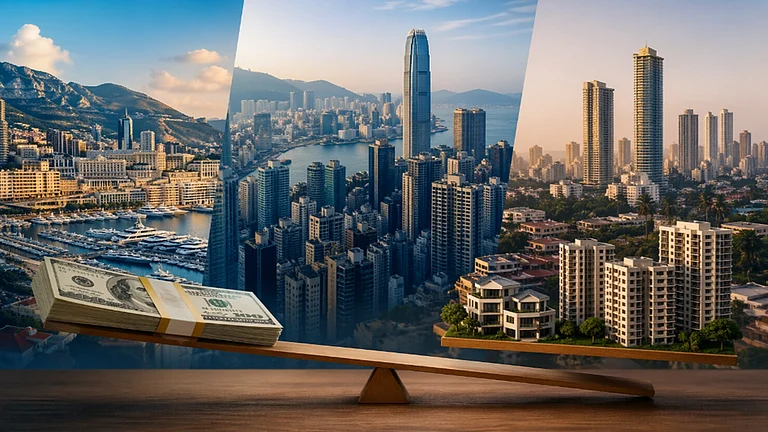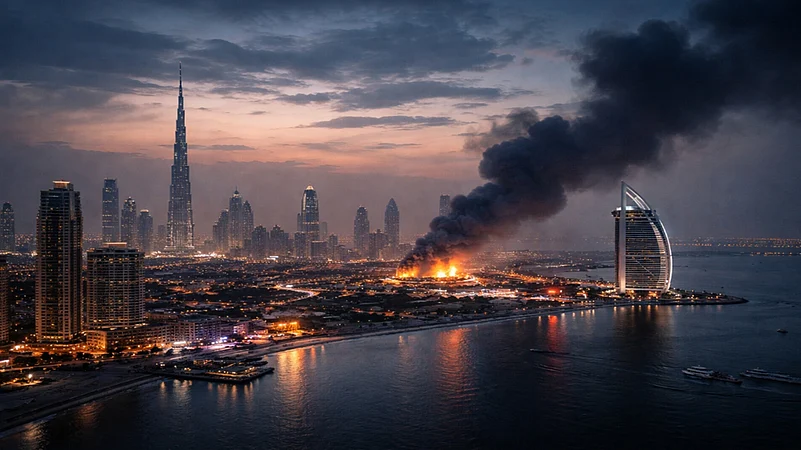

Hit hard by fast-rising property prices at home, a growing number of salaried professionals, wealthy Indians and entrepreneurs are looking beyond Indian metros and channeling their savings into global real estate markets. And Dubai has emerged as a preferred investment destination for Indian homebuyers. However, recent Iranian retaliatory strikes on Dubai’s airspace amid a wider Middle East escalation could dent its image and prompt investors to reassess the emirate’s long-standing reputation for safety.
According to industry experts, investors focused on Dubai may experience a temporary perception shift about how safe the market is. The UAE's quick steps and strong safety precautions, on the other hand, show how committed it is to stability.
Morgan Owen, Managing Director - Middle East & North Africa, ANAROCK Group, says, “Dubai is and will remain a preferred destination to buy ultra-luxury real estate. The market fundamentals are strong, and the city will continue to be attractive and have growth potential in the long run. As an illustration - after the terrorist attacks in Mumbai in 2008, the real estate market suffered a brief halt in sales and small price drops. However, it bounced back within a few months because of strong economic fundamentals and renewed investor confidence.”
“Dubai's real estate sector may also have short-term perceptions of risk, but its strong security measures and growth drivers will continue to make it appealing to Indian HNIs in the long term,” he adds.

Investment advisors point out that any attack creates a temporary perception dent, especially in a city that sells safety as part of its luxury promise. Indian HNIs may pause, reassess, and renegotiate, but they rarely exit on emotion alone.
“Capital at that level tracks governance strength, policy stability, tax efficiency and long-term control. If authorities respond swiftly and communication remains tight, confidence stabilizes quickly. Globally, prime real estate markets have survived similar shocks. In fact, seasoned investors often see moments after these as entry points post corrections, not exit signals. The brand UAE may wobble briefly, but structural appeal remains intact, as of now,” says Aman Dhall, Angel Investor & CEO, CommsCredible Venture Fund.
Financial experts, however, say geopolitics plays a very important role while investing outside one’s home country. “Till recently, Dubai was considered as a safe sanctuary due to its dissociation from West Asia politics. But recent attacks on Dubai could impact the sentiment among HNIs for real estate investment. Real estate investment, unlike financial investment, gets more impacted by such events. So, geopolitics should be weighed in before investing a large part of one’s net-worth in such locations,” advises Abhishek Kumar, Founder of SahajMoney.
How Will Dubai Realty Get Impacted?
All said and done, however, when assessing how recent events might impact Dubai's appeal to Indian HNIs, it is important to look at the maturity of this specific investor base. The Dubai-India real estate corridor is deeply established, and these buyers are historically long-term players, not reactionary ones. Naturally, whenever regional geopolitical noise peaks, you will see a temporary 'wait-and-see' approach in the market for a few days. That isn't panic; it is simply prudent wealth management.
“However, we have to look at how sophisticated capital defines a 'safe haven.' For Indian wealth, a safe haven isn't necessarily a location completely isolated from the realities of its broader geography - it is a jurisdiction equipped to effectively neutralise those external variables. What investors have watched over the last few days is a highly practical demonstration of the UAE's defense infrastructure. Seeing these systems successfully intercept threats actually transitions Dubai’s security from a theoretical concept into a proven, operational fact. In many ways, it reassures Indian family offices that the premium they pay for stability here is entirely justified,” says Ritu Kant Ojha, Dubai-based real estate strategist and CEO, Proact Luxury Real Estate.
Since the core drivers for Indian investment -geographical proximity, capital preservation, and lifestyle - remain fundamentally unchanged, the market is likely to absorb this specific news cycle quite efficiently.
“I expect transaction velocities to remain normal. Ultimately, seasoned Indian investors understand that any short-term hesitation in the market doesn't alter the long-term trajectory of Dubai real estate; rather, it often creates a brief, strategic window to acquire premium assets,” says Ojha.
Given the recent events in Dubai, it is only natural that there is a period of close evaluation for Indian HNIs, especially for ultra-luxury properties where safety and perception are closely linked. Nevertheless, it is worth noting that Dubai’s attractiveness for Indian HNIs is not merely based on a transactional relationship but is underpinned by a regulatory environment, tax environment, infrastructure, and perception of stability.
“Indeed, any security issues may temporarily influence sentiment and trigger a period of caution for HNIs. However, as a mature investor class, they would be quick to distinguish between episodic events and fundamentals. Dubai’s response mechanism for addressing security issues, along with its transparent communication and robust system of governance, would be a strong factor for restoring investor confidence. In the long term, Dubai’s potential for higher yields, liquidity, and connectivity makes it a strategically important location for portfolio diversification,” says Paras Rai, Managing Director and Co-Founder, Property Master.
Dubai has indeed worked very hard for decades to become known as one of the safest ultra-luxury destinations in the world. So, this one-off event is unlikely to change overnight.
“Indian HNIs have always looked at investing in Dubai as more than just making money. They also look at lifestyle, tax efficiency, and the golden visa ecosystem. But with high-end real estate, perception is very important. If security issues last too long, wary purchasers may choose Singapore, London, or even India's own high-end neighbourhoods. The true test will be how quickly and clearly the UAE government acts to restore trust. Dubai has faced problems before, and in the past, it has built stronger infrastructure rather than backing down. Indian HNI capital will keep a careful eye on things, but it won't leave for no reason,” says Shankey Agrawal, Partner, BMR Legal.