






Summary of this article
Nvidia lost nearly $493 billion in market value during a volatile trading week
Indian mutual funds hold Nvidia shares directly and through overseas funds
Mirae Asset S&P 500 Top 50 ETF has the highest exposure at 12.90 per cent
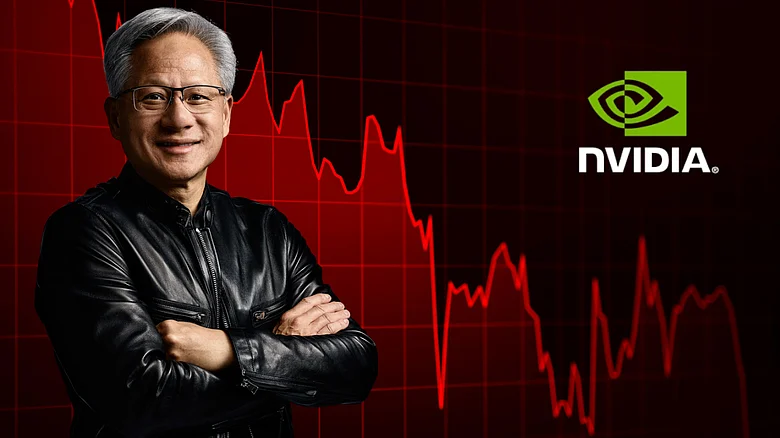
Nvidia's share price came under pressure after reports surfaced about CEO Jensen Huang's alleged extramarital affair with a woman suspected of having links to Chinese intelligence. The controversy intensified following reports of his resignation, adding to concerns about the chipmaker's leadership.
Following the reports, Nvidia's market value fell from around $4.498 trillion (Rs 424.38 lakh crore) at the end of the previous week to about $4.005 trillion (Rs 377.86 lakh crore) after a volatile week of trading. The fall wiped out nearly $493 billion (Rs 46.52 lakh crore) in market value.
This also affected investors in international funds that invest in US technology stocks or track indices such as the Nasdaq 100 and the S&P 500.
Several Indian mutual fund schemes hold Nvidia shares directly, while others have exposure through overseas exchange-traded funds (ETFs) and actively managed funds. The extent of this exposure varies across schemes, depending on how much they have invested in the stock, either directly or through an underlying fund.
Investors may, therefore, be exposed to Nvidia even if their Indian mutual fund scheme does not hold the company's shares directly.
Nvidia Exposure In Indian Mutual Funds
Indirect Exposure: Mirae Asset S&P 500 Top 50 ETF had 12.90 per cent of its portfolio in Nvidia, while Mirae Asset NYSE FANG+ ETF had 9.93 per cent. Motilal Oswal Nasdaq 100 ETF and ICICI Prudential Nasdaq 100 Index Fund held 8.02 per cent and 8.35 per cent in the stock. Motilal Oswal S&P 500 Index Fund had an allocation of 7.56 per cent.
These funds track indices that assign a significant weight to Nvidia. Their exposure depends on the stock's weight in the index rather than the fund manager's investment decision. This allocation can change when the index provider rebalances the index or revises Nvidia's weight. The fund's actual holdings may also differ slightly from the index.
The Kotak US Specific Equity Passive FoF invests 99.93 per cent of its assets in the Nasdaq 100 UCITS ETF, where Nvidia accounts for 8.02 per cent of the portfolio.
Invesco India Invesco EQQQ Nasdaq-100 ETF FoF invests in the Invesco EQQQ Nasdaq-100 UCITS ETF. The Indian scheme had 99.63 per cent of its assets invested in the overseas ETF. Nvidia accounted for 8.05 per cent of the underlying ETF's portfolio as of July 31, 2026.
Mirae Asset Global X Artificial Intelligence & Technology ETF FoF invests in the Global X Artificial Intelligence & Technology ETF. Nvidia accounts for 2.35 per cent of the overseas ETF's portfolio.
Kotak Global Innovation Overseas Equity Active FoF invests in Wellington Global Innovation Fund. The Indian scheme had 78.1 per cent of its assets invested in the overseas fund, where Nvidia accounted for 8.6 per cent of the portfolio as of September 30, 2026. This translates into an estimated effective exposure of around 6.72 per cent for the Indian FoF.
Edelweiss US Technology Equity FoF invests in JPMorgan Funds - US Technology Fund, while Franklin U.S. Opportunities Equity Active FoF invests in Franklin U.S. Opportunities Fund. Both underlying funds have included Nvidia among their holdings in earlier disclosures.

Direct Exposure: Aditya Birla Sun Life International Equity Fund has a direct allocation to the company, with 4.91 per cent of its portfolio invested in the chipmaker. Edelweiss Technology Fund also holds Nvidia directly, with an allocation of 4.74 per cent.
Other actively managed schemes with direct exposure include Axis Innovation Fund, which has 1.36 per cent invested in Nvidia, and Franklin India Technology Fund, with an allocation of 1.35 per cent. ICICI Prudential US Bluechip Equity Fund has 0.66 per cent exposure. Unlike index funds, these schemes can change their holdings based on the fund manager's assessment of Nvidia's business prospects and valuation.
Nvidia also features in the portfolios of some diversified domestic schemes. DSP Multi Asset Allocation Fund has 1.44 per cent invested in the stock, while DSP Value Fund and Axis Large & Mid Cap Fund have allocations of 0.91 per cent and 0.63 per cent, respectively.
How Much Could A Further Fall In Nvidia Affect Mutual Fund Returns
The impact on a mutual fund's NAV depends on Nvidia's weight in the portfolio and the extent of the stock's price movement. If Nvidia falls 10 per cent and all other investments remain unchanged, a scheme with 12.90 per cent exposure could see its portfolio value decline by about 1.29 per cent due to that holding alone. For a scheme with 4.91 per cent exposure, the corresponding impact would be about 0.49 per cent. For a scheme with 0.63 per cent exposure, it would be around 0.06 per cent.
This is an illustrative calculation. In practice, other stocks in the fund's portfolio could also gain or lose value, either offsetting or adding to the impact of Nvidia's decline.
The rupee-dollar exchange rate is another factor for international schemes. A weakening rupee against the dollar can cushion some of the impact of a fall in US stocks when returns are translated into rupees. A strengthening rupee can have the opposite effect.





