




Summary of this article
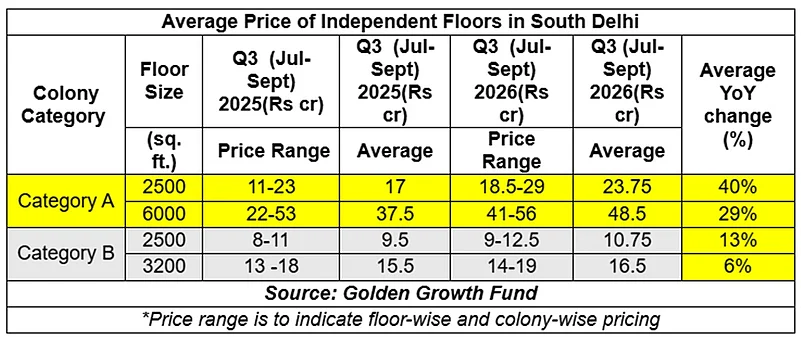
Luxury floor prices in South Delhi's Category A colonies rose by up to 40 per cent year-on-year in Q3 2026, with a 2,500 sq. ft. floor now costing Rs 18.5-29 crore.
Category B colonies recorded a relatively modest price increase of 6-13 per cent, depending on the size of the property.
Around 18,500 plots across 42 Category A and B colonies offer an estimated redevelopment opportunity worth Rs 6.5 lakh crore, according to Golden Growth Fund.
Buying an independent floor in South Delhi is getting considerably more expensive. Prices in some of the capital's premium residential colonies have gone up by as much as 40 per cent in the July-September 2026 quarter compared with a year ago, according to a report by Golden Growth Fund, a Category II real estate-focused Alternative Investment Fund.
The increase has been particularly sharp in Category A colonies, where even a 2,500 sq. ft. floor now commands Rs 18.5-29 crore. A year ago, similar properties were available in the range of Rs 11-23 crore, the report said.
Larger homes have also become more expensive. A 6,000 sq. ft. floor in these colonies, which was priced at Rs 22-53 crore in the third quarter of 2025, was priced at Rs 41-56 crore in the September 2026 quarter. This represents an annual increase of 29 per cent.
The rise was visible in the larger homes too. A 6,000 sq. ft. floor, which was priced at Rs 22-53 crore in Q3 2025, now costs Rs 41-56 crore. The price has gone up by 29% in a year.
The list of Category A colonies includes Vasant Vihar, Panchsheel Park, Anand Niketan, Shanti Niketan, Westend, Chanakyapuri, Golf Links, Jor Bagh, Sundar Nagar and Mayfair Garden.
Prices have moved up in Category B colonies as well, though the increase has been less pronounced. A 2,500 sq. ft. floor in these areas now costs Rs 9-12.5 crore, against Rs 8-11 crore a year earlier, marking a rise of 13 per cent.
For a 3,200 sq. ft. floor, the price range has moved from Rs 13-18 crore to Rs 14-19 crore, an increase of 6 per cent.
Greater Kailash, Green Park, Gulmohar Park, Defence Colony, Safdarjung Enclave, Niti Bagh, Anand Lok, Chirag Enclave and Kailash Colony are among the Category B colonies covered in the report.
Why Are Prices Rising?
Demand from high-net-worth individuals (HNIs) and non-resident Indians (NRIs) is one of the factors supporting prices. But the bigger constraint is the limited availability of properties in these established neighbourhoods. Buyers looking for larger homes in familiar localities have relatively few options, particularly when they want an independent floor rather than an apartment in a high-rise building.
Redevelopment is also changing the nature of housing supply in these colonies. Older properties are being redeveloped into new independent floors, attracting buyers willing to pay a premium for newer construction and larger living spaces.
"South Delhi's residential market continues to demonstrate strong momentum, with luxury independent floor prices appreciating by 6-40 per cent across key colonies," said Ankur Jalan, CEO, Golden Growth Fund.
He said the fund was also seeing interest from affluent investors looking to diversify their investments amid geopolitical uncertainties in West Asia. The established infrastructure, limited supply and rental potential of South Delhi properties were among the reasons for their continued appeal, he added.

Rs 6.5 Lakh Crore Redevelopment Opportunity
The scale of the redevelopment opportunity is substantial. Golden Growth Fund estimates that around 18,500 plots are spread across 42 Category A and B colonies in South Delhi. Their redevelopment potential is pegged at Rs 6.5 lakh crore.
The Municipal Corporation of Delhi (MCD) puts Delhi's residential colonies in eight categories, from A to H. These categories are used to fix circle rates and calculate property tax and stamp duty on property transactions.
With 18,500 plots in these colonies, developers have a sizeable stock of old properties to work with. Redeveloping them could bring more independent floors into areas where finding an empty plot is difficult. But the rising prices are making these neighbourhoods increasingly unaffordable for many prospective buyers.





