




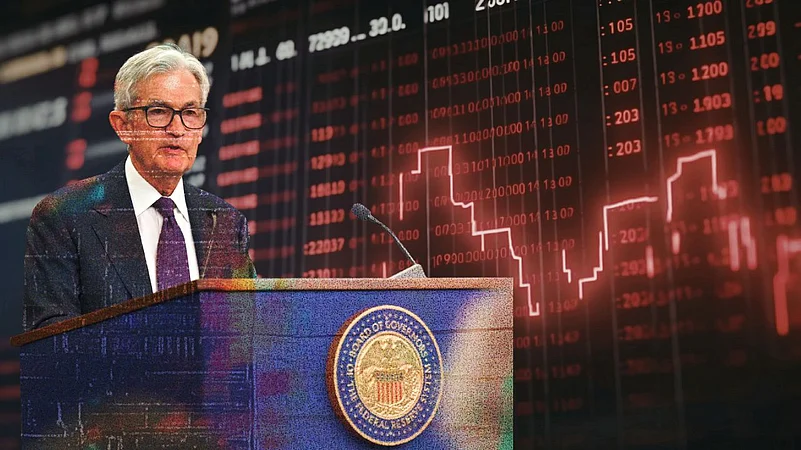

The US Federal Reserve (Fed) kept its benchmark interest rate unchanged for the third straight meeting as policymakers remained cautious over persistent inflation and awaited a leadership transition.
The rate-setting Federal Open Market Committee (FOMC) decided to keep the benchmark interest rate unchanged at 3.50 per cent to 3.75 per cent range, in line with market expectations. Prior to the two-day FOMC's meeting, which concluded on April 29, Chicago Mercantile Exchange's FedWatch Tool showed a 100 per cent chance that the US Fed will maintain status quo.
The meeting was likely the last one chaired by Jerome Powell, who is set to step down as Fed Chair on May 15. However, he announced that he will continue on the US Fed's Board of Governors until the US Department of Justice's investigation into him is "well and truly over."
Powell said the US economy is expanding but "inflation has moved up with growing global energy prices" as developments in West Asia have added uncertainty.
Central banks usually raise interest rates when inflation is high to reduce spending and encourage savings. This helps slow down rising prices. When the economy is weak, they usually cut rates to boost spending, investment, job creation and growth.
What US Fed's Decision Means For Indian Markets
The US Fed’s decision to keep interest rates unchanged may keep global markets cautious, and its impact will likely to be seen on Indian stocks, the rupee and commodities as well. Ravi Singh, chief research officer - research at Master Capital Services, said the current liquidity situation is still challenging for emerging markets like India.
"On the liquidity front, the setup is pretty clear. With US Treasuries still offering highly attractive yields, Foreign institutional investors (FIIs) just don't have the urgency to chase emerging market returns right now." However, he added that "the silver lining is our domestic flows through Systematic Investment Plans (SIPs). They are acting as a massive shock absorber, effectively putting a floor under any major FII dumping."
Singh said a hawkish Fed stance may keep the US dollar supported and put pressure on the rupee.
"In the currency markets, a hawkish Fed naturally keeps the Dollar Index bid up, which keeps the rupee sweating near its historic lows." He added that the Reserve Bank of India (RBI) is likely to remain active to manage volatility. "You can expect the RBI to be highly active here, stepping in to iron out any sharp spikes in volatility."
Speaking on commodities, Singh said, "Normally, high rates crush gold, but the geopolitical risk premium is keeping it structurally bid. Crude, meanwhile, is just chopping around, caught in a tug-of-war between rate-driven demand fears and geopolitical supply risks."
How Have Domestic Markets Reacted To US Fed's Decision Today
Domestic equities saw a broad-based sell-off on April 30, a day after the US Fed's decision. Benchmark indices slipped more than 1.50 per cent, as of the mid-session.
As of 12:30 PM, the 30-share BSE Sensex, had lost as much as 1,237.50 points, or 1.59 per cent, to hit an intraday low of 76,258.86. Likewise, the NSE Nifty 50 tumbled 380.80 points, or 1.57 per cent, to the day's low at 23,796.85.
Broader markets too came under sharp selling pressure, with the Nifty Midcap 100 falling as much as 1.75 per cent and the Nifty Smallcap 100 declining up to 1.53 per cent. The Nifty 500 index, which captures nearly 92 per cent of the free-float market capitalisation of all NSE-listed companies, slipped as much as 1.63 per cent.
While Powell’s warning on rising inflation due to higher energy costs and the US Fed’s signal that rate cuts may take longer than expected weighed on investor sentiment in the April 30 session, the real trigger was the fresh escalation in geopolitical tensions between the US and Iran, which sent crude oil prices sharply higher and raised fresh concerns over inflationary pressures.


Brent crude climbed as high as $126 per barrel, its highest level since 2022. The WTI crude surged up to $110 a barrel. For India, higher crude prices are a key concern as the country depends heavily on oil imports.
The US Treasury has frozen more than $344 million in cryptocurrency allegedly linked to Iran. Reports also said the US may deploy Dark Eagle hypersonic missiles to the West Asia. Meanwhile, Russian President Vladimir Putin warned the US of “damaging consequences” if it takes fresh military action against Iran, adding to global uncertainty.
Gold's June futures contract on the Multi Commodity Exchange (MCX) rose as much as 1.70 per cent to Rs 1,51,595 per 10 grams. In the international market, on COMEX, the June futures contract surged up to 1.75 per cent to $4,641.40 per ounce.
Even though gold prices rose in today's session, the metal is still facing pressure from interest rate expectations.





