






Summary of this article
Delhi HC allows 85-year-old father to evict son.
Senior citizens need not prove harassment for eviction.
Son and daughter-in-law ordered to vacate within four weeks.
An 85-year-old man in Delhi had spent years living with harassment from his eldest son and daughter-in-law. After his wife died, the situation at home worsened. Matters reached a breaking point in September 2022, when his eldest son put his hands on his younger son during an argument.
The elderly father eventually had to approach the police, and later the courts, to seek relief. Four years later, he has secured an eviction order from the Delhi High Court, which ruled that senior citizens do not need to prove harassment through extensive evidence to reclaim their homes from children.
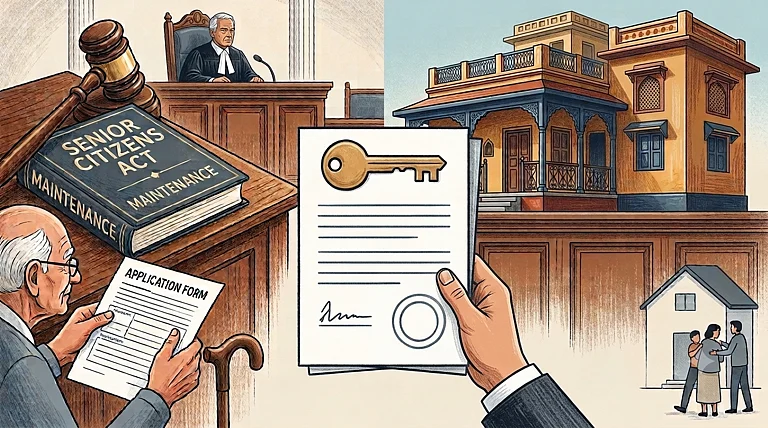
His Son Refused To Move Out Of His Father's House
Malhotra owns a flat in Masjid Moth, Delhi. He acquired the property on lease from the Delhi Development Authority (DDA) in 1980 and converted it into freehold in 2000.
His eldest son moved into the house in 2003 after getting married. As his other two sons got married in 2005 and 2008, Malhotra asked the eldest son to arrange separate accommodation. However, he and his wife refused to leave.
Following Malhotra's wife's demise in late 2020, the alleged harassment took a higher degree. Malhotra ultimately filed a police complaint after he was again assaulted in September 2022, and began legal proceedings to get his son and daughter-in-law evicted.
No Need To Prove Harassment To Seek Eviction
The lower courts had denied support to Malhotra as they did not believe that Malhotra had enough evidence to support his claim. But the Delhi High Court overruled these decisions, stating that the Maintenance and Welfare of Parents and Senior Citizens Act, 2007 does not state that elderly parents have to establish instances of ill-treatment through detailed evidence for seeking eviction.
The court recognised that harassment inside homes can be difficult to establish through independent witnesses or other evidence. Proceedings under the Act are summary in nature, and authorities cannot demand proof equivalent to that required in civil or criminal trials.
It also criticised the enquiry reports prepared by the Sub-Divisional Magistrate for failing to properly examine the evidence and explain why the allegations were rejected.
A Parent Cannot Be Forced To Share Their Home
The eldest son's side argued that the eviction case was driven by a dispute between the two brothers. The court, however, held that a family dispute does not automatically make an elderly parent's complaint invalid.
Since Malhotra is the property's absolute owner and the relationship with his eldest son has deteriorated, the court ruled that he cannot be compelled to share his home against his wishes.
The Delhi High Court finally directed the son and daughter-in-law to vacate the flat within four weeks, ruling that an 85-year-old man is entitled to live in his own home peacefully and with dignity.