





Summary of this article
Rising digital payment fraud is putting consumer trust to the test, with fraudsters increasingly relying on social engineering and fake payment confirmations.
RBI's tighter authentication norms aim to make digital transactions safer, but repeated OTPs and payment approvals can inconvenience customers.
Biometrics, tokenised cards and real-time fraud detection are helping payment companies strengthen security while keeping checkouts quick and convenient.
India's digital payments system keeps setting records. The Unified Payments Interface (UPI) alone processed 25.47 billion transactions worth Rs 31.53 lakh crore in October 2026, according to National Payments Corporation of India (NPCI) data. However, the speed that makes paying easy has also helped fraudsters.
"A payment system runs on confidence. The day a customer stops and thinks twice before approving a payment, or a shopkeeper starts doubting the confirmation on a phone screen, you have a trust problem," says Kumar Manish, Founder & CEO, SabPaisa, a payment aggregator.
Manish points to provisional Reserve Bank of India (RBI) data showing 3.58 lakh reported cases of digital payment fraud involving Rs 493 crore in September 2026, up 18 per cent from a year earlier.
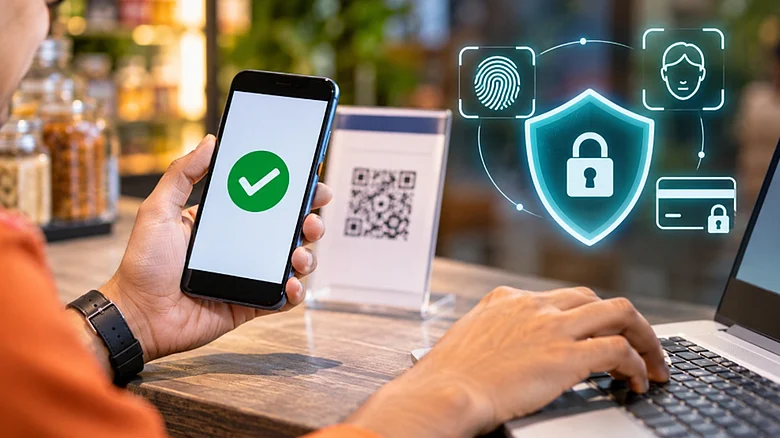
Much of today's fraud does not involve breaking into a system. The customer is persuaded to pay. Fraudsters pose as customer support staff or talk users into sharing an OTP. Merchants, meanwhile, face counterfeit UPI apps that show a realistic confirmation screen though no money has moved.

"We see small retailers checking their bank statement in the middle of the evening rush because they can't trust what the customer's phone is showing. That is a cost of fraud which never shows up in the numbers," he says.
Regulators have responded with tighter rules. Since October 2022, Card-on-File Tokenisation norms have barred merchants and payment gateways from storing actual card numbers, and they must hold a token instead.
“Recurring debits above Rs 15,000 need additional authentication each time, with the limit at Rs 1 lakh for insurance premiums, mutual fund subscriptions and credit card bills. RBI directions effective April 2026 require two distinct authentication factors for domestic digital payments, reducing reliance on SMS OTPs. MuleHunter.AI, developed by the Reserve Bank Innovation Hub, is also being used to detect mule accounts,” says Manish.
These safeguards have come at a cost to the user. When tokenisation rolled out, shoppers had to key in card details again on every platform. Loan EMIs or business software subscriptions above Rs 15,000 need approval every billing cycle.
"Every one of these rules is necessary. The trouble starts when security is added as one more checkpoint the customer has to clear. A delayed OTP is enough to fail an EMI, and then the customer is annoyed, and the merchant's cash flow takes the hit," says Manish.
The industry is now moving towards checks that run in the background. UPI users can approve payments of up to Rs 5,000 with a fingerprint or face scan in place of a PIN. Tokenised cards allow one-click checkouts online without exposing the card number. Banks and payment aggregators also run risk engines that study the device, location and behaviour behind each transaction, stopping suspicious payments and letting the rest through.
"People tend to think of security and convenience as a trade-off, that you give up one to get the other. It doesn't have to work that way. The best security is the kind the customer never notices," he says.
The shift matters most for institutions collecting payments at scale, such as universities, hospitals and public sector enterprises.
For a university or a hospital collecting fees, what matters is knowing the money has actually settled. “If that confirmation can't be tampered with and reconciliation happens on its own, a lot of the fraud risk goes away before anyone has to think about it," says Manish.