





Summary of this article
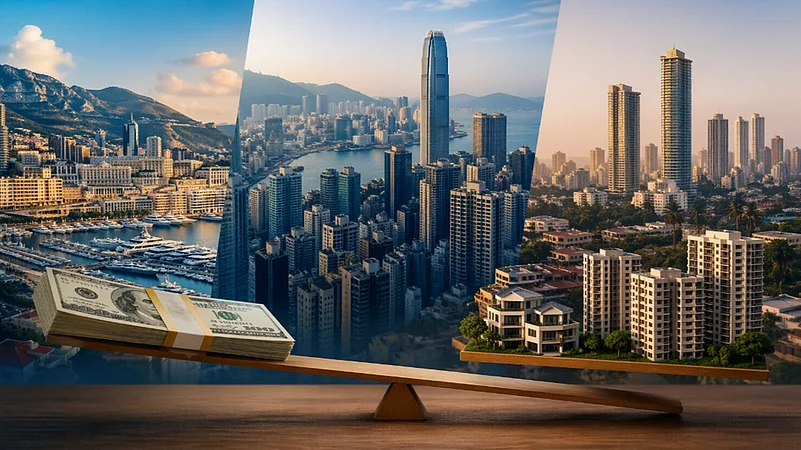
The report’s Prime International Residential Index (PIRI) tracker shows that Monaco remains the world’s most expensive prime housing market in 2025, where $1 million buys just 16 square metres of space.
Luxury home prices climbed roughly 8.7 per cent in Mumbai, 6.9 per cent in Delhi, and 9.4 per cent in Bengaluru, outpacing the currency effect and reducing how much space buyers get for the same dollar budget.
The global luxury property market remains uneven. Out of 100 cities tracked, 73 saw prices rise while 24 recorded declines.
Luxury homes in India’s top cities are getting pricier, and that’s quietly shrinking how much space global buyers can get for a $1 million budget. Even though the rupee has weakened, it hasn’t been enough to offset the surge in property prices. According to Knight Frank’s Wealth Report 2026, buyers in Mumbai, Delhi and Bengaluru found themselves able to purchase less prime residential space in 2025, as strong demand and sharp price rises outpaced currency movements.
The report’s Prime International Residential Index (PIRI) tracker shows that Monaco remains the world’s most expensive prime housing market in 2025, where $1 million buys just 16 square metres of space. It’s followed by Hong Kong (23 sq m) and Geneva (28 sq m).
While Indian cities still offer more space for the same money, that advantage is shrinking. In Mumbai, $1 million now buys about 96 sq m of prime property, down from 99 sq m a year ago. In Delhi, it buys 205 sq m (from 208 sq m earlier), and in Bengaluru, about 357 sq m (down from 370 sq m).
This drop isn’t because the rupee strengthened - it actually weakened by around 5.4%. But property prices in these cities rose even faster. Luxury home prices climbed roughly 8.7 per cent in Mumbai, 6.9 per cent in Delhi, and 9.4 per cent in Bengaluru, outpacing the currency effect and reducing how much space buyers get for the same dollar budget.
Indian Cities Climb Global Rankings
Despite shrinking space, India’s luxury housing markets are gaining global prominence. Knight Frank’s global house price report, PIRI 100 - an index of 100 cities around the world - saw average prices rise 3.2 per cent in 2025. For the second consecutive year, luxury housing prices have seen higher growth than mainstream markets.
Bengaluru rocketed up 32 spots in the rankings to be ranked as the world’s 8th most rapidly-appreciating luxury housing market on the back of price increases of 9.4 per cent. Mumbai also experienced healthy growth this year, climbing to 10th place globally on price rises of 8.7 per cent, with buoyant demand across premium and super-premium segments helping lead the market and propel high-end sales to record levels above $2 million. Price growth in Delhi was once again healthy as demand across the luxury market remained firm, with the city climbing 1-spot to rank as the world’s 17th most expensive market on price rises of 6.9 per cent.
A Mixed Global Picture
The global luxury property market remains uneven. Out of 100 cities tracked, 73 saw prices rise while 24 recorded declines. Some markets saw extreme movements. For example, Tokyo experienced a large increase of 58.5 per cent in luxury new-build apartments. Some Chinese cities saw declines in prices, including Guangzhou, which experienced a decline in prices of more than 12 per cent.
By region, the Middle East posted the strongest growth at 9.4 per cent, led by Dubai, where prices rose 25.1 per cent. Latin America and the Caribbean posted growth of 4.7 per cent. The Asia-Pacific region posted similar growth to Europe at about 3–4 per cent. North America was the only region to decline, slipping 0.9 per cent amid weakness in Canadian housing.
What’s Driving The Trend
Shishir Baijal, international partner, chairman & managing director, Knight Frank India, says, “India’s rise in the rankings reflects growing wealth and strong demand for luxury homes, especially in cities like Bengaluru, Mumbai, and Delhi. As the number of high-net-worth individuals continues to grow, so does the appetite for premium real estate.”
Liam Bailey, global head of research at Knight Frank, adds: “Luxury housing is increasingly being driven by global wealth creation rather than local economic cycles. Many ultra-wealthy buyers are now spreading their investments across multiple countries, using prime property not just as a home, but as a lifestyle and strategic asset.”


In short, even as currencies fluctuate, one trend is clear: demand for luxury real estate is staying resilient - and in many places, it’s getting more expensive faster than buyers might expect.





