



Summary of this article
A new report titled 'People Risk 2026 Report' by Marsh warns that rising living costs outpacing wage growth are creating structural financial insecurity for employees.
The risk is now ranked the fourth biggest 'people risk' globally.
Based on responses from over 4,500 HR and risk professionals, the report links financial stress to lower productivity, higher attrition, and cultural erosion.
Employees' financial insecurity can become an organisational issue if ignored. According to a report titled, People Risk 2026 Report, recently released by Marsh, a global insurance broking and risk management firm, employee financial insecurity can directly threaten corporate productivity, retention, and workplace culture. As the cost of living continues to outpace wage growth globally, the report finds the risks for organisations due to the financially stressed workforce.
The report collected responses from 4,517 respondents, including 2,256 human resource professionals and 2,261 risk professionals. The survey included representations from major economies, including professionals in the United States (1,046), Canada (313), India (311), the UK (307), and France (107), among others. The responses were collected from 26 markets between October and November 2025.
As per the report, which analysed people risks, financial insecurity now ranks as #4 people risk globally out of the top 10 risks for every region surveyed. The reports reveal that such financial pressure is not temporary but structural, driven by persistent inflation, high interest rates, and the soaring costs of food, healthcare, and housing.





Variable Pay And Gig-Style Arrangements
Adding to this is the economic shift towards variable pay and gig-style arrangements. The variable payment has increased income volatility while taking away the traditional employer-sponsored benefits that once served as a safety net.
Financial Stress Cycle
The report highlights an organisationally risky “financial stress cycle” that develops when employees face sustained financial strain. This occurs when an organisation’s compensation and benefits fail to meet basic needs, which leads to increased employee disengagement and higher attrition or turnover. As the company loses talent, it incurs higher recruitment costs, which in turn reduces its ability to invest in improved rewards and fix the problem.
This stress cycle does not just hurt the bottom line; it erodes the culture of the company and potentially triggers misconduct, unethical decision-making, and a decrease in cyber threat literacy, as distracted workers may be less likely to follow security best practices, making them prone to errors.
Over time, financial stress can also reduce the adaptability of employees, making it difficult for organisations to reskill their workforce or even to sustain the momentum.

What Organisations Can Do
To address this, the report urges organisations to shift their perspective and stop viewing pay as a mere cost and start seeing it as a ‘stabilising control’. The report suggests a disciplined approach to wage adequacy, regular assessment of pay against cost-of-living pressures, and implementing benefits tailored to different life stages. In fact, 35 per cent of surveyed professionals now believe that life-stage-specific benefits should be a top priority.

The report stresses that transformation and growth slow down when a workforce is focused on survival rather than the organisation’s future. To build a resilient business, leaders must ensure they are building a financially resilient workforce.
FAQs
What is the financial stress cycle mentioned in the report?
The financial stress cycle is a vicious loop where employee benefits are not aligned, causing financial stress and insecurity for them, leading to higher attrition and costs. It further prevents an organisation from investing in better rewards that are needed to solve the issue.
How does the financial insecurity of an employee impact a company’s security and culture?
It can normalise unethical, self-protective behaviours over employee collaboration and may leave the employees prone to error and vulnerable to cyber threats due to distractions.
What are the top benefits most demanded by employees across all generations?
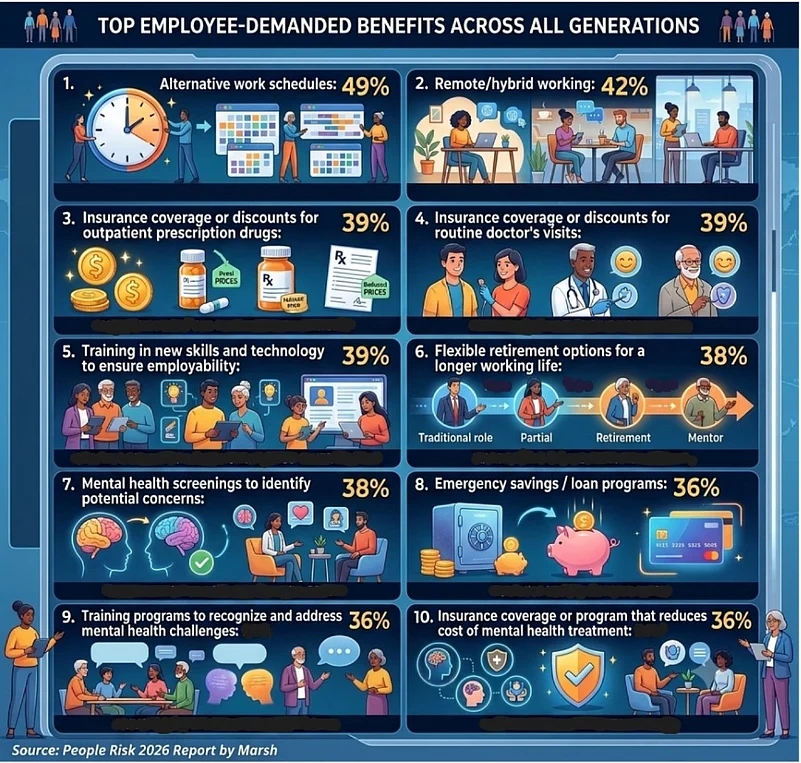
The top-rated benefits include alternative work schedules (49 per cent), remote or hybrid working (42 per cent), and insurance coverage for prescription drugs and doctor visits (39 per cent).





