





Summary of this article
A Rs 10,000 monthly SIP started at 30 could grow to around Rs 2.08 crore by the time the investor turns 60. Starting the same SIP at 40 would build a much smaller corpus of Rs 72.4 lakh, assuming a 10 per cent annual return.
Those who start investing at 40 need to put away nearly Rs 28,700 every month to reach the same Rs 2.08 crore target by 60. That's the price of losing ten years of compounding.
Retirement expenses will also be much higher than they are today. For instance, a household spending Rs 1 lakh a month now may need around Rs 5.74 lakh a month after 30 years, assuming 6 per cent annual inflation.
Investors in their early thirties often want to start saving for retirement but feel there is plenty of time. Many believe they can invest a larger amount once their income improves. The problem is that by the time they reach 40, they may be earning more, but they have already lost ten valuable years of compounding.
Let's look at what those ten years can actually mean in rupee terms.
Suppose two people decide to retire at 60. One starts a monthly SIP of Rs 10,000 at 30, while the other begins the same SIP at 40. Both continue investing until retirement.
Assuming a 10 per cent annualised return, here is how their savings could grow.

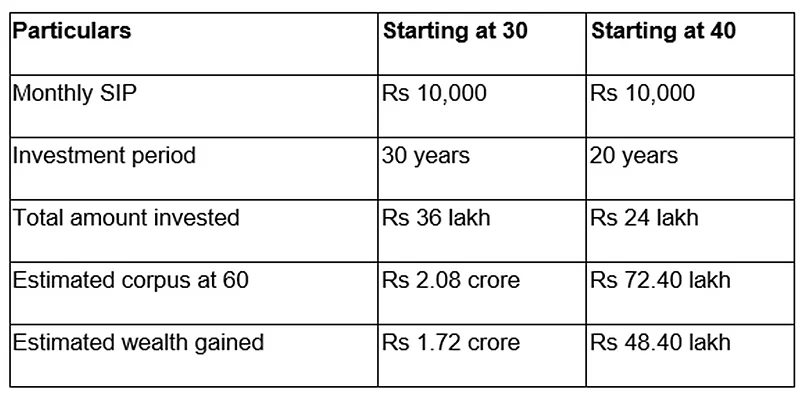

Illustrative calculations assuming a 10 per cent effective annual return, monthly compounding and SIP instalments at the beginning of each month.
Look at the difference. The person starting at 30 invests only Rs 12 lakh more over the entire period, but ends up with approximately Rs 1.36 crore more at retirement.
“That's the real benefit of starting early. Much of the additional wealth doesn't come from the investor's own pocket. It comes from allowing the accumulated money and its returns to compound over a longer period,” says Charu Pahuja, CFP, Director & Chief Operating Officer, Wise FinServ.
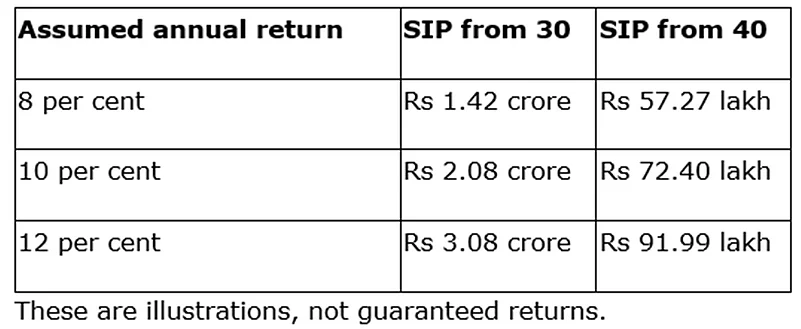
What If The Market Delivers Lower Returns?
We shouldn't assume that equity mutual funds will deliver 10 per cent every year. Returns will fluctuate, sometimes quite sharply.
Even so, the advantage of starting early is visible across different assumptions.
What If Someone Is Already 40?
“I wouldn't advise such an investor to worry about the years already gone. What matters now is how much they can comfortably set aside,” Pahuja says.
But the numbers do call for a change in approach.
To accumulate approximately Rs 2.08 crore by 60, assuming the same 10 per cent return, someone starting at 40 would need a monthly SIP of roughly Rs 28,700 instead of Rs 10,000.
That is a considerable increase in the monthly commitment.
Of course, someone who cannot invest that amount immediately can start with what is affordable and increase the SIP as their income grows.
Retirement Planning Must Also Account For Inflation
There is one more thing investors tend to underestimate: the cost of living after retirement.
If a family's monthly expenses are Rs 1 lakh today, at 6 per cent inflation those expenses could rise to roughly Rs 3.21 lakh in 20 years and Rs 5.74 lakh in 30 years.
So, accumulating a large corpus is not enough. We must also ask how much that money will actually buy when retirement arrives.
“I believe retirement planning works best when investors begin early, increase investments with rising income and review their asset allocation as retirement gets closer,” says Pahuja.
Someone starting at 40 can still build a meaningful retirement corpus. It simply requires a different savings commitment.
The ten years between 30 and 40 may not feel particularly important when we are young. But when we look at the retirement numbers, those years can turn out to be among the most valuable in an investor's financial life.
Calculation Note: SIP projections use an effective annual return converted to a monthly rate, with contributions assumed at the beginning of each month. All values are rounded and exclude investor-level taxes. Actual mutual fund returns are market-linked and may be higher or lower.