





Summary of this article
Supreme Court proposes no insurance, no fuel pilot for uninsured vehicles
Nearly 56 per cent of Indian vehicles lack valid motor insurance
Automatic number plate checks may trigger e-challans for uninsured vehicles
New cars and two-wheelers will require longer third-party insurance cover
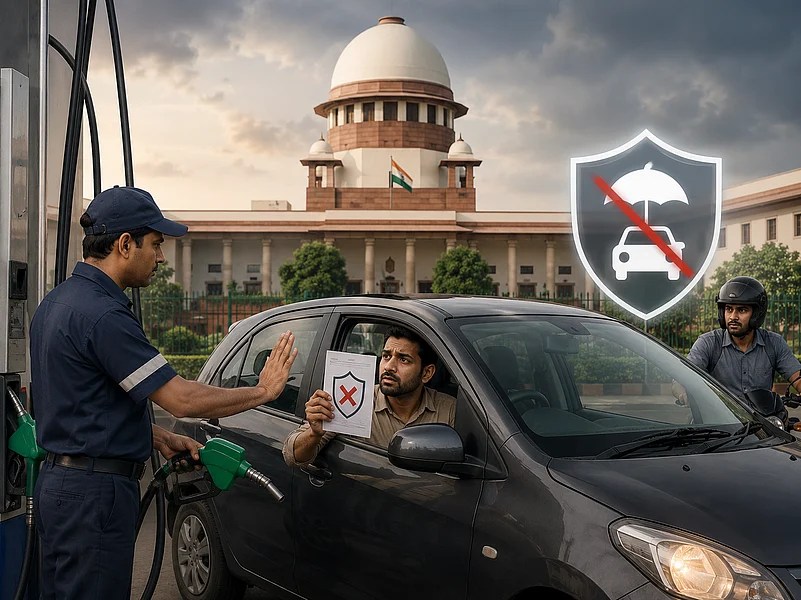
The Supreme Court (SC) has directed authorities to prepare a pilot project that could prevent vehicles without valid insurance from buying petrol or diesel.
The “no insurance, no fuel” proposal is part of wider directions aimed at identifying uninsured vehicles, issuing penalties and making motor insurance easier to understand. The system is yet to be rolled out nationally, and vehicle owners face no immediate ban at fuel stations.
Why The Court Stepped In
Third-party motor insurance is compulsory under the Motor Vehicles Act. It covers the vehicle owner’s legal liability when another person is injured, killed or suffers property damage in an accident.

3 September 2026
Get the latest issue of Outlook Money

Despite this requirement, nearly 56 per cent of vehicles on Indian roads are uninsured. The court cited figures showing that 16.54 crore out of 30.48 crore vehicles did not have valid insurance, according to a recent report by NDTV.
The court said the absence of insurance frequently leaves accident victims and their families struggling to obtain compensation. The scale of the problem is significant, with 4,87,705 road accidents recorded in 2024.
How The Pilot May Work
The Insurance Regulatory and Development Authority of India (Irdai), in consultation with the Ministry of Road Transport and Highways, has been asked to evolve the fuel-linked pilot.
Under the proposed arrangement, a vehicle’s registration number could be checked against insurance records at a fuel station. Fuel may be refused if the vehicle does not have valid cover, until the insurance is renewed. The petroleum ministry has conveyed that it has no objection in principle to the proposal.
The court also directed that Automatic Number Plate Recognition cameras on highways and roads be linked with the Insurance Information Bureau database and the VAHAN portal. This could allow automatic e-challans to be issued when an uninsured vehicle is detected.
State police personnel are also to be given handheld devices or mobile applications to verify insurance status in real time and issue challans.
Longer Cover For New Vehicles
The court has increased the mandatory third-party insurance tenure for newly purchased vehicles. New cars will require four-year third-party cover, up from three years, while new two-wheelers will require six-year cover instead of five years. Irdai has been directed to issue the necessary directions.
This change concerns third-party cover and should not be confused with own-damage insurance, which protects the policyholder’s vehicle against risks such as accidents, theft or fire.
Clearer Choices For Buyers
Insurers will also have to explain motor cover through a four-layer structure: mandatory third-party insurance, optional legal liability cover for occupants or pillion riders, personal accident cover and own-damage cover.
Customers are to receive an option form and an information sheet showing what each cover includes and the premium payable. Insurers must also explain the benefits of comprehensive motor insurance in an easy-to-read format on their websites.
FAQs
1. Will vehicles without insurance be denied fuel immediately?
No. The “no insurance, no fuel” system is only a proposed pilot and has not yet been implemented nationwide.
2. How could uninsured vehicles be identified?
Fuel stations, number plate recognition cameras and police devices may verify insurance status through the VAHAN portal and Insurance Information Bureau database.
3. What is the revised third-party insurance tenure for new vehicles?
New cars will require four-year third-party cover, while new two-wheelers will need six-year cover, subject to Irdai’s directions.





