







Summary of this article
Turning financial information into actionable retirement insights
Understanding risks, returns, and long-term planning
Making informed choices for a secure retirement
We live in a world overflowing with financial information. Every day, millions of Indians are exposed to market forecasts, social media “tips”, YouTube influencers, WhatsApp forwards, product brochures, and investment blogs and articles, among others.
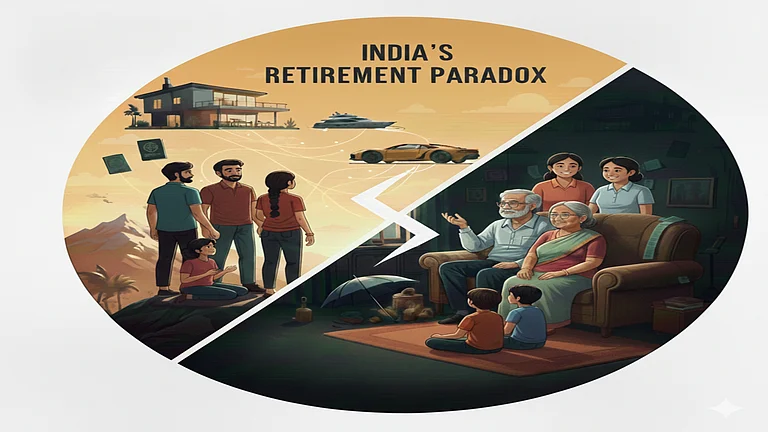
Yet, despite this abundance, most people still struggle to make confident, long-term retirement decisions. One reason for that is the lack of information insight.
In retirement planning, information tells you what exists; insight tells you what to do.

The Retirement Planning Paradox
The paradox of today’s financial landscape is striking: We have more data than ever; we have more tools than ever; and we have more choices than ever.
Yet, many individuals feel more confused than ever. This confusion leads to inertia, sub-optimal decisions, or short-sighted actions that can derail decades of retirement preparation.
What Is Insight? A Simple Definition
Insight is information filtered through understanding, context, and personal relevance. Insight emerges when you can answer: “What does this mean for my retirement and my life goals?”
Most individuals receive information. However, very few receive insight, and only those who act on insight are able to build long-term financial freedom.
The 5 Filters That Turn Information into Retirement Insight
Let’s explore the essential filters that help investors move from noise to clarity.
1. The Time Horizon Filter: Long-Term Lens vs Short-Term Noise
Markets move daily. Retirement is decades long. When people react to daily volatility, they exit equity prematurely, they stop their systematic investment plans (SIPs), they miss compounding cycles, and they replace long-term strategy with short-term emotion.
Insight requires this understanding: “Volatility is not a threat; it is the price you pay for long-term returns.”
Retirement decisions must be driven by the calendar, not the clock.
2. The Personal Context Filter: Your Goals Are Greater Than General Advice
Most financial advice is generic. But your retirement plan depends on your age, your earning capacity, your lifestyle, your dependents, your health, your aspirations, your risk appetite.
What works for one investor may not work for another.
Insight begins when you ask: “Is this advice relevant to my unique situation?”
3. The Behavioural Filter: Managing Biases
Behaviour shapes retirement outcomes more than products.
Common behavioural traps include:
• Recency bias: assuming the recent past will repeat
• Loss aversion: fearing losses more than valuing gains
• Herd behaviour: following the crowd
• Overconfidence: overestimating knowledge
• Anchoring: sticking to old beliefs despite new realities
Insight is recognising your own biases and neutralising them with discipline.
The Retirement Planning Manifesto calls this behaviour the “invisible hand” behind retirement success.
4. The Simplicity Filter: Focus on What Truly Matters
Investors are overwhelmed by choice, such as, dozens of mutual fund categories, multiple National Pension System (NPS) tiers, insurance-linked products, asset classes, and market-linked ideas. However, this abundance leads to “analysis paralysis”.
Insight comes from simplicity: clear asset allocation, consistent SIP discipline, periodic rebalancing, and long-term perspective.
Most great retirement outcomes come from boringly consistent behaviours, not complicated products.
5. The Credibility Filter: Trust the Source, Not the Noise
In the digital era, everyone has a microphone.
Everyone has opinions, and everyone sounds authoritative. But insight requires credible input.
Thus, one should look for regulated advisors, established institutions, transparent research, and long-term track records. One should also avoid decisions based on non-expert influencers, unverified WhatsApp advice and viral predictions
A simple rule is that if the advice sounds too easy, too guaranteed, or too sensational — it is probably not an insight.
Insight Leads to Better Retirement Decisions
When information is filtered through these five lenses, individuals make better decisions. They stay invested during downturns, increase their SIPs as income grows, choose asset allocation based on goals, avoid panic and greed cycles, take insurance seriously, and plan for long-term cash flows, not short-term returns
Insight-guided decisions compound silently, but powerfully over time.
The Insight Advantage: Why It Matters More for Retirement
Retirement planning is different from other financial goals because of a few reasons.
1. You cannot borrow for retirement.
2. You cannot postpone retirement indefinitely.
3. You cannot afford major mistakes late in life.
4. You must navigate a long income-less phase.
5. Your decisions today shape your dignity tomorrow.
The Role of Advisors, Planners And The Financial Ecosystem
The true value of advisors and educators is not giving information. It is offering context, relevance, and behavioural guidance.
A good advisor helps you stay disciplined, avoid emotional mistakes, align investments to goals, build sustainable retirement income, and adjust plans as life circumstances change.
From Noise to Navigation: A Call to Action for Every Indian
In an age where misinformation spreads faster than truth, financial literacy alone is not enough. What India needs is financial capability — the power to interpret information correctly and act wisely.
Retirement is too important to leave to chance or to the loudest voice in the room.
True freedom comes when individuals move from data and understanding to insight and action.
Closing Thought
If Information informs, then insight transforms. The smartest retirement decisions are not made by those who know the most — but by those who understand the most.
As this series continues, we will explore how to build a retirement corpus, manage risks, design income strategies, and prepare for a healthy, purposeful post-work life. That’s because your tomorrow deserves not just knowledge —but wisdom, too.
The author is the author of The Retirement Planning Manifesto - The Age of Information Abundance — and Insight Scarcity





