







Summary of this article
Delhi police have arrested eight suspects in the Rs 14.85 crore senior citizen digital arrest scam.
Fraudsters posed as TRAI and police in a fake money laundering probe.
So far, Rs 2.08 crore has been frozen from mule accounts across states in the case.
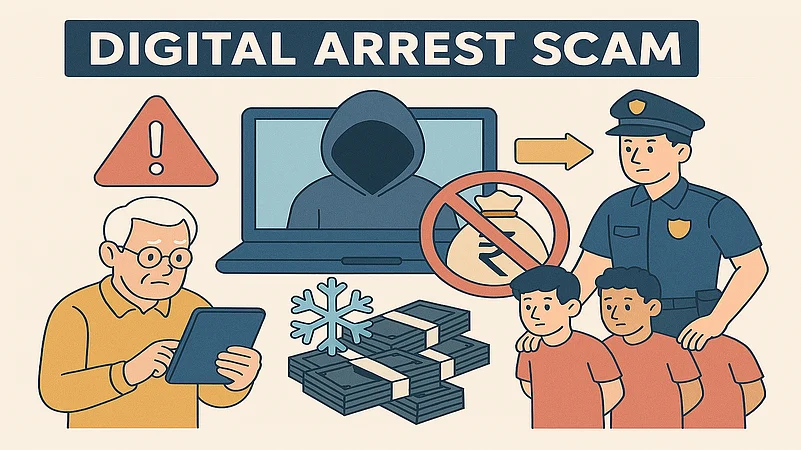
The Delhi Police has arrested five people in the recent digital arrest case of an elderly couple in Greater Kailash 2, Delhi. The couple (Om Taneja, 81, and wife Indira Taneja, 77) was duped out of Rs 14.5 crore by the fraudsters, who posed as officials of the Telecom Regulatory Authority of India (TRAI) and Mumbai police to trap the couple. On the pretext of their (senior couple) involvement in an alleged money laundering case, fraudsters convinced the seniors to transfer funds to different bank accounts.
With these 5 arrests, the total number of arrests in this case reaches eight. Those who have been arrested include Pradyuman Tiwari, a priest who performs private pujas at the Varanasi ghats, Bhupender Kumar Mishra, an MBA graduate who worked in a private company previously, Aadesh Kumar Singh, a tutor with a BA (Honours) degree, and Arun Kumar Tiwari, a data entry operator who allegedly ran a charitable NGO in Varanasi. Another suspect, Mahavir Sharma, a B.Com graduate, is from Bhubaneswar and lives in Ahmedabad, per a report by The Indian Express.


The first three suspects who have been arrested earlier were Divyang Patel, a B.Com graduate, who had completed CA (Inter) and operated an NGO and a financial services firm in Vadodara, Gujarat; Shitole Krutik, who holds an IT diploma from New Zealand; and Ankit Mishra, a former sales executive for a securities firm. Both Shitole Krutik and Ankit Mishra have been arrested in Gujarat.
The Delhi Police’s Intelligence Fusion and Strategic Operations (IFSO) unit has coordinated various raids across multiple states. Under the supervision of the Deputy Commissioner of Police (DCP) Vinit Kumar and Assistant Commissioner of Police (ACP) Prem Chandra Khanduri, a special team investigated and traced the money trail leading to several mule accounts used in the scam. The police caught people suspected to be involved and managed to freeze Rs 2.08 crore so far of the duped amount. However, it is a small portion of the total duped amount of Rs 14.85 crore.

It draws attention to the scale of operation of such scams, the vast and organised network, which spreads beyond Indian borders. Per the report, such frauds are being devised by a syndicate of fraudsters operating from Cambodia and Nepal, who use local people to execute the scam.
Fraudsters use mule accounts and ask victims to transfer funds to these accounts to launder the money. Doing this, they create a long money trail to transfer the money outside India. Once the money crosses the border, tracing it becomes difficult.
In an era where everything is shifting to digital modes, starting from banking, healthcare, education, shopping, and so on, digital fraud is increasing manifold. People, especially senior citizens who are easy targets of the fraudsters, need to be aware that digital arrest does not exist in law. There is no such concept as digital arrest. No authority can ask you to keep your video and audio on until the investigation is ongoing and transfer your money to their bank accounts.

Digital arrest incidents are becoming common among seniors. They are being tricked on the pretext of their involvement in crimes, such as money laundering, the Delhi blast case, sextortion, and other issues of national security, among others.
So, if some official asks to transfer the money to their account, be alert, inform family, trusted friends, and your bank before acting on the caller’s (fraudsters') advice and transferring the money.





