






Summary of this article
Cybercrimes increased to 22 lakh cases; reuslting in a loss of over Rs 36 crore by February 2025.
Family members need to step in to educate elderly on red flags, like pressure tactics, digital arrest threats, OTP requests, etc.
Remember to report the fraud immediately to #1930 to minimise the loss under RBI's zero liability clause.
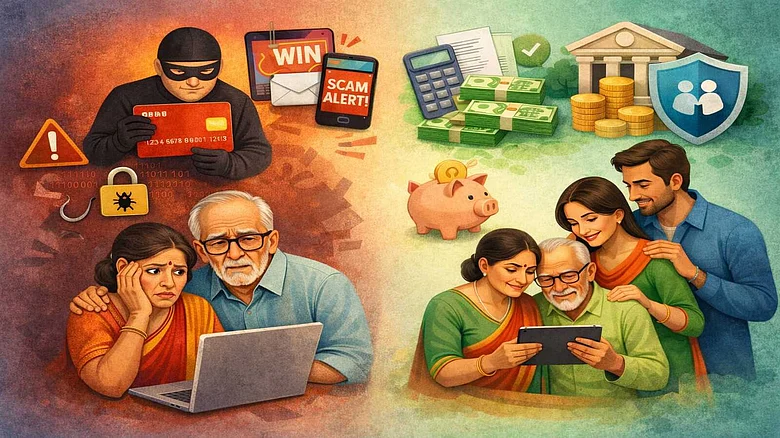
Senior citizens are easy targets of fraudsters primarily for two reasons: they are generally not digitally savvy, and they usually have some accumulated corpus. The fraud can happen in any manner, ranging from data theft, unauthorised access to the banking information, passwords, OTPs, etc., and of course, impersonation fraud or digital arrest scams. When children live away, many seniors miss out on everyday exposure to new technologies which is a almost a given if younger generation lives with them. So, they often don't know how to use digital tools for financial transactions, bill payments, social interactions, and so on.
According to a government statement, cybercrime incidents have risen from around 10.29 lakh in 2022 to 22.68 lakh in 2024, leading to a financial loss of Rs 36.45 lakh as reported on the National Cyber Crime Reporting Portal (NCRP) as of February 28, 2025.
Recently, an 81-year-old man losing Rs 7.12 crore in a digital arrest scam, where fraudsters impersonated as Mumbai Police Officers, reported PTI. They extorted money from him on the pretext of verifying his involvement in a drug trafficking racket. The seniors transferred this huge sum over a period of two months and didn’t inform anyone, because they instructed him to do so. The result? Loss of retirement savings, humiliation, trauma, legal hassle, and maybe a new health issue.



In such cases, family members can step in to create a safe digital environment and update elderly about digital advancements.

What Steps Can Seniors Or Their Families Take Next?
Being duped for entire retirement savings by someone you trusted is justifiably difficult to handle, but a family member can play a significant role. Here are ways children can secure their elderly parents’ finances by being more vigilant.
To help address these risks, here are some practical steps families can take:
Open Communication
Money is not openly discussed in typical Indian families. Wives and daughters are usually kept outside the money discussions and decision-making at home. In short, open communication is important within a family so that if ever one receives a suspicious call, message, or incident, one discusses it with family members without going silo and accessing the bank account to transfer funds to fraudsters.
Prashanth Ramdas, Partner, Khaitan & Co, says, “Children should educate senior citizens in the family about typical red flags in scam calls, which include robotic speech, poor grammar, refusal to identify a specific office or officer, threats of legal action, pressure to keep matters secret, and requests for OTPs or CVV numbers. Family members should maintain regular, non-intrusive conversations about their banking activity. Such conversations should not be an interrogation but should be from genuine interest.”

Preventive Controls
Younger family members, who are well-conversant with digital system need to take the initiative and keep elderly parents updated as far as possible. Further, they can set up security measures on their parents’ digital devices. For digital transactions specifically, such as banking, unified payment interface (UPI), investment, etc., setting two-factor authentication (2FA) is useful. Updating seniors’ devices with the antivirus tools could be more convenient than leaving it to them to do it themselves.
One can also set the transaction limit for UPI and banking apps and set an alert on their phones if feasible.
Joint Bank Account
Another way to ensure their financial safety could be to have a joint account with the elderly parents. The “either or survivor” mode of operation in a bank account offers family to oversee the transactions and also intervene if needed. Set strong passwords and alerts on their phone, but your email ID, so that both the elderly and young members remain updated about the transactions in the account. Also, teach them to never reply to links or share OTPs or PINs.

UPI Circle
UPI is digital, and it is undoubtedly popular because of the convenience it provides. So, instead of letting seniors stay away from it, families can use the UPI circle facility. Under the UPI Circle facility, the primary user can set the transaction limit for the secondary user either for every transaction or only for a set high-value transaction. So whenever there is any high-value transaction, approval will be asked, and that can prompt a discussion before approving the transaction.
Note that NPCI has set a daily transaction limit at Rs 15,000.
Power Of Attorney For Transactions
Ramdas says, “Through a PoA, a trusted child can step in to manage finances before a scam happens. They can pay bills, monitor accounts, and authorise legitimate transactions on the senior’s behalf. Instead of making a child a joint account holder (which gives them full withdrawal rights), a POA gives them authorised rights within a defined scope, which may be safer for the senior citizen. Further, unlike informal family dynamics, a PoA creates a documented, clear framework, with defined obligations for both parties.”
But he cautions that POA is a governance tool and not a fraud prevention tool. It needs to be used carefully as it is not useful if a scammer calls the senior directly and tricks them into revealing their UPI PIN or bank credentials, a PoA would not help. Further, a PoA always runs the risk of misuse by the family members and can lead to financial abuse.

Reporting System
Make seniors memorise the cybercrime helpline number #1930. So that they can use it immediately in case they would ever need to report a cybercrime. Notably, the Reserve Bank of India (RBI) ensures limited liability in cyber fraud cases if it is reported early.
Ultimately, digital safety becomes possible through more awareness and also by not giving in to fraudsters’ tactics. With that in mind, families need to openly discuss money matters and fraud prevention methods to keep elderly members updated and alert.





