


Summary of this article
Kerala High Court upholds daughter's inheritance rights despite birth just after four months of marriage.
Trial court erred excluding daughter, Kerala High Court restores her Class I heir status.
It modified the preliminary decree for property partition. It now includes 5 equal shares: wife, daughter, 2 sons, and mother.
In a significant judgment related to the inheritance rights of a child whose legitimacy is in question, the Kerala High Court ruled on a “conclusive presumption” of the legitimacy of the child as per the Evidence Act, 1872. The bench comprising Justice Sathish Ninan and Justice P. Krishna Kumar allowed the petition filed by the mother who sought inheritance rights for her daughter.
Case Background
The case relates to an intestate succession where the father died intestate on December 10, 2012. He is survived by his wife, one daughter, and two sons. After his death, his widow and children filed for partition of the property. Per the law, his property was to be inherited by the class I legal heirs, which include his wife, children, and mother.
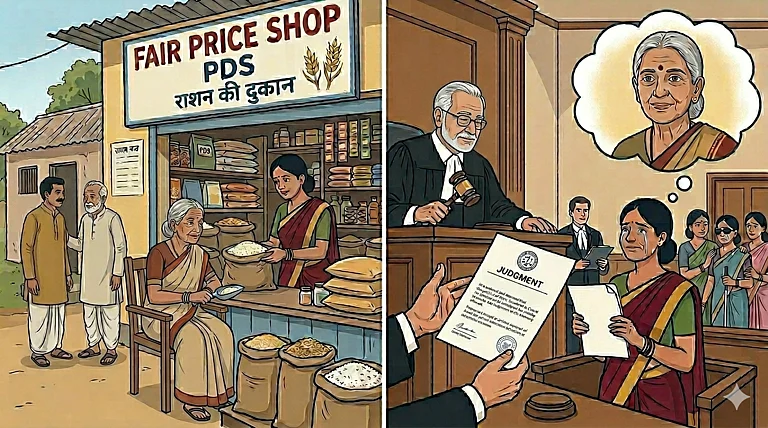
But the problem arose when the daughter was excluded from inheriting the property. It was because of the fact that she was born just four months after her parents’ wedding. The trial court issued the preliminary decree to divide the property into four shares (wife, 2 sons, and mother), excluding the daughter. The trial court held that the wife failed to establish the deceased’s paternity and thus excluded the daughter from inheritance.




Arguments
The plaintiff’s (wife’s) counsel argued that she and her husband were in a relationship prior to their marriage and that he had also acknowledged being responsible for the pregnancy when he was alive. The counsel also presented testimony from the wife’s father, who witnessed that her daughter’s husband treated the child as his own and asserted the paternity. His documents, including passport, pension payment order, and Employees’ Provident Fund passbook, also reflect her name.
On the other hand, the defendants (husband’s mother and other relatives) denied a premarital relationship. They argued that the deceased (husband) had no access to the wife before marriage, and thus, the daughter could not be his biological child.

Court Observation
The court observed that the trial court made an error in discarding the oral testimony of the witness (wife’s father). It referred to Sections 32(5) and 50 of the Indian Evidence Act, 1872.
It said, “As per Section 32 of the Evidence Act, written or verbal statements made by a deceased person as to certain matters are themselves relevant facts. Statements relating to the existence of any relationship by blood, marriage, or adoption between persons are relevant, provided that the person making such a statement had special means of knowledge of the relationship and that the statement was made before the dispute was raised. As the person who made the verbal statement is dead, it can be proved only through a person who heard the statement when it was made. Since Krishnan is dead, the verbal statement made by him—he having special means of knowledge of his relationship by blood with the child—at the time when the child was conceived, which was much prior to the commencement of the dispute, is a relevant fact under Section 32(5) of the Evidence Act. When such verbal statements were spoken through PW1, who directly heard them, they are admissible in evidence.”
The court also referred to Section 112 of the Act, which mandates a conclusive presumption of legitimacy for any child born during a valid marriage.
It noted, “Even when the birth occurred within four months of the marriage, Section 112 of the Evidence Act raises a conclusive presumption as to the legitimacy of the child, unless it is proved that the parties to the marriage had no access to each other at any time when the child could have been begotten.”
Notably, the defendants failed to provide sufficient evidence to prove non-access.

Court Judgement
The court allowed the appeal and held, “Plaintiff No. 2 is the legitimate daughter of late Krishnan (daughter’s father); she is entitled to an equal share in the plaint schedule properties along with the other Class I heirs. The finding rendered against plaintiff No. 2 is therefore legally unsustainable. Therefore, the impugned judgment and preliminary decree are liable to be interfered with.”
It ruled that the daughter is a legitimate daughter of her deceased father and modified the preliminary decree directing partition of property into five equal shares each for the wife, daughter, 2 sons, and mother.