

Summary of this article
Income Tax portal now accepts bribery and harassment complaints
E-Nivaran generates acknowledgement numbers for complaint tracking and follow-up
Taxpayers can report misconduct even without PAN or TAN
Confidentiality and timely resolution will determine taxpayer trust in system
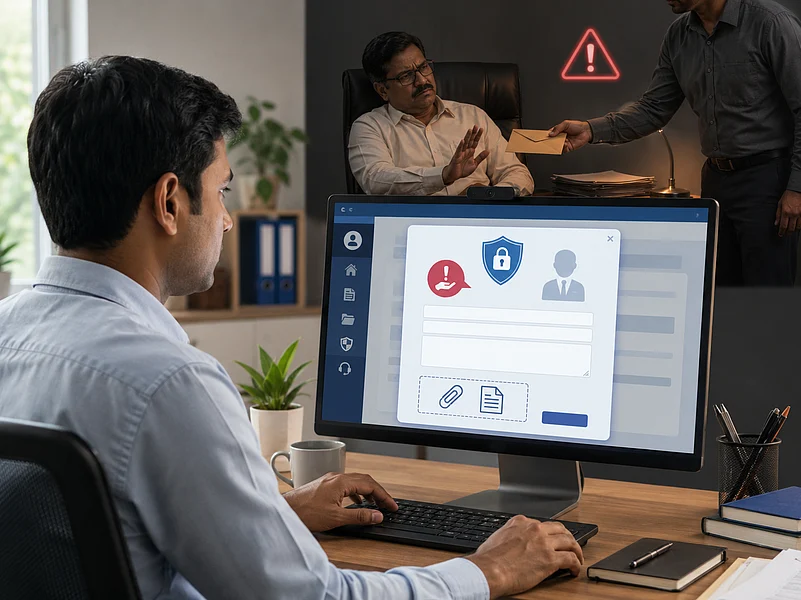
Taxpayers now have a digital route to complain about bribery, misconduct or sexual harassment involving Income Tax officers. The facility has been added to the grievance section of the Income Tax Department’s (ITD) e-filing portal, bringing serious complaints within a system that can be acknowledged and tracked.
Earlier, the lack of a clear channel could discourage taxpayers with pending proceedings from speaking up.
How A Taxpayer Can File A Complaint
The new category is available within the existing E-Nivaran grievance system. After signing in, a taxpayer can go to “Grievances”, choose “Submit Grievance” and select the relevant category. The options now specifically include corruption, misbehaviour, harassment and sexual harassment.

1 October 2026
Get the latest issue of Outlook Money

The complainant can enter the officer’s name and designation, describe the incident and attach supporting material, such as emails, if available. Evidence is not compulsory at the filing stage, while the description must contain at least 100 characters. An acknowledgement number is generated after submission and should be retained for tracking and follow-up.
A pre-login facility is also available for people without a Permanent Account Number (PAN) or Tax Deduction and Collection Account Number (TAN), with identity verification carried out through a one-time password.
“The Income Tax Department has added a dedicated tab on its e-filing portal that lets taxpayers report bribery or sexual harassment involving officers directly,” says Shourya Garg, founder, Garg & Garg Tax Associates. He says it offers a defined channel where earlier many people might have raised the matter informally or remained silent.
Confidentiality Will Be The Key Test
Priyal Goel Jain, partner and NRI tax expert, Dinesh Aarjav and Associates Chartered Accountants, says the ability to identify an officer and explain the misconduct in plain terms makes the facility significant.
Its credibility, however, will depend on what happens after submission. Garg says access should be restricted to a small group of senior officials, preferably outside the complainant’s jurisdiction. Identity details should also be masked from routine access.
These safeguards are particularly important when an assessment, appeal or refund matter is still pending. Unless taxpayers feel protected from retaliatory action, they may hesitate to use the facility.
Tracking And Timely Resolution Matter
The general E-Nivaran benchmark is around 30 days, though complex grievances may take closer to eight weeks. No separate deadline has yet been specified for these misconduct categories. Taxpayers can check the status using the acknowledgement number and approach Centralised Public Grievance Redress and Monitoring (CPGRAMS), the government’s central grievance platform, if the matter remains unresolved.
Both practitioners say clear escalation rules, independent examination and regular oversight will be essential. Publishing broad timelines and aggregate outcomes, without revealing complainants’ identities, could indicate whether the system is producing results.
Taxpayers should record the incident promptly, preserve relevant documents, retain the acknowledgement number and follow up. The portal has created a formal doorway; trust will depend on what happens once a complaint enters it.
FAQs
1. How can taxpayers file a misconduct complaint against an Income Tax officer?
Log in to the e-filing portal, open “Grievances”, select “Submit Grievance” and choose the relevant misconduct category.
2. Is supporting evidence compulsory while submitting the complaint?
No. Taxpayers may attach emails or other records if available, but evidence is not mandatory at the filing stage.
3. How can taxpayers track or escalate their complaint?
The acknowledgement number can be used to track its status. If unresolved, the taxpayer may escalate the matter through CPGRAMS.