NPS can be a Plan B tool to safeguard against inflation, healthcare, and longevity pressures.
MSF under NPS infrastructure allows 100 per cent investment in equity.
There is zero administration cost for companies, and they can also enjoy tax-benefits under Section 36(1)(IV) of the Income Tax Act, 1961.
Use NPS As Plan B To Keep You Financial Secure, Says HDFC Pension’s Saurabh Chaturvedi
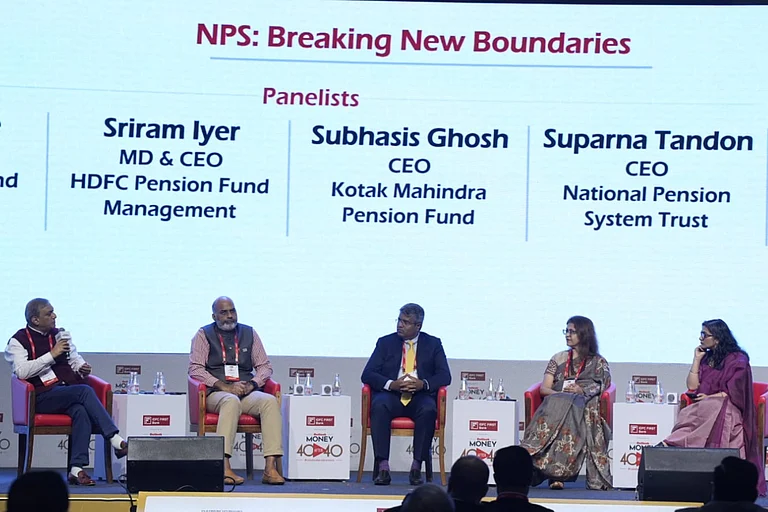
Saurabh Chaturvedi, from HDFC Pension, facilitated an insightful workshop at the two-day 40after40 event organised by Outlook Money on February 20 and 21. He explained how critical NPS is as plan B to stay financially secure

Summary
Advertisement
The National Pension System (NPS) was designed initially for retirement planning, but it is now turning into a scheme to provide financial back-up throughout one’s life. Saurabh Chaturvedi, HDFC Pension, led a workshop, “The future-proof plan for your family”, in the 40after40 event organised by Outlook Money on February 20 and 21. He captivated attendees with the reality check by sharing examples, emphasising that Plan A does not always work and thus, one should always have a Plan B.
He shares the real-life example of a 46-year-old man whose 18-year job suddenly vanished due to corporate restructuring. His income stopped, but his equated monthly instalments (EMIs), school fees, and other responsibilities didn’t stop. This exposes the reality of relying on a single career path and how risky it can be to not have a backup plan.

Plan A May Fail, Time For Plan B
The speaker stressed that Plan A, which is about jobs, business, and savings, is no longer sufficient. He shared that relentless inflation can eat up one’s savings if not planned well. He shared that a Rs 1,000 grocery bill in 2000 would increase to Rs 28,000 by 2050. Similarly, a longer life span and medical emergencies will add to the financial responsibilities. Elaborating on that, he shared that the cost of a bypass surgery was Rs 1 lakh in 2000, which is projected to be Rs 60 lakh by 2050.
Advertisement
Chaturvedi highlights the five pressure points: Inflation, longevity, healthcare, family dynamics, and lifestyle aspirations that require people to have a Plan B, which is inflation-proof, tax-efficient, and keeps them financially secure.
He shares that NPS is the plan that can serve as a financial backup under Plan B.
Key Highlights From His Workshop About NPS:
The NPS is a government-backed voluntary scheme regulated by the Pension Fund Regulatory and Development Authority (PFRDA). The scheme is available for Indian citizens aged 0-85 years.
Under the Multiple Scheme Framework (MSF) of the NPS, one can invest up to 100 per cent into equities or in a mix of asset classes, including corporate debt, government securities, and alternative investments. The vesting period in this is only 15 years or retirement, whichever is earlier.
A Rs 5,000 monthly contribution from age 25 can build a corpus of Rs 6.98 crore by the age of 60, assuming an 11 per cent return and that the initial investment is increased by 10 per cent annually. But at the same time, a five-year delay means starting to invest at 30 would create a corpus of Rs 3.62 crore, leading to a shortfall of more than 90 per cent.
NPS offers tax benefits on employer contribution up to 14 per cent of the salary (basic and dearness allowance) under Section 80CCD(2), and an additional contribution of Rs 50,000 by employees under Section 80CCD(1B), and a tax-free lump sum at maturity.
NPS is the scheme for all stages of life. NPS Vatsalya for children, then accumulation, consolidation, and decumulation phase for employees and workers, and annuity for post-retirement years, with the option of 100 per cent tax-free return of purchase price to the nominees.
Advertisement
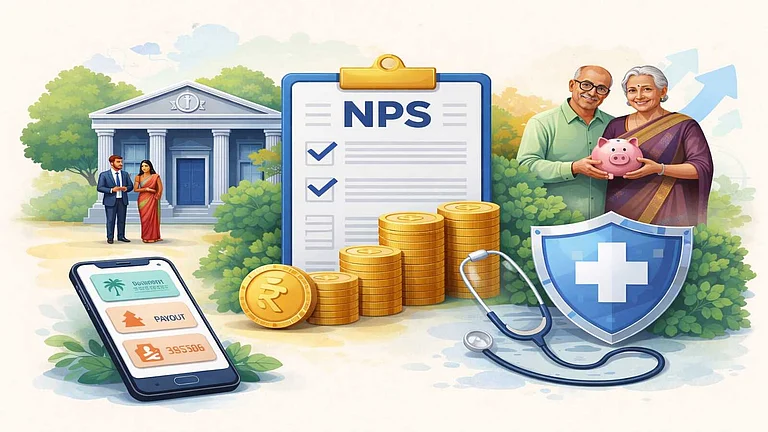
Companies can offer NPS to their employees with zero administration cost and enjoy tax benefits on their 14 per cent contribution as Business Expense under section 36(1)(IV) of the Income Tax Act, 1961.
Financial stress can lead to financial anxiety, leading employees to waste 3 hours weekly. One in three employees loses focus and productivity due to money worries, and financially stressed employees are twice as likely to look for a new job.
Under NPS, revenues are linked with asset under management (AUM), which means higher persistency leads to higher AUM, which in turn leads to higher revenue. It can increase distributors' revenue by around five times.
Chaturvedi concluded by asking attendees to start early and enrol under NPS to ensure a future-proof Plan B for self and family.
Show comments
Published At:
Tags