India’s four new labour codes, replacing 29 legacy laws, were implemented in November 2025 but are not yet fully operational. The Centre has now finalised rules on wages, industrial relations, social security and workplace safety, which are expected to be notified soon
Will The New Labour Codes Be Operational From April 1, 2026?
The four new labour codes are expected to be notified and operationalised in the upcoming new financial year. These are aimed at reforming the employment rules and preparing a future-ready workforce and resilient industries

Summary
Advertisement
The Union Government announced four new labour codes on November 21, 2025, replacing the existing 29 labour laws, with an aim to enhance and streamline the law, simplify compliance, and modernise labour laws formed before independence to the current needs and technologically advancing work environment. These four codes are: The Code on Wages, 2019 (Wage Code), The Industrial Relations Code, 2020 (IR Code), The Code on Social Security, 2020 (SS Code), and The Occupational Safety, Health and Working Conditions Code, 2020 (OHS Code).
While the codes were implemented in November 2025, there was no clarity about when the new codes would be fully operational. As the process to issue the final rules by the centre and the state involves issuing draft rules, publishing them to receive comments from the stakeholders, and then preparing the final rules, the effective date of their being fully operational was not given. The expectation, however, indeed existed for a likely operationalisation from April 1, 2026.
Advertisement

Now, the centre has finalised the rules under these labour codes, which may soon be notified for implementation, tentatively in April 2026, the Economic Times reported, citing a government official. As per the report, the Labour and Employment Ministry has finalised the rules that need to be vetted by the Law Ministry before the rules are notified.
However, the date of notification or operationalisation is not yet disclosed.
Once the final rules are notified by the central government and state government for their specific states, these will change the employment, payment, leaves, and social security conditions among various other rules for both organised and unorganised sector workers.
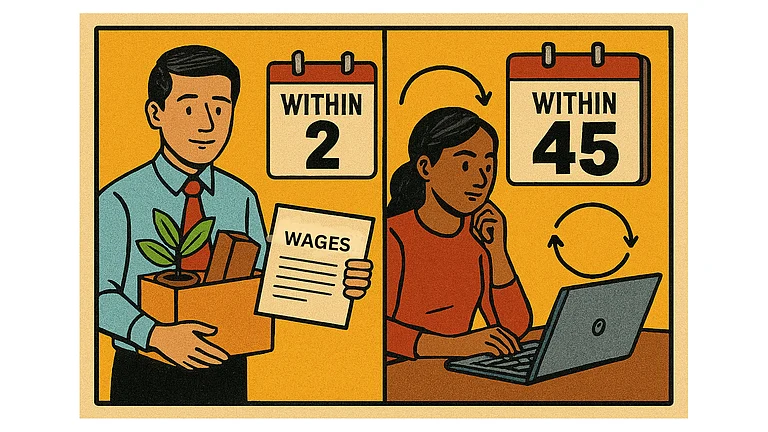
Some of the prominent reforms to be introduced through these four labour codes are a minimum wage for all workers, equal pay for equal work for all, fixed term workers to get all the benefits similar to the permanent employees, issuance of appointment letter to all workers to ensure employment history and social security, mandatory women representation in the grievance redressal committees, establishing National OSH boards to ensure safety and health standards of workers, mandatory safety committees in entities with more than 500 workers.
Advertisement
The new codes have also changed the definition of wages. As per the new codes, the wages will include basic pay, dearness allowance (DA), and retaining allowance, and it cannot be less than 50 per cent of the total salary. In case the allowance (other than DA and retaining allowance) is more than 50 per cent of the salary, the excess amount will be added to the wages.
The Employees’ Provident Fund Organisation (EPFO) has also announced changes to be consistent with these codes. Recently, the Minister of Labour and Employment, Mansukh Mandaviya, informed the Lok Sabha that “Under the Code on Social Security, 2020, the existing Employees' Pension Scheme, 1995, continues to be in force for a maximum period of one year or until it is replaced by a revised Employees' Pension Scheme formulated under the Code.”
These labour codes are aimed at setting the foundation for a stronger and financially secure workforce and resilient industries.
Advertisement
Show comments
Published At: