





Summary of this article
List all card dues with interest rates and due dates to avoid costly misses.
Stop fresh card spending temporarily to ensure repayments actually reduce debt.
Use the avalanche or snowball method and stay consistent.
Pay well above the minimum due to cut interest and close debt faster.
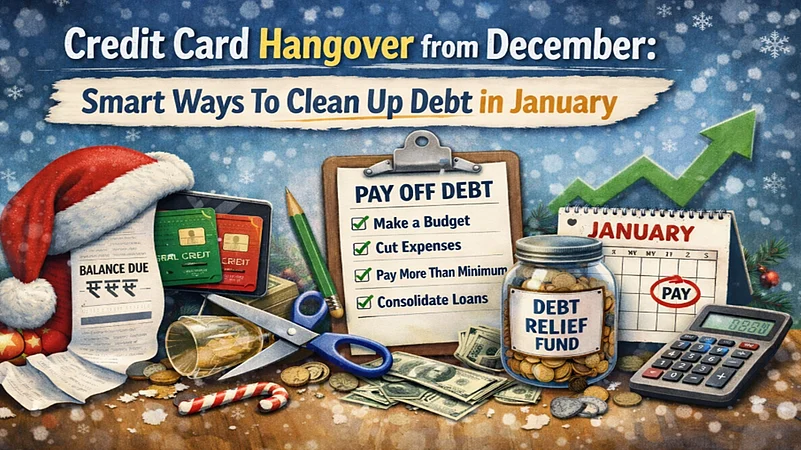
The new year brings with it a sense of renewal - an ideal time to review, reset, and recalibrate your financial habits. One of the most productive resolutions you can make this January is to tackle the credit card debt that might have piled up over the past year or the festive season.
Credit cards are convenient, but costly when balances rollover. With monthly interest rates of 3–3.5 per cent - equivalent to 36-42 per cent annually - they carry some of the most expensive borrowing costs. Left unchecked, these debts can snowball, eroding long-term savings potential. Clearing them early should top your financial to-do list.
1. Know Exactly What You Owe
Begin by listing every outstanding balance - card-wise, with interest rates and due dates. “Create a simple table or spreadsheet that also includes minimum payments and billing cycles. This clarity helps you prioritise repayment and prevents missed deadlines, which otherwise trigger additional finance charges,” says Amar Ranu, head - investment products & insights, Anand Rathi Shares and Stockbrokers.
2. Pause New Spending
For a few weeks, hit pause on new card transactions, including tempting ‘Buy Now Pay Later’ (BNPL) offers. Although these schemes often advertise zero interest, they come with processing fees that can annualize to 15–20 per cent. Avoiding new debt gives your repayment effort real impact.
3. Choose A Repayment Strategy
Repayments, much like investments, need personalisation. Depending on your cash flows, upcoming obligations, and tolerance for interest cost, choose one of two proven methods:
Debt Avalanche: Prioritize cards with the highest interest rate first while paying minimums on others. “Once cleared, redirect that EMI toward the next costliest card. This mathematically minimizes total interest paid,” suggests Ranu.
Debt Snowball: Pay off the smallest outstanding first to gain a psychological boost. Those early wins build confidence and momentum for tackling larger debts.
Both methods work - the key is to stay consistent and disciplined.
4. Consolidate Your Credit Card Debt
For those juggling multiple cards, consider a personal loan equivalent to your total balance. Personal loans often come at half the cost of credit card interest rates and simplify repayment with one fixed EMI. This also helps improve your credit utilisation ratio - an important factor in credit score improvement.
5. Accelerate Repayments
Be aggressive where possible. “Increase your EMI payments or make part-prepayments whenever you receive a bonus, incentive, or freelance income. Every extra rupee reduces your interest outgo and shortens the repayment window - freeing up future cash flow for savings or investments,” says Ranu.
6. Don’t Fall For the ‘Minimum Payment’ Trap
Paying only the minimum due prolongs repayment drastically and inflates your cost. For instance, a Rs 40,000 outstanding at 36 per cent annual interest, if repaid with just Rs 2,000 monthly, would take nearly 31 months and cost around Rs 22,000 in interest alone, taking the total outgo to roughly Rs 62,000. Paying more upfront saves significantly in the long run.
7. Track, Plan, And Rebuild
Once the slate is clean, institute a monthly tracking habit - using tools or apps to monitor card usage, repayment ratios, and due dates. “Aim to keep your credit utilisation under 30 per cent for optimal credit health. Treat your cards as short-term convenience, not as an extension of income,” says Ranu.



Debt-free living isn’t just about numbers; it’s about peace of mind. Beginning the year by clearing your credit card hangover sets the tone for the months ahead - one of discipline, clarity, and financial empowerment.





