





Summary of this article
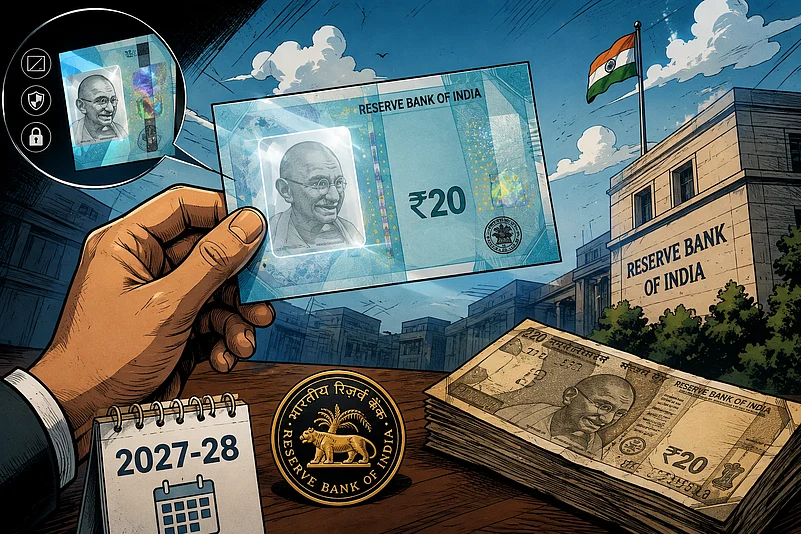
RBI targets polymer banknotes rollout from early 2027-28 after pilot.
Polymer notes to improve durability, security and circulation lifespan.
Lower denomination Rs 10 and Rs 20 notes prioritised.
The Reserve Bank of India (RBI) is conducting a pilot project to test polymer banknotes in Indian conditions and is aiming to introduce them from the beginning of the next financial year, subject to the outcome of the trial.
Pilot Underway Before Wider Rollout
At a press conference after the August monetary policy committee (MPC) announcement on August 5, 2026, RBI Governor Sanjay Malhotra said that the central bank is evaluating how the new notes perform under India’s climatic conditions and existing currency handling systems before taking a final decision on large-scale implementation.
“We are targeting that they are in circulation, if everything goes as per plan, in the beginning of the next financial year,” Malhotra said.
Polymer banknotes are made using biaxially oriented polypropylene (BOPP)-based material instead of paper. They generally last longer in circulation and can incorporate additional security features that make counterfeiting them more difficult. Countries, such as Australia, Canada, the UK, Singapore, New Zealand and Vietnam already use polymer currency.
Focus On Lower Denomination Notes
Malhotra said polymer notes are particularly suitable for lower denomination currency notes, such as Rs 10 and Rs 20, as these notes change hands more frequently and wear out faster than higher denomination notes.
“These notes have been in circulation for more than 30 years in various countries. And one finds that the life is much more, 3-4 times the life of the paper substrate. And then it also expands our capacity as…the needs of the economy increase,” he said.
The RBI has invited bids for the supply of polymer substrate, with the bidding window open until August 18, 2026. The initial requirement is about 68,000 reams of BOPP-based substrate across two denominations. The material will include security features, such as a transparent window with a portrait, a metallic numeral, a magnetic pseudo-thread, a shadow image and an iridescent pattern.
Printing Costs Decline
According to the RBI’s annual report for 2025-26, the cost of printing currency declined 23.5 per cent to Rs 4,875.20 crore in 2025-26 from Rs 6,372.80 crore in the previous year. However, the total value of banknotes in circulation increased 11.80 per cent to Rs 41.23 trillion as of the end of March 2026.
The annual report also mentioned that RBI plans to strengthen the security features of banknotes and improve their durability under its Utkarsh 2029 programme. It added that increasing the lifespan of currency notes and maintaining self-sufficiency in banknote production remain key priorities.





