






Summary of this article
Small UPI payments up to Rs 2,000 will stay outside MDR.
Consumers should check final bills on higher-value merchant payments.
Payment choices may depend on convenience, rewards and acceptance.
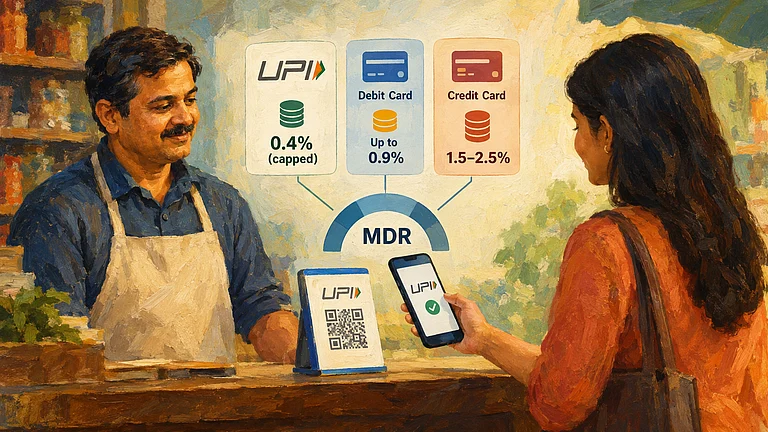
The new Unified Payments Interface (UPI) merchant discount rate (MDR) framework will apply to specified merchant transactions above Rs 2,000 starting October 15, 2026. While the change is aimed at the payments ecosystem, consumers will not have to pay the MDR directly or indirectly.
For people using UPI for everyday purchases, the immediate impact is limited. The bigger consumer question is what happens when the payment value crosses Rs 2,000 and whether merchants try to recover the cost through other charges.
Small UPI Payments Will Not Get Costlier
UPI payments of up to Rs 2,000 will not attract a direct or indirect charge for consumers. This covers many routine purchases, including groceries, food, and other small-value transactions.
“For consumers, the biggest benefit is that small-value UPI payments continue to remain free. Whether you are paying for a cup of coffee, groceries, or a quick local purchase, there is no additional payment cost to worry about,” said Kunal Jhunjhunwala, founder of airpay.
Jhunjhunwala added that consumers may not need to change their usual payment habits because of the new framework. UPI has already become a common payment method for smaller purchases, where convenience plays an important role.
Most Everyday UPI Payments Are Outside The Framework
The new MDR framework does not cover person-to-person (P2P) payments. A large portion of merchant transactions also falls outside of the revised structure, limiting the number of everyday payments directly affected by the change.
“Consumers are not expected to see any change in the economics of their UPI payments. For transactions up to Rs 2,000, there is no direct or indirect charge to the consumer, while the MDR applies to specified larger merchant transactions,” said Aditya Gupta, CEO and founder of novio, a consumer credit platform from Credilio Financial Technologies.
According to Gupta, around 96 per cent of person-to-merchant (P2M) transactions will also remain outside the revised framework. This means most consumers should not see a change in the cost of their regular UPI payments.
Consumers Should Check The Final Amount
MDR applies to specified merchant transactions above Rs 2,000, but the cost is not supposed to be passed on to consumers through an additional fee or another pricing mechanism.
For higher-value purchases, consumers should, therefore, check the final amount before completing the transaction. This is particularly relevant if a merchant adds a separate payment-related charge to the bill.
“As a general norm, MDR costs should not be passed on to consumers. The same has also been reiterated by the authorities as well. However, consumers should still remain aware of the final amount they are being charged, particularly on larger payments,” Gupta added.
UPI Will Still Compete With Cards And Cash
The new framework does not change the basic cost of low-value UPI payments. However, consumers can still choose between UPI, cards, and cash based on the transaction and the benefits offered by each payment method.
“For smaller payments, convenience plays a big role. With UPI, consumers don’t need to carry cash or a physical card, and they can pay directly from their bank account. Keeping these transactions free adds to that convenience,” Jhunjhunwala added.
Rewards, acceptance and ease of use can also influence payment choices. For consumers, the immediate impact of the MDR framework is, therefore, limited for payments up to Rs 2,000, while larger merchant transactions warrant closer attention to the final amount charged.





