






Summary of this article
KOSPI crashed 10 per cent, triggered circuit breakers, halting trading after heavy sell-off
Sell-off triggered after regulators cautioned against leveraged investment products
Regulator chief expressed regret over early approval of leveraged products
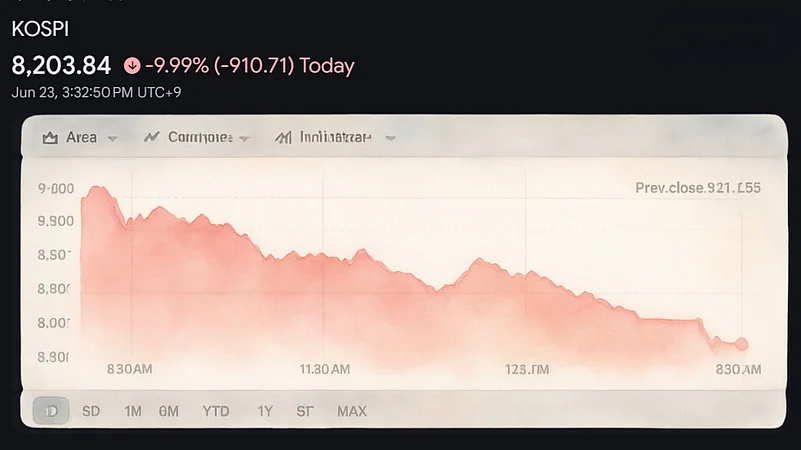
South Korea’s stock market saw a brutal sell-off on June 23, with the KOSPI hitting the lower circuit, triggering a trading halt. The benchmark index closed at 8,203.84, down 910.71 points or 10 per cent from the previous session.
When the index fell over 8 per cent from the previous close and stayed there for a full minute, the exchange stepped in to stop further trading for 20 minutes. Trading resumed briefly for around 15 minutes, but another circuit breaker was triggered soon after, and then the trading remained halted until the market closed.
This was the fifth-biggest single-day fall in KOSPI’s history. The worst crash so far was on March 4 this year, when the index had dropped 12.06 per cent following the fallout from the West Asia conflict between the US and Iran.
The broader KOSDAQ index also took a heavy hit, tumbling nearly 8 per cent and slipping below the 900 mark.
Samsung Electronics fell 12.31 per cent and SK Hynix tumbled 12.47 per cent. The two chipmakers together account for more than half of South Korea’s total stock market value.
Why Did South Korea's Stock Market Crash Today
The sell off came after the chief of South Korea's market watchdog cautioned on leveraged exchange traded funds (ETFs). A large portion of retail investors’ money is concentrated in leveraged ETFs and margin positions, especially in tech stocks. Margin positions refer to trades where investors borrow money from brokers to buy more stocks than they can afford with their own capital. Once prices started falling, it triggered forced liquidations and margin calls, rapidly magnifying the downward spiral as retail investors were forced out of their positions.
Sentiment was also hit by a regulatory setback. South Korea was once again excluded from being upgraded to Developed Market status in the MSCI index review. Many institutional and foreign investors had pre-emptively bought into Korean equities expecting this upgrade to catalyze a fresh wave of global capital. The rejection triggered an immediate unwinding of those positions.
According to Ross Maxwell, Global Strategy Operations Lead, VT Markets, "The sell-off was magnified by weakness in semiconductor and artificial intelligence-related stocks, which have been key drivers of Korea’s recent rally. There was also a spillover effect from the correction in US mega-cap technology stocks, where investors have become increasingly concerned about over-stretched valuations and the pace of future AI-driven earnings growth."
Concerns Over Leveraged Products In South Korea
On June 22, Lee Chan-jin, head of South Korea’s market watchdog Financial Supervisory Service (FSS), had expressed concerns over leveraged products, saying that the government had moved too quickly in preparing the products, and adding that “the side effects have become very large, which is now a serious concern for the government.”
He also criticised the outcome of the products, saying, “The outcome is that only brokerage firms are benefiting.”
Last month, the regulator had approved brokerages to launch single-stock leveraged investment products linked to Samsung Electronics and SK Hynix. The regulatory approval was aimed at bringing investment flows back to the domestic market from "Seohak Ants", a term used for Korean investors buying overseas stocks, at a time when elevated exchange rates continued to weigh on sentiment late last year.
Expressing regret over the decision, Lee said, “I feel we should have blocked it even if it meant taking extreme measures… I personally regret it.”
Earlier on June 17, South Korea's market watchdog had issued a warning on leveraged stock investments. The regulator said, “With stock market volatility increasing recently, there have been cases where the prices of single-stock leveraged or inverse products fluctuate sharply in the short term.”
Will This Lead FPIs To Divert Funds Into Indian Equities
Foreign portfolio investors (FPIs), who have been on a selling spree in Indian stocks, may see some renewed allocation towards India, analysts said. According to Maxwell, “such corrections in could create room for some foreign investor inflows. Global investors often rebalance capital across emerging markets when volatility rises in one particular region. India remains attractive due to its domestic-demand-driven growth, relatively stable macroeconomic conditions and smaller exposure to the global technology cycle.”
He added, “Korea and Taiwan still remain strategic markets for semiconductor and technology exposure. India is more likely to attract selective inflows from investors seeking diversification and earnings visibility rather than a complete rotation away from tech heavy indices in Korea and Taiwan.”





